Earth’s gravitational pull could explain the Moon’s long volcanic history
A lunar model suggests Earth’s tidal pull could concentrate heat near the Moon’s core, offering a possible clue to its prolonged history of volcanic activity.

 Edited By: Joshua Shavit

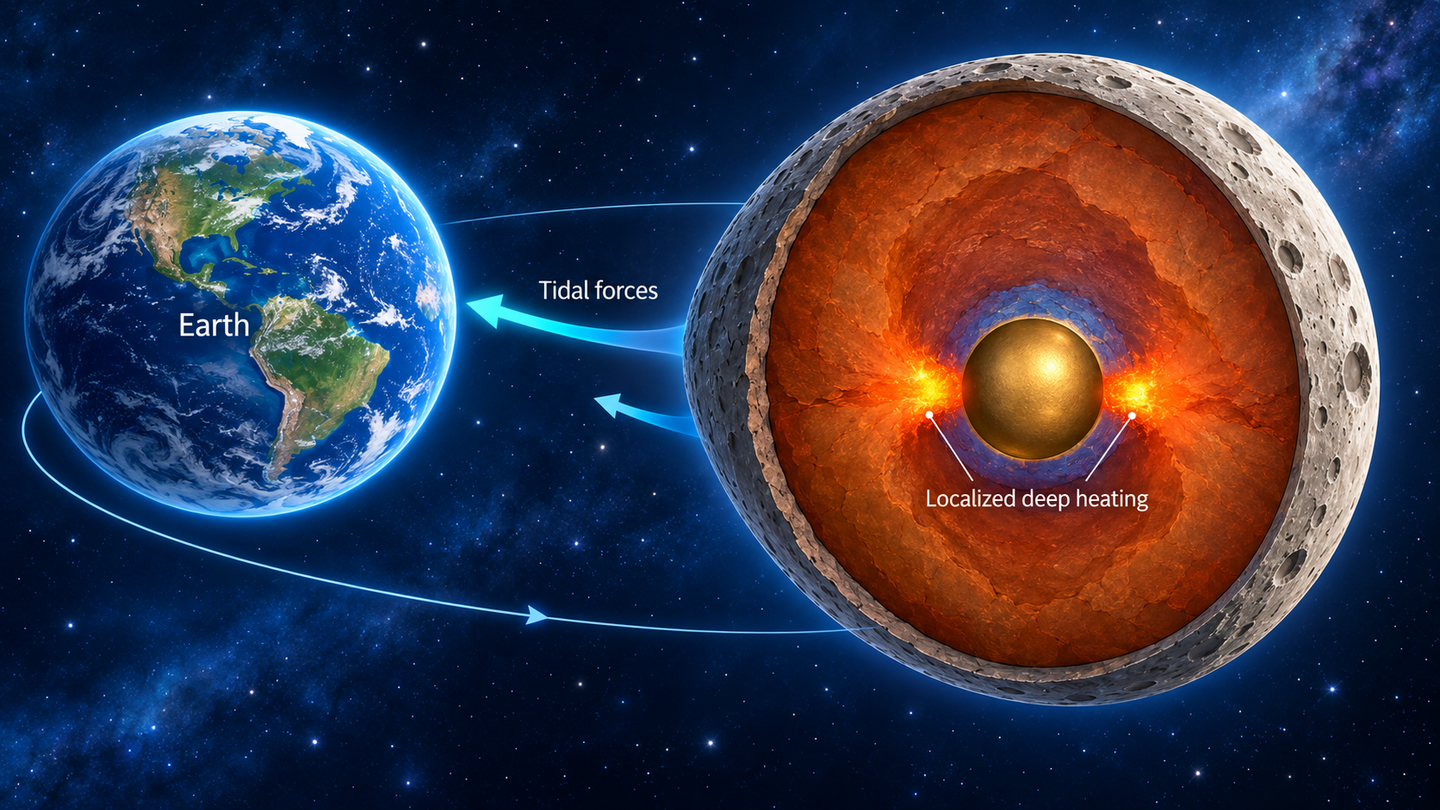
Earth’s tidal pull could have concentrated heat near the Moon’s core-mantle boundary, as illustrated by the glowing regions in this cutaway. The heating pattern is a model prediction; sizes and distances are not to scale. (CREDIT: The Brighter Side of News)
- Simulations suggest tidal forces could concentrate heat near the Moon’s core-mantle boundary rather than warm its interior evenly.
- A high-eccentricity scenario generated 150 gigawatts in a zone covering about 2.5% of the mantle, versus 1.5 gigawatts at lower eccentricity.
- The proposed heat source could influence mantle movement, but the study does not demonstrate that it powered surface eruptions.
A small region deep inside the Moon could once have produced a disproportionate share of its internal heat. Computer simulations suggest Earth’s gravitational tug could concentrate that heating near the boundary between the lunar core and mantle. The result offers a possible piece of the puzzle behind the Moon’s prolonged volcanic history.
The work, published in Planet, was led by Miao Chen with Da Wang at Chengdu University of Technology. Co-author Yun Liu works at the Institute of Geochemistry of the Chinese Academy of Sciences. Their models examine how the Moon’s deep structure could turn repeated tidal deformation into localized heating.
The findings describe a possible mechanism, rather than a newly observed underground heat source. Its strength depends heavily on assumptions about the ancient lunar orbit and the properties of deep rock. Establishing how much this mechanism contributed to actual volcanism will require more complete calculations and independent evidence.
Why the Moon’s volcanic history needs explaining
Lunar rocks preserve evidence of volcanic activity long after the Moon’s earliest development. Basalts returned by China’s Chang’e-5 mission record eruptions about 2 billion years ago. Those samples have sharpened questions about how a relatively small body retained conditions suitable for producing magma so late in its history.
Radioactive decay provides one source of internal heating, while the Moon also began its life with considerable stored heat. However, radioactive heat production declines as unstable elements decay, and the lunar interior gradually cools. The researchers investigated tidal heating as an additional contributor to that evolving energy budget.
The familiar example of tides involves ocean water moving under gravitational forces. Solid worlds also deform under tidal forces, even when the movement is much less obvious. As the Moon travels around Earth, changes in tidal stress repeatedly flex its interior.
Because lunar material does not respond like a perfectly elastic spring, some deformation energy becomes heat. Where that energy is dissipated depends partly on how readily the material deforms and flows. That property, called viscosity, makes the structure of the deep interior central to the calculation.
A weak layer changes where heat accumulates
Earlier studies have suggested a zone of unusually low viscosity near the Moon’s core-mantle boundary. Such a region would respond differently to tidal forcing than more resistant surrounding material. Chen and colleagues incorporated deep viscosity differences into calculations of where tidal energy would dissipate.
The team then used three-dimensional mantle-convection simulations to examine the consequences for temperature and material movement. Mantle convection is the slow circulation of interior rock as temperature and density differences affect its buoyancy. The calculations combined spatially varying tidal heating with radioactive heating and temperature-dependent viscosity. At each time step, the model updated viscosity as temperatures changed and adjusted tidal heating to account for the material’s evolving response.
In the modeled Moon, tidal dissipation became concentrated near the equatorial region of the core-mantle boundary. Cross sections displayed two symmetric areas of enhanced heating. The researchers named the feature the Tidal Heating Anomaly Zone, or THAZ.
Those paired regions are features of the model’s cross sections, rather than two underground hotspots mapped by instruments. Their importance lies in the predicted concentration of energy within the deep mantle. A calculation that averaged heating throughout the Moon could miss the intensity of such localized effects.
Orbital assumptions make a hundredfold difference
To estimate the potential heating, the researchers considered conditions relevant to roughly 3.2 billion years ago. They used an orbital period of about 16 present-day Earth days. They then compared two orbital eccentricities, which measure how much an orbit departs from a circle.
The higher value, 0.5, represents a substantially elongated orbit and stronger variations in tidal forcing. The lower value, 0.05, represents a much more nearly circular path. These are contrasting scenarios for testing the mechanism, not measurements proving that the ancient Moon followed either configuration throughout the modeled interval.
Under the high-eccentricity scenario, a strongly heated zone occupying approximately 2.5% of the mantle generated about 150 gigawatts of tidal power. The estimated radioactive heating within that same region was 34.9 gigawatts. Tidal heating therefore exceeded the local radioactive contribution by about 4.3 times in this particular comparison.
Reducing eccentricity to 0.05 lowered the modeled tidal contribution to 1.5 gigawatts, a hundredfold decrease. At that level, tidal heating was smaller than the radioactive contribution within the zone. The comparison shows why the headline heating figure must remain tied to its assumed orbital conditions.
The gigawatt values describe power, meaning the rate at which heat is generated. They are not a measured temperature, the Moon’s total heat production or evidence of a particular eruption. The 4.3-fold comparison likewise applies to the selected deep region, rather than the entire lunar interior.
From deep heating to rising mantle material
The simulations suggest concentrated heat could change the mantle’s temperature structure and encourage upward movement of material. In the stronger-heating case, large upwellings developed near the core-mantle boundary and slowed cooling. This provides a possible route for redistributing deep heat toward shallower regions.
The models also included a dense layer of titanium-rich material associated with the late crystallization of the lunar magma ocean. Such material may have sunk during an early rearrangement of the mantle. The researchers explored whether heating-driven upwellings could mobilize it despite its greater compositional density.
That possibility matters because the locations and compositions of potential magma sources influence later volcanic activity. Moving fertile material into shallower regions could affect where melting becomes possible under subsequent conditions. However, this proposed connection remains a model interpretation, not a demonstrated reconstruction of the rocks sampled by lunar missions.
The modeled heating pattern also does not directly explain why lunar volcanic plains occur predominantly on the nearside. Producing heat at depth and allowing magma to reach the surface are separate problems. Differences in the overlying crust and lithosphere would also have to be considered when interpreting the distribution of eruptions.
What the simulations still leave unresolved
Several important physical processes remain outside the current thermal model. It does not include the latent heat absorbed when rock melts or the transport of heat by moving magma. Both processes could alter the balance between heat generated at depth and heat retained in the interior.
The coupling between tidal heating and convection also uses a simplified scheme, and the numerical grid limits finer-scale detail. These choices make the calculations useful for examining broad behavior without resolving every feedback between temperature, viscosity and flow. More detailed models could change the predicted strength and persistence of localized heating.
The next test is whether the mechanism remains effective when melting, magma transport and cooling are treated together. Constraints from lunar observations and returned samples will also be needed to narrow the plausible interior structures and orbital histories. That combination could establish whether concentrated tidal heating supplied a meaningful part of the energy behind the Moon’s long volcanic life.
Dig deeper into the Moon’s interior and volcanic history
These studies connect recent measurements of lunar tides with evidence for deep structure and prolonged volcanism.
Thermal asymmetry in the Moon’s mantle inferred from monthly tidal response
GRAIL gravity measurements reveal differences in the lunar mantle’s tidal response, offering evidence for a heterogeneous interior. (Nature, May 2025)
A Low-Viscosity Lower Lunar Mantle Implied by Measured Monthly and Yearly Tides
Spacecraft tracking and interior modeling support a softer layer at the base of the mantle, a key ingredient in deep tidal-heating studies. (AGU Advances, September 2024)
The lunar solid inner core and the mantle overturn
Geophysical constraints and simulations investigate the lunar core and the redistribution of dense material within the mantle. (Nature, May 2023)
Research findings are available online in the journal Planet.
The original story "Earth’s gravitational pull could explain the Moon’s long volcanic history" is published in The Brighter Side of News.
Related Stories
- Buried volcanic structure suggests that our Moon once had a powerful magnetic field
- Ten thousand faults reveal how the Moon’s radius shrank by about 45 meters
- New global map finds recent tectonic activity across the Moon’s surface
Like these kind of feel good stories? Get The Brighter Side of News' newsletter.
Joseph Shavit
Writer, Editor-At-Large and Publisher
Joseph Shavit, based in Los Angeles, is a seasoned science journalist, editor and co-founder of The Brighter Side of News, where he transforms complex discoveries into clear, engaging stories for general readers. With vast experience at major media companies like The Los Angeles Times, Times Mirror and Tribune Publishing, he writes with both authority and curiosity. His writing focuses on space science, planetary science, quantum mechanics, geology. Known for linking breakthroughs to real-world markets, he highlights how research transitions into products and industries that shape daily life.