Scientists use light to control random motion inside molecules
A molecular motor acts as a light-controlled brake on a neighboring rotor, combining experimental evidence of slower motion with large calculated rate changes.
 IOCB Prague Writer: Tereza Mašínová

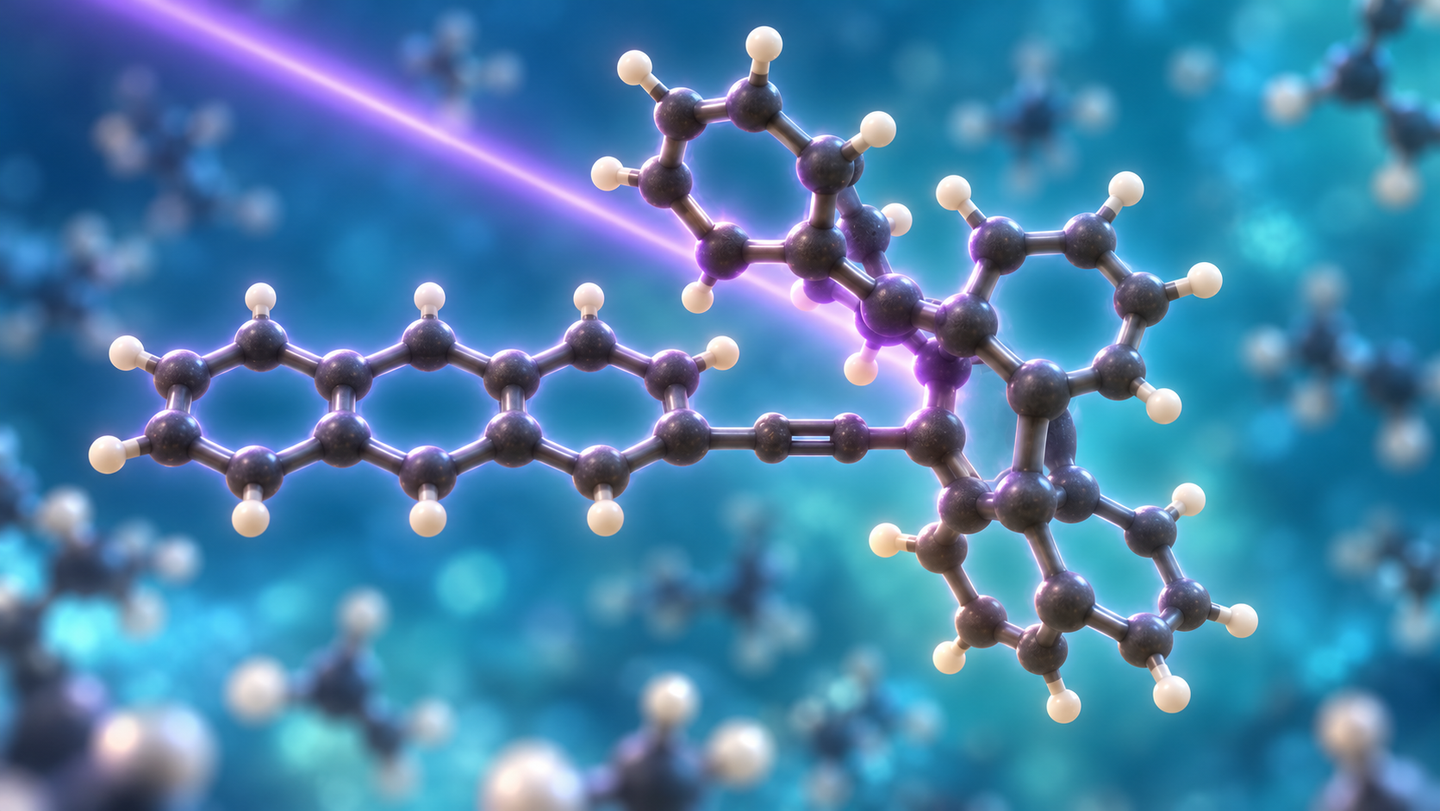
An illustration of a light-controlled molecular motor and neighboring rotor. Changing the motor’s configuration creates an obstruction that sharply slows the rotor’s random, thermally driven motion. (CREDIT: The Brighter Side of News)
- A light-controlled molecular motor can reversibly hinder the random rotation of another component within the same molecule.
- Spectroscopy confirms different rotational behavior, while calculations predict roughly 300,000-fold slower rotation near room temperature.
- The work demonstrates a control principle, but continuous four-state operation was not directly observed under conditions that resolved the slower rotor.
A molecular motor can do more than turn itself. By shifting into another configuration, it can obstruct a neighboring component and make that component's random rotation dramatically harder. A newly developed system uses light to control this molecular brake, offering a way to regulate motion without turning the attached rotor into a continuously driven propeller.
Jiří Kaleta's team at IOCB Prague built the motor and rotor into a rigid molecular framework, then investigated how they interacted. Their findings appear in Angewandte Chemie International Edition. The Institute of Organic Chemistry and Biochemistry of the Czech Academy of Sciences collaborated with researchers at the University of Chemistry and Technology Prague and Charles University.
The distinction between the two moving components is central to the result. Light changes the motor's configuration, while thermal energy keeps jostling the attached rotor. Controlling the space around that rotor changes how readily it turns, rather than eliminating the random motion that dominates molecular environments.
A brake for constantly moving parts
Molecules operate under conditions very different from those of familiar machinery. Thermal fluctuations produce incessant, unpredictable motion, including rotation of molecular components around bonds. Building a more elaborate mechanism therefore requires ways to regulate those movements, not simply attach miniature versions of wheels and axles.
“When we shine light on the molecule, the motor changes its spatial arrangement, which in turn affects the motion of the rotor,” explained first author Lukáš Severa. The light does not directly drive the second component around its axis. Instead, the motor acts as a movable obstruction that changes the energy needed for the rotor to pass.
That obstruction is a consequence of molecular geometry. In the less restricted configuration, the rotor has enough clearance to rotate readily. When the motor moves into its path, close encounters between parts of the molecule raise the rotational energy barrier, making successful turns much less frequent at the same temperature.
Building the components into one molecule
The design combines a light-driven motor with a rotor made from anthracene, a rigid structure of connected carbon rings. A triptycene scaffold holds the components in a defined arrangement, and an alkynyl linker connects the rotor to that framework. These chemical structures establish the spacing needed for the motor to influence a separate rotational axis.
X-ray crystallography confirmed the structure and the close alignment of the two axes. The researchers also added methyl groups to the anthracene unit, making its orientations easier to distinguish spectroscopically. Those modifications helped them identify whether rotation remained rapid or became slow enough for separate orientations to appear in the measurements.
The motor follows a four-stage cycle involving alternating light-induced changes and thermal rearrangements. The experiments used irradiation centered around 385 nanometers, in the ultraviolet region. Two configurations provide relatively open conditions for the attached rotor, while two impose greater obstruction, according to the experimental interpretation and calculations.
The samples contained equal amounts of mirror-image motor molecules. These counterparts rotate in opposite directions, so the mixture has no overall directional bias. More importantly, the attached anthracene rotor remains thermally driven: the study demonstrates reversible regulation of its random motion, not conversion into a uniformly turning output shaft.
The motor also helped determine how the molecule was assembled. In one configuration, it shielded a reactive site, allowing the researchers to modify a neighboring site selectively. Further reaction under hotter conditions completed the structure, showing how the same physical obstruction could influence both synthesis and subsequent motion.
What the experiments actually measured
To follow the motor's switching cycle, the team combined ultraviolet-visible spectroscopy with nuclear magnetic resonance, or NMR. These methods reveal changes in molecular structure through light absorption and signals from atomic nuclei. Repeated switching and relaxation cycles showed reversible behavior without detectable photochemical fatigue over the experimental timescale.
The researchers then used variable-temperature NMR to compare two stable configurations, one relatively open and one hindered. Measurements extended from 25 degrees Celsius to minus 95 degrees Celsius. In the open configuration, rotation remained fast on the NMR timescale throughout that range, meaning the instrument did not resolve separate rotor orientations.
The hindered configuration behaved differently as the solution cooled. Signals broadened and eventually separated into two sets, revealing distinct orientations of the anthracene rotor. At minus 95 degrees Celsius, the two populations occurred in an approximately two-to-one ratio, providing direct evidence of slower rotational exchange.
These observations establish a difference in motion, but they do not directly measure a 300,000-fold change across both configurations. The experimental estimates of the hindered rotational barrier were also only approximate. To examine the detailed mechanism and estimate relative rates, the researchers turned to calculations of molecular energies and possible rotational pathways.
Why the calculated slowdown is so large
Density functional theory, a computational method for estimating molecular properties, identified routes by which the rotor could pass the motor. The favored pathway had a calculated barrier of about 20 kilojoules per mole in the open state. In the hindered state, that barrier rose to about 51 kilojoules per mole.
The difference, 31 kilojoules per mole, corresponds to roughly five orders of magnitude in calculated rotational rates at 20 degrees Celsius. IOCB Prague describes the slowdown as approximately 300,000-fold. That figure summarizes the model-based rate contrast, supported by the experimental evidence that the two states behave differently.
Even the braked rotor is not necessarily motionless at room temperature. The calculated timescales remain extremely short, and stronger restriction becomes easier to distinguish as temperature falls. Cooling reduces the thermal energy available to overcome the barrier, magnifying the contrast between the two configurations.
The institute illustrates that temperature dependence with a deliberately extreme comparison. If an unbraked rotor turned once per second at a sufficiently low temperature, its braked counterpart could take roughly 350 billion years per turn. This is a hypothetical comparison of rates, not an observed rotation time or evidence that a molecular device could remain intact for that duration.
A control principle with a remaining challenge
Regulating one component with another is an important step toward coordinating more complicated molecular systems. Kaleta describes the need clearly: “If you want to build a more complex mechanism, having a motor alone is not enough.” Brakes and other control elements must manage how separate parts interact, rather than leave every movement independent.
The present experiments also expose a practical limitation. Temperatures low enough to resolve the slower anthracene rotation were too low for the motor's thermal rearrangement steps to remain operative. Consequently, the researchers could not directly observe continuous four-state, gearbox-like operation while simultaneously resolving that slower rotor motion.
The result therefore establishes a reversible molecular gate rather than a finished nanoscale transmission. It shows how changing one component's geometry can strongly regulate another component's random rotation, with experiments and calculations providing complementary evidence. A next challenge is to demonstrate coordinated operation under conditions that allow both the motor cycle and the controlled motion to be followed together.
Dig deeper into molecular motors and motion control
These resources explain related approaches to controlling molecular movement and the foundations of artificial molecular machines.
A photochemical rotor bias in dual molecular motors
This study explores photochemical behavior in a system containing two molecular motors, adding context for coordinating multiple moving components. (Nature Chemistry, June 2026)
Formylation boosts the performance of light-driven overcrowded alkene-derived rotary molecular motors
The research examines how chemical modifications alter light-driven motor performance, complementing the newer focus on regulating a secondary rotor. (Nature Chemistry, April 2024)
From Brownian to Deterministic Motor Movement in a DNA-Based Molecular Rotor
A different molecular platform investigates the relationship between thermal fluctuations and controlled rotor movement. (Nano Letters, April 2024)
Research findings are available online in the journal Angewandte Chemie.
The original story "Scientists use light to control random motion inside molecules" is published in The Brighter Side of News.
Related Stories
- Quantum sensor breakthrough could finally map proteins and other biomolecules
- Light controlled therapy exposes cancer cells hiding from chemotherapy
- Scientists discover sugar molecules that predict disease years early
Like these kind of feel good stories? Get The Brighter Side of News' newsletter.
Joshua Shavit
Writer and Editor
Joshua Shavit is a NorCal-based science and technology writer with a passion for exploring the breakthroughs shaping the future. As a co-founder of The Brighter Side of News, he focuses on positive and transformative advancements in technology, physics, engineering, robotics, and astronomy. Having published articles on AOL.com, MSN, Yahoo News, and Ground News, Joshua's work highlights the innovators behind the ideas, bringing readers closer to the people driving progress.