TikTok video leads scientists to a new species of transparent fish in India
A TikTok video led researchers to a tiny pale fish living in borewell groundwater near the India-Nepal border.

 Edited By: Joseph Shavit

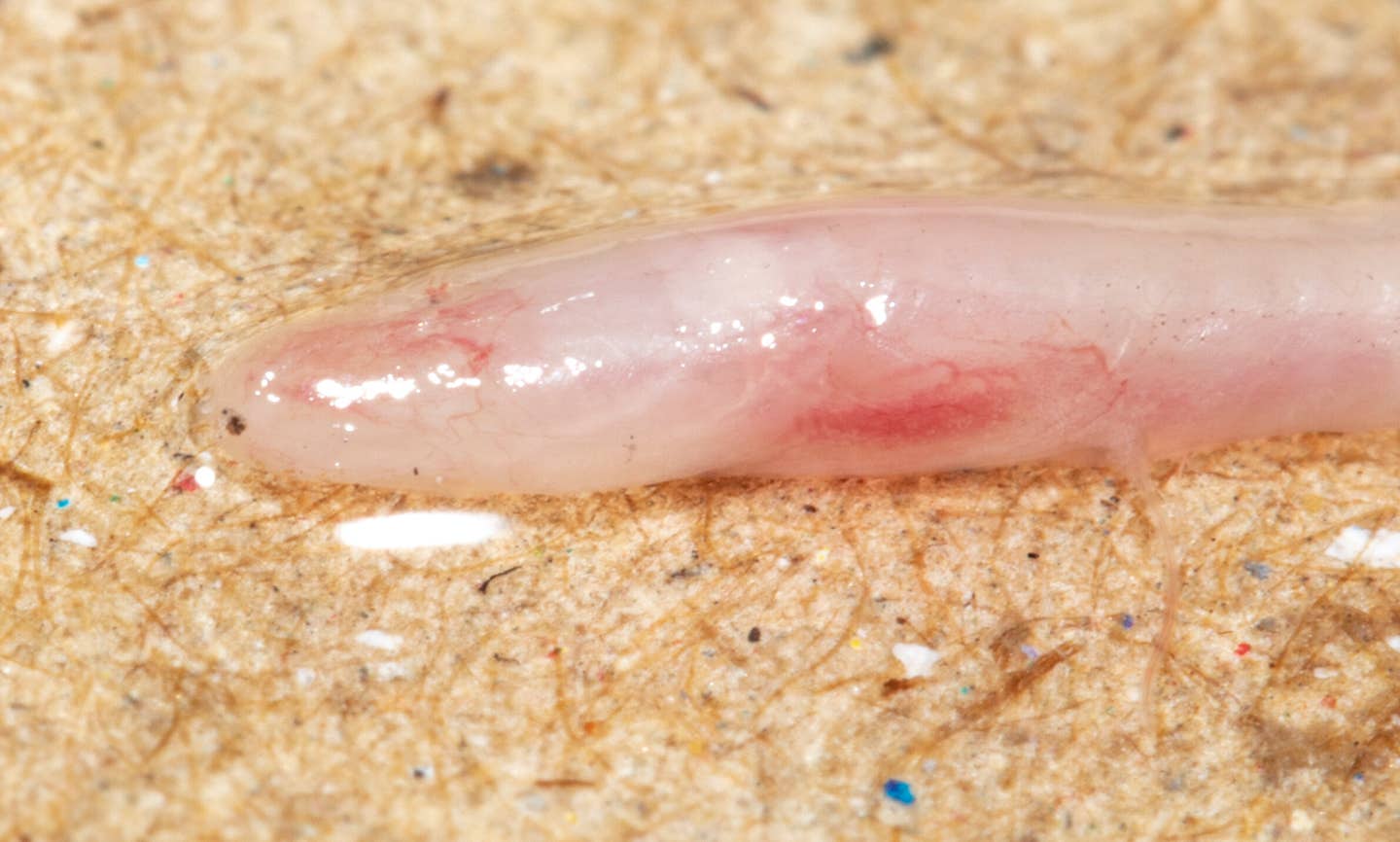
Gangaichthys indonepalicus, a tiny blind fish found in groundwater, reveals an unexplored ecosystem beneath the Gangetic Plain. (CREDIT: ZooKeys / Ishan Agarwal)
- A tiny, nearly transparent fish found in borewell water in Bihar has been identified as both a new species and a new genus of earthworm eel.
- DNA, skeletal scans, reduced eyes, lack of pigment, and unusual fin and vertebral features distinguish Gangaichthys indonepalicus from known relatives.
- Only three physical specimens are known, and researchers still have major gaps in genetic comparisons, distribution, and anatomy.
A four-centimeter fish pulled from groundwater beneath northern India has opened a window into an ecosystem almost impossible to see. The pale, nearly transparent animal represents both a new species and a new genus of subterranean earthworm eel.
Named Gangaichthys indonepalicus, the fish is the first known subterranean member of the earthworm eel family Chaudhuriidae. It is also the first subterranean fish recorded from the Gangetic Basin and Indo-Gangetic Plain.
An international team from India and China described the animal, and the work involved researchers from the Thackeray Wildlife Foundation, Shivaji University, the Shanghai Synchrotron Radiation Facility, and the Zoological Survey of India.
The investigation began not in a laboratory or museum, but with a TikTok video posted in 2024.
A social-media clip triggers a difficult search
The short video showed an unusual tiny fish emerging from a borewell near the India-Nepal border.
“The unique morphology of the fish in the video, and the fact that there are no known stygobitic fish known from the region, motivated us to track down the species to ascertain its identity,” the research team stated.
Stygobitic animals live permanently in subterranean aquatic environments.
Finding actual specimens required far more effort.
Researchers sampled more than 15 borewells during fieldwork in 2024 and 2025. They manually pumped thousands of liters of groundwater, often after first securing permission from borewell owners.
“Procuring samples of this unusual fish was challenging,” said Akshay Khandekar of the Thackeray Wildlife Foundation.
The first specimen appeared after roughly 2,000 liters of water had been pumped. It was damaged during the process and died immediately.
Another 500 liters produced the only intact specimen, which later became the holotype, the individual used as the formal reference for the new species.
Only three physical specimens are known from two borewells.
A fish shaped by life in darkness
The intact holotype measured 40.6 millimeters in standard length. A damaged paratype measured 36.5 millimeters.
Its appearance strongly reflects underground life.
The fish lacks visible body pigment and appears pale and partly translucent. Its eyes are reduced and covered by skin. Pink tissue around the gills and anal region remains visible, while the vertebral column can appear as a pink line toward the tail.
The body is narrow and eel-like, becoming more compressed toward the rear.
It lacks pelvic fins, scales, and lateral-line canals. Its dorsal, anal, and tail fins join into a continuous fin structure.
The skeleton also proved unusual.
Researchers counted 64 vertebrae, including 28 abdominal and 36 caudal vertebrae. The fish carries 37 dorsal fin rays, 35 anal fin rays, six caudal fin rays, and only one pectoral fin ray.
No ossified ribs appeared in the scans.
CT imaging and DNA point to a new genus
Because subterranean animals can independently evolve similar features, reduced eyes and lack of pigmentation were not enough to establish a new genus.
Researchers therefore combined external anatomy, skeletal details, and genetic evidence.
High-resolution micro-computed tomography revealed unusual structures in the vertebral column, skull, and jaws.
The neural spines are narrow and taper to points. Other traits include differences in the neural arch and an elongated metapterygoid, a bone associated with the jaw region.
Genetic analysis strengthened the case.
Researchers examined portions of two genes, mitochondrial Cytochrome Oxidase 1, or CO1, and nuclear RAG1. The sequences from the two tested specimens were identical.
CO1 comparisons showed an average genetic divergence of 20.7% from Chaudhuria caudata and 22.2% from Pillaia indica.
Those differences, combined with the anatomical evidence, supported recognition of a previously unknown genus within Chaudhuriidae.
Its known world spans only a few kilometers
All physical specimens came from around Balgangwa village in Bihar’s Pashchim Champaran District.
Photographic records also place the fish in Triveni, across the border in Nepal’s Nawalparasi District.
Every known location lies within a straight-line distance of about 11 kilometers.
The fish has appeared only in groundwater drawn from hand-pumped borewells reaching roughly 10 meters below the surface.
Researchers searched nearby wells and ponds but found no additional animals.
That limited record makes the species especially difficult to study. Only one specimen survived intact enough for extensive examination.
The apparent absence of ribs also requires caution.
The micro-CT scans did not use contrast agents. Weakly ossified or cartilage-based structures could therefore be difficult to detect in such a small subterranean fish.
A wider range for an obscure fish family
The discovery expands the known distribution of Chaudhuriidae by roughly 500 kilometers westward.
It also makes Gangaichthys the northernmost known member of the family and the fifth monotypic chaudhuriid genus, meaning the genus currently contains only one recognized species.
“Gangaichthys means fish of the Ganga,” explained researcher Agarwal.
The genus name refers to the Ganga, or Ganges River. The species name indonepalicus reflects its occurrence around the India-Nepal border.
“As the species occurs on the border between India and Nepal we picked indonepalicus as the specific epithet, which reflects the distribution of the species,” said Tejas Thackeray.
Researchers proposed “Indonepalese blind earthworm eel” as the English common name.
Practical implications of the research
The discovery gives scientists their first evidence that the alluvial groundwater systems of the Gangetic Basin support a specialized subterranean fish.
It also exposes how difficult that biodiversity can be to document.
Comparative genetic information remains limited. CO1 data were available for only two other chaudhuriid species, while comparable nuclear sequences were unavailable for the family.
That prevents researchers from fully resolving the new genus’s precise evolutionary position.
Further groundwater sampling could clarify whether Gangaichthys indonepalicus occupies a broader range than the handful of known localities suggests.
“India is an incredibly diverse country, spanning huge gradients in climate and topography and multiple biogeographic regions,” Agarwal said. “However, there is a huge gap in knowledge, both Linnaean and Wallacean shortfalls, with many more species yet to be discovered.”
A fish first noticed in a short social-media video has therefore revealed something much larger: an almost entirely unexplored habitat beneath one of South Asia’s major river plains.
Dig deeper into subterranean fish and groundwater biodiversity
These resources explore India’s little-known groundwater fishes, the evolution of blindness and pigment loss, and the broader challenge of documenting and protecting subterranean ecosystems.
This 2026 paper describes another newly recognized blind groundwater fish from India, found in a well in Assam, and documents extreme subterranean traits including the complete absence of a skull roof. It provides a close regional comparison for understanding how much undocumented fish diversity may remain beneath the Indian subcontinent. (Scientific Reports, 2026)
This research examines the diversity and distribution of burrowing and aquifer-dwelling synbranchid eels in southern India, while highlighting the sampling difficulties and conservation problems surrounding fishes that spend much of their lives underground. (Vertebrate Zoology, 2025)
Drawing on 859 studies, this global review maps decades of research on groundwater animals, sampling methods and geographic knowledge gaps. It shows how unevenly subterranean biodiversity has been studied and why aquifers can still yield entirely unexpected species. (Ecohydrology, 2024)
Experiments with cave, surface and hybrid loaches found that reduced eyes and pigmentation can reflect both inherited genetic differences and responses to darkness. The work helps explain how characteristic subterranean features can develop during the early stages of adaptation to life underground. (Evolution, 2024)
This analysis focuses on India’s remarkable aquifer-dwelling fishes and argues that groundwater extraction, habitat alteration and gaps in environmental governance can threaten species before their distributions and biology are fully understood. (Trends in Ecology & Evolution, 2021)
Research findings are available online in the journal ZooKeys.
The original story "TikTok video leads scientists to a new species of transparent fish in India" is published in The Brighter Side of News.
Related Stories
- Scientists discover a major geological rift tearing India in two
- How animal feces became an evolutionary force 540 million years ago
- Ancient crocodile-like predators rewrite current knowledge of how animals adapted to the land
Like these kind of feel good stories? Get The Brighter Side of News' newsletter.
Rebecca Shavit
Writer
Based in Los Angeles, Rebecca Shavit is a dedicated science and technology journalist who writes for The Brighter Side of News, an online publication committed to highlighting positive and transformative stories from around the world. Having published articles on MSN, AOL News, and Yahoo News, Rebecca's reporting spans a wide range of topics, from cutting-edge medical breakthroughs to historical discoveries and innovations. With a keen ability to translate complex concepts into engaging and accessible stories, she makes science and innovation relatable to a broad audience.