Helix Nebula reveals what happens to material shed by a dying star
Faint bow shocks around the Helix Nebula expose stellar fragments being stripped apart before rejoining the galaxy.
 Northwestern University Writer: Amanda Morris

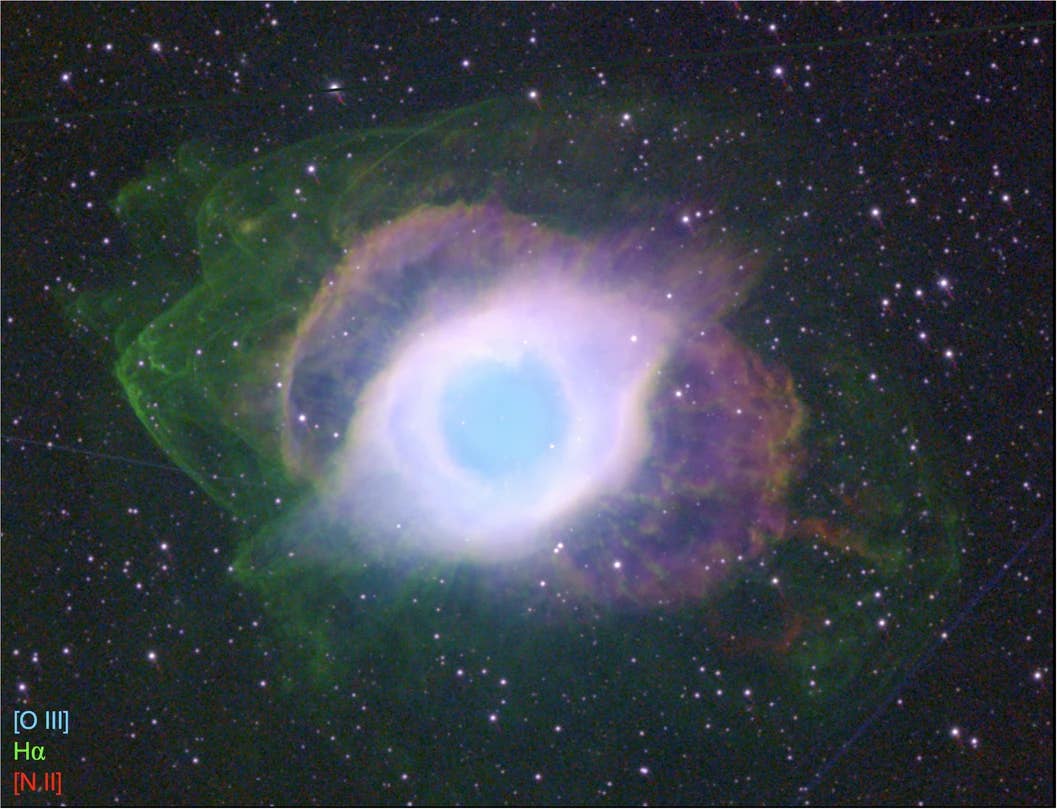
Color representation of the Helix Nebula. (CREDIT: Pieter van Dokkum et al, Nature)
- The Helix Nebula is revealing how debris from a dying star gets broken apart and mixed into the gas between stars.
- Astronomers identified at least 22 bow-shaped shock waves that become smaller and more fragmented as stellar debris travels outward.
- The fragments appear to lose their coherent structure in about 10,000 years, giving astronomers a new benchmark for understanding how galaxies recycle stellar material.
The Helix Nebula is shedding more than a spectacular glow. Far beyond its bright central ring, fragments from a dying star are being torn apart as they collide with surrounding gas, exposing a missing step in how stellar material returns to the galaxy.
An international team, including astrophysicists connected with Northwestern University, traced that destruction in new observations of the Helix. The work follows debris as it is stripped, fragmented and mixed into interstellar space.
Located about 650 light-years from Earth in Aquarius, the Helix is one of the closest and best-studied planetary nebulae. Its bright ring formed from material expelled late in a star’s life. A white dwarf remains at the center.
The new view reaches well beyond those familiar structures. On the nebula’s eastern side, the team identified at least 22 complete or partial arcs glowing in hydrogen-alpha light. These bow shocks resemble waves that build ahead of a boat moving through water.
Bow shocks trace debris being destroyed
The arcs form as mostly invisible clumps of stellar debris move through thin interstellar gas at high relative speeds. Their shocks reveal the fragments indirectly because most of the objects producing them do not glow detectably in the observed emission lines.
Lead author Pieter van Dokkum said the observations show material shed late in a star’s life being broken apart and returned to the galaxy. That transfer from recognizable debris into diffuse gas between stars has been difficult to observe directly.
The shocks change noticeably with distance from the central white dwarf. Those closer in are larger, thinner and sharply defined. Farther away, they become smaller, broader, fuzzier and increasingly fragmented.
“The shocks change dramatically with the distance from the central star,” said co-author Imad Pasha, a member of Dragonfly FRO and visiting scholar at Northwestern’s Center for Interdisciplinary Exploration and Research in Astrophysics. “Those nearer the center are large, thin and sharply defined. Farther out, they become smaller, fuzzier and increasingly fragmented.”
The characteristic size of the bow shocks falls by about two orders of magnitude between roughly 0.4 and 1.4 parsecs from the white dwarf. The team interprets that progression as evidence that dense fragments are steadily stripped and broken apart.
A short survival time for stellar fragments
Shock models indicate velocities of about 80 to 90 kilometers per second on the eastern side. After accounting for the nebula’s motion through surrounding gas, the researchers estimate the ejecta are expanding at roughly 35 to 45 kilometers per second.
At a distance of about one parsec, those speeds imply that the clumps are roughly 20,000 to 30,000 years old. That predates the planetary nebula, estimated at about 12,000 years old.
The material therefore most likely came from an older envelope expelled during the star’s late asymptotic giant branch, or AGB, phase, when stars lose large amounts of material.
The researchers estimate that the coherent fragment-and-bow structures survive for roughly 10,000 years once exposed to the surrounding medium. Their analysis gives an e-folding time of about 7,000 years for the decline in bow curvature scale.
The team cautions that this timescale describes how long the dense fragment and its visible bow remain coherent. It is not a direct measurement of a specific mass-loss or momentum-transfer rate.
A calibration image exposes an overlooked network
The discovery emerged unexpectedly while the team was testing MOTHRA, the Modular Optical Telephoto Hyperspectral Robotic Array, at El Sauce Observatory in Chile. The Helix was chosen because it is large, bright and well studied.
MOTHRA was still partly constructed when the observations were taken. Even so, it revealed faint structures in ionized gas that had not been seen before, including the extensive network of eastern bow shocks.
“We thought we were taking a calibration image of one of the best-known nebulae in the sky,” said co-author Roberto Abraham, a member of Dragonfly FRO and professor of astronomy at the University of Toronto. “Instead, we found this extraordinary network of bow-shaped structures. It was immediately clear that the faint outer Helix was telling us a story that had largely been missed.”
When complete, MOTHRA will use 1,140 high-end telephoto lenses with specialized filters. The array will be optically equivalent to a 4.8-meter f/0.08 refractor and designed to detect extremely faint gas over large areas of sky.
The Helix observations represent about 20 minutes of on-source exposure time with the completed array, suggesting similar structures could be found around other planetary nebulae.
The Sun will eventually join the same cycle
The Helix offers a direct view of how material lost by an aging star can lose its identity and blend into interstellar space. That process is central to how galaxies recycle gas, dust and newly formed elements.
The team expects comparable fragment-driven bow shocks around other planetary nebulae, especially when a nebula moves through surrounding gas faster than roughly 40 kilometers per second. Future observations could test whether fragment survival depends on shock velocity.
The largely invisible clumps might also be detectable through molecular emissions, including carbon monoxide rotational lines and a molecular hydrogen line at 2.12 micrometers.
The Helix also provides a preview of the Sun’s distant future. It too will eventually shed its outer layers, allowing some of its material to enter the same galactic recycling process.
Practical implications of the research
The Helix observations give astronomers an empirical timescale for a stage of stellar recycling that has been difficult to measure directly. Once late-stage stellar ejecta fragment and encounter diffuse interstellar gas, the dense structures may lose their coherent form in about 10,000 years.
That estimate can provide a benchmark for galaxy-formation models, which often represent unresolved mixing through simplified prescriptions. MOTHRA may also allow astronomers to test whether the same destruction process appears around other planetary nebulae.
For the Helix, the bow shocks reveal where stellar debris is being dismantled before joining the gas between stars. Much later, some of that material may become part of new clouds, stars or planets, continuing the same cycle that the Sun is expected to enter in the distant future.
Dig deeper into stellar recycling and planetary nebulae
These resources explore how dying stars shed material, how stellar winds interact with interstellar gas, and how that debris can ultimately contribute to future generations of stars and planets.
Intricacies of Helix Nebula Revealed With NASA’s Webb
Webb’s 2026 view of the Helix Nebula resolves comet-like knots, stellar winds, molecular hydrogen and layers of cooling gas, providing a complementary look at how material from a dying Sun-like star is processed and recycled. (NASA Science, 2026)
Three new identifications of extended UV emission around asymptotic giant branch stars
Observations of three AGB stars reveal extended ultraviolet structures produced as their stellar winds interact with surrounding interstellar gas, including increasingly elongated bow shocks and wakes around faster-moving stars. (Monthly Notices of the Royal Astronomical Society, 2024)
H2 molecular gas in the old planetary nebula NGC 3587
This work identifies molecular hydrogen clumps inside the evolved Owl Nebula and examines an asymmetric outer halo shaped by interaction with the interstellar medium, offering another view of dense material surviving late stellar evolution. (Monthly Notices of the Royal Astronomical Society, 2024)
Investigating dust properties in AGB wind-ISM interaction regions
Researchers examine dust in regions where winds from aging AGB stars collide with the interstellar medium, helping clarify how bow shocks process material expelled before the planetary-nebula stage. (Astronomy & Astrophysics, 2022)
A far-infrared survey of bow shocks and detached shells around AGB stars and red supergiants
This influential Herschel survey documented widespread bow shocks, detached shells and other structures created when winds from evolved stars meet surrounding interstellar gas, establishing an important observational foundation for stellar-wind recycling studies. (Astronomy & Astrophysics, 2012)
Research findings are available online in the journal Nature.
The original story "Helix Nebula reveals what happens to material shed by a dying star" is published in The Brighter Side of News.
Related Stories
- Scientists find evidence of a rare double supernova in the Jellyfish Nebula
- Radio observations reveal once hidden structures around the Orion Nebula
- The Eye of Sauron: Helix Nebula Reveals How Sun-like Stars Die
Like these kind of feel good stories? Get The Brighter Side of News' newsletter.
Joseph Shavit
Writer, Editor-At-Large and Publisher
Joseph Shavit, based in Los Angeles, is a seasoned science journalist, editor and co-founder of The Brighter Side of News, where he transforms complex discoveries into clear, engaging stories for general readers. With vast experience at major media companies like The Los Angeles Times, Times Mirror and Tribune Publishing, he writes with both authority and curiosity. His writing focuses on space science, planetary science, quantum mechanics, geology. Known for linking breakthroughs to real-world markets, he highlights how research transitions into products and industries that shape daily life.