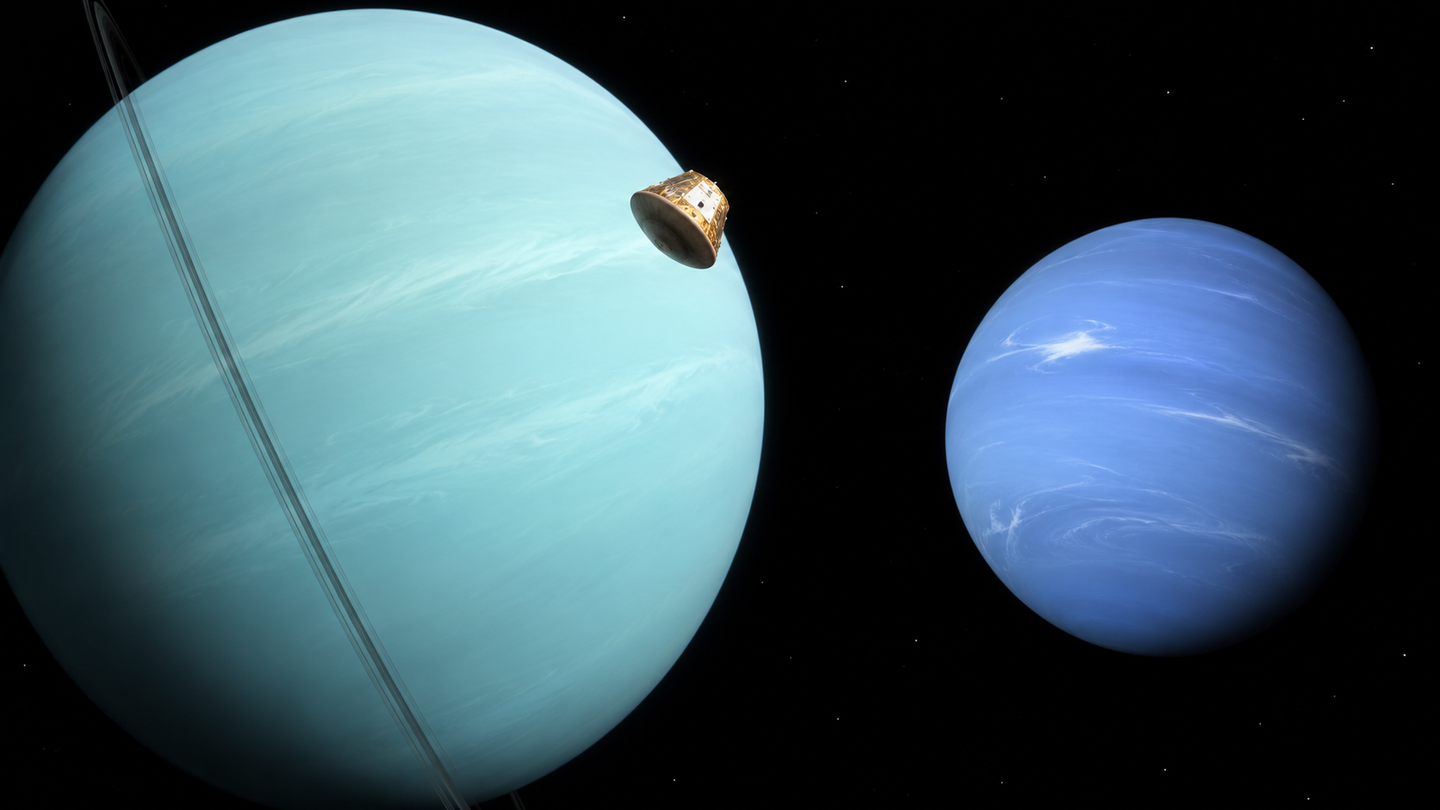
The universe will end much sooner than previously predicted, new model finds
A new calculation puts white dwarf evaporation at roughly 10^78 years if a proposed form of gravitational particle production occurs.

 Edited By: Joshua Shavit

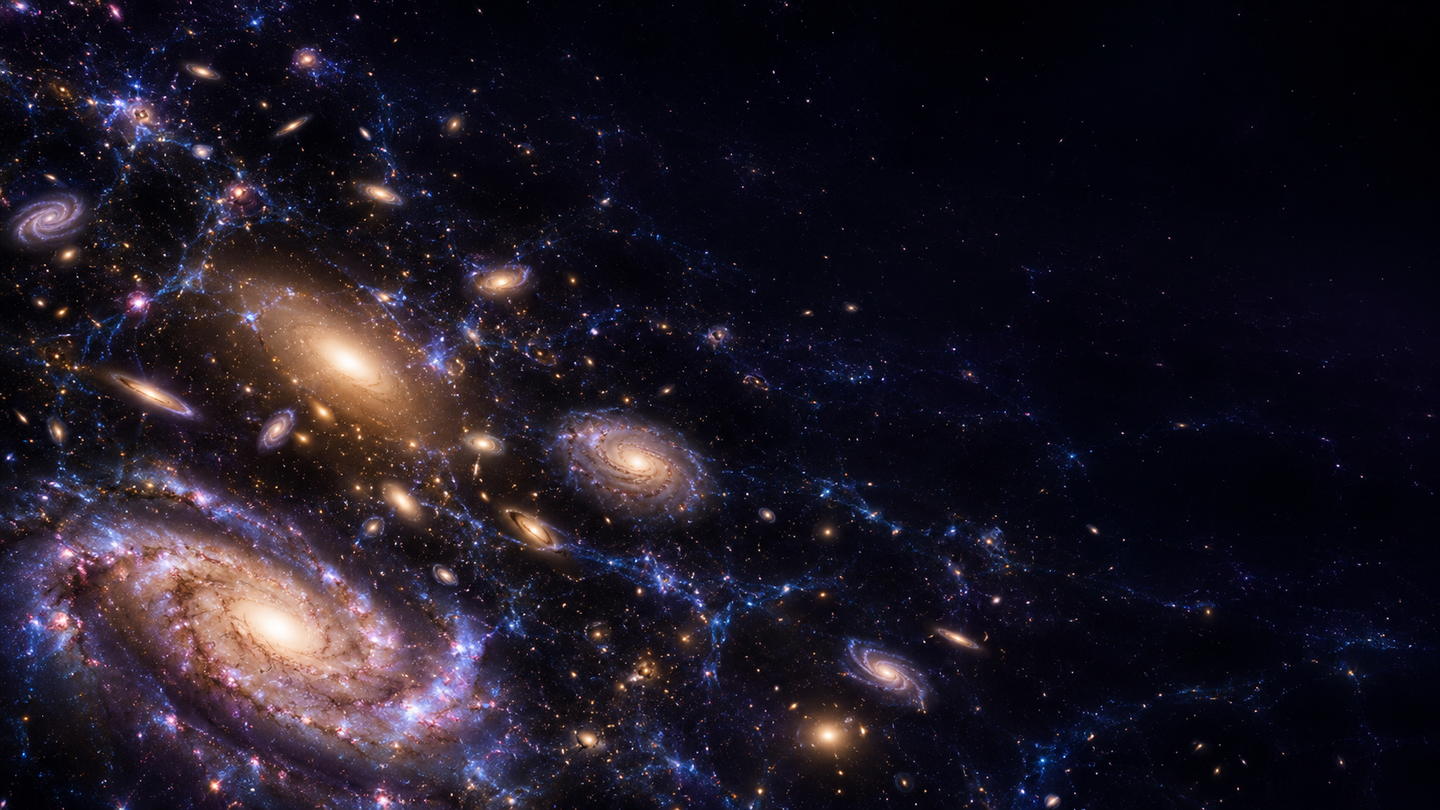
Bright galaxies give way to dark voids in this artist’s impression of the universe’s distant future. The study estimates that white dwarfs could evaporate in about 10⁷⁸ years if a proposed process similar to Hawking radiation occurs. (CREDIT: The Brighter Side of News)
- A Radboud University team calculated a characteristic timescale of roughly 10^78 years for white dwarfs under a proposed form of gravitational particle production.
- The model extends an idea related to Hawking radiation to objects without event horizons. The proposed effect remains unconfirmed.
- The estimate concerns the survival of stellar remnants. Other processes could shape the universe’s future on different timescales.
A white dwarf can shine long after the star that made it has stopped fusing fuel. What remains is a dense core that cools as it gives up its stored heat. A team of physicists and mathematicians has now asked whether an isolated remnant could eventually lose the material that makes up the star itself.
Heino Falcke, Michael Wondrak and Walter van Suijlekom of Radboud University report their calculations in the Journal of Cosmology and Astroparticle Physics. Under their model, a white dwarf has a characteristic evaporation timescale of roughly 10^78 years. That is a 1 followed by 78 zeros.
The proposed process is related to Hawking radiation, the prediction that black holes emit particles when quantum effects are included. The team asks whether the curvature of spacetime around an object could produce a similar effect even when the object has a surface. A white dwarf offers a test of that idea on paper because it packs a great deal of matter into a small space without forming a black hole.
The calculation concerns what might happen after familiar sources of heat and light have faded. It does not establish when the universe ends. Questions about how far the universe will cool as it expands involve other physics, including how expansion changes the background radiation.
How Hawking radiation enters the calculation
In classical general relativity, a black hole’s event horizon marks the boundary beyond which light cannot escape to distant observers. Stephen Hawking’s calculation brought quantum fields into that curved spacetime. It predicted radiation detectable in principle outside the black hole. The outgoing energy comes at the expense of the black hole’s mass.
The effect is often pictured as a pair of particles appearing at the horizon, with one escaping and the other falling in. That picture is a teaching aid. Hawking’s result comes from how quantum fields behave in the spacetime of a black hole. The radiation does not require a particle to travel outward from inside the horizon. This distinction also matters when comparing other theoretical work on event horizons.
Hawking radiation does not contradict the classical rule about what can escape an event horizon. The two descriptions use different assumptions. The classical result describes the motion of matter and light in spacetime. The quantum calculation adds a prediction about fields in that spacetime and the radiation distant observers would measure.
For an isolated black hole, standard Hawking theory predicts that a smaller mass corresponds to a higher temperature and a shorter lifetime. Stellar black holes would emit extremely weak radiation, which makes it difficult to distinguish the effect from other sources around them. Proposals to collect black hole energy often consider much brighter sources, such as hot gas orbiting outside the horizon.
A model for stars without event horizons
The Radboud team builds on its 2023 paper that spacetime curvature could drive particle production beyond the usual black hole setting. In the follow-up, the authors calculate the effect for a spherical, nonrotating object with uniform density. They use a simplified quantum field and assume spacetime becomes flat far from the object. Actual stellar remnants can rotate and have complex interiors. The model isolates the proposed effect so the researchers can estimate its size.
In the calculation, the characteristic lifetime falls as average density rises. If the density increases fourfold, the timescale drops by a factor of eight under the model’s scaling. The result helps explain why an extremely dense neutron star would have a shorter timescale than a white dwarf. The two belong to different classes of stellar remnants, with different structures and observable behavior.
For a representative neutron star, the estimate is about 10^67 years, the same order of magnitude as a stellar black hole’s evaporation time. That comparison does not put all black holes on the same clock. A black hole’s standard Hawking lifetime depends strongly on its mass, and very massive black holes can last far longer. Observations of massive black holes give a sense of how wide that mass range can be.
White dwarf evaporation and a different fate for cooled stars
The much larger figure of 10^1100 years comes from a different study. It examined what might happen to some white dwarfs after they cool into dark remnants called black dwarfs. In that calculation, extremely slow nuclear reactions could change the composition of a sufficiently massive remnant until it becomes unstable and explodes. The estimate assumes, among other things, that the relevant matter survives long enough for those reactions to proceed.
The new timescale asks how long a white dwarf might endure if curvature-driven particle production steadily removes energy. Under the model, that process could take effect long before the nuclear route reached its endpoint. The comparison is between possible fates for certain remnants, with different assumptions about the physics involved. Research on white dwarf atmospheres deals with objects we can observe today, far earlier in their evolution.
Other changes could also alter a remnant’s future. A star may exchange matter with a companion, merge with another remnant or encounter an environment where it absorbs more energy than it loses. The new paper estimates a characteristic time for its proposed process under ideal conditions. Actual binary systems illustrate how a companion can change what happens to a white dwarf.
Why the mechanism still needs testing
For white dwarf evaporation to happen as modeled, the energy carried away would have to come from the object and its gravitational field. Ordinary cooling already carries energy away from a warm white dwarf. The proposed effect would be relevant even after the remnant had largely exhausted that supply of heat.
The proposal has drawn a published comment and a reply over how to interpret the underlying calculation. The issue matters because a model that predicts particle production must also establish when energy escapes to distant observers and when that loss reduces the mass of the object. The decay times in the new paper depend on how those steps are treated.
The team also extrapolated the calculation to objects with much lower densities, including the Moon and a human body. The resulting timescale was on the order of 10^90 years. The exercise illustrates how weak the proposed effect becomes for ordinary matter. Familiar physical and biological processes operate on far shorter timescales.
Calculations about the universe’s long-term future depend on how matter and spacetime behave over intervals no observation can span. The model offers a specific question to investigate now: whether the quantum fields around an object without a horizon can carry away energy in the way the calculation predicts. Answering it would clarify the relationship between curvature and radiation even if the disappearance of dead stars remains far beyond observation.
Practical implications
The proposed mechanism gives researchers a way to test how quantum fields behave around dense objects without event horizons. Future calculations could check whether the result holds for rotating remnants with realistic interiors and whether the predicted particles carry energy away. Studies of event horizons help frame the distinction.
If the mechanism holds up, models of the far future would need to account for an additional way stellar remnants can lose mass. The predicted rate is too small to measure directly in white dwarfs today, so the immediate work is theoretical.
Dig deeper into black hole radiation and stellar remnants
Comment on “Gravitational Pair Production and Black Hole Evaporation”
The authors question the interpretation of the calculation behind the proposed mechanism. (Physical Review Letters, November 2024)
Wondrak, van Suijlekom, and Falcke reply
The original team responds and explains its interpretation. (Physical Review Letters, November 2024)
Gravitational Pair Production and Black Hole Evaporation
The precursor study explores a way to calculate particle production from spacetime curvature. (Physical Review Letters, June 2023)
Black Dwarf Supernova in the Far Future
The calculation explores whether very slow fusion could make some cooled white dwarfs explode. (arXiv, August 2020)
Particle creation by black holes
Hawking derives the prediction that a black hole emits thermal radiation. (Communications in Mathematical Physics, August 1975)
Research findings are available online in the Journal of Cosmology and Astroparticle Physics.
The original story "The universe will end much sooner than previously predicted, new model finds" is published in The Brighter Side of News.
Related Stories
- Dark matter may end our universe in a 'Big Crunch'
- Universe predicted to end in 20 billion years with a 'Big Crunch'
- The 'Long Freeze': A quiet apocalypse predicted to end the universe
Like these kind of feel good stories? Get The Brighter Side of News' newsletter.
Joseph Shavit
Writer, Editor-At-Large and Publisher
Joseph Shavit, based in Los Angeles, is a seasoned science journalist, editor and co-founder of The Brighter Side of News, where he transforms complex discoveries into clear, engaging stories for general readers. With vast experience at major media companies like The Los Angeles Times, Times Mirror and Tribune Publishing, he writes with both authority and curiosity. His writing focuses on space science, planetary science, quantum mechanics, geology. Known for linking breakthroughs to real-world markets, he highlights how research transitions into products and industries that shape daily life.