Mercury’s cratered surface has been hiding evidence of a much smaller planet
Hidden faults suggest Mercury may have lost about 23 kilometers from its diameter, changing ideas about its core and thermal history.
 Hokkaido University Writer: Rie Tamon

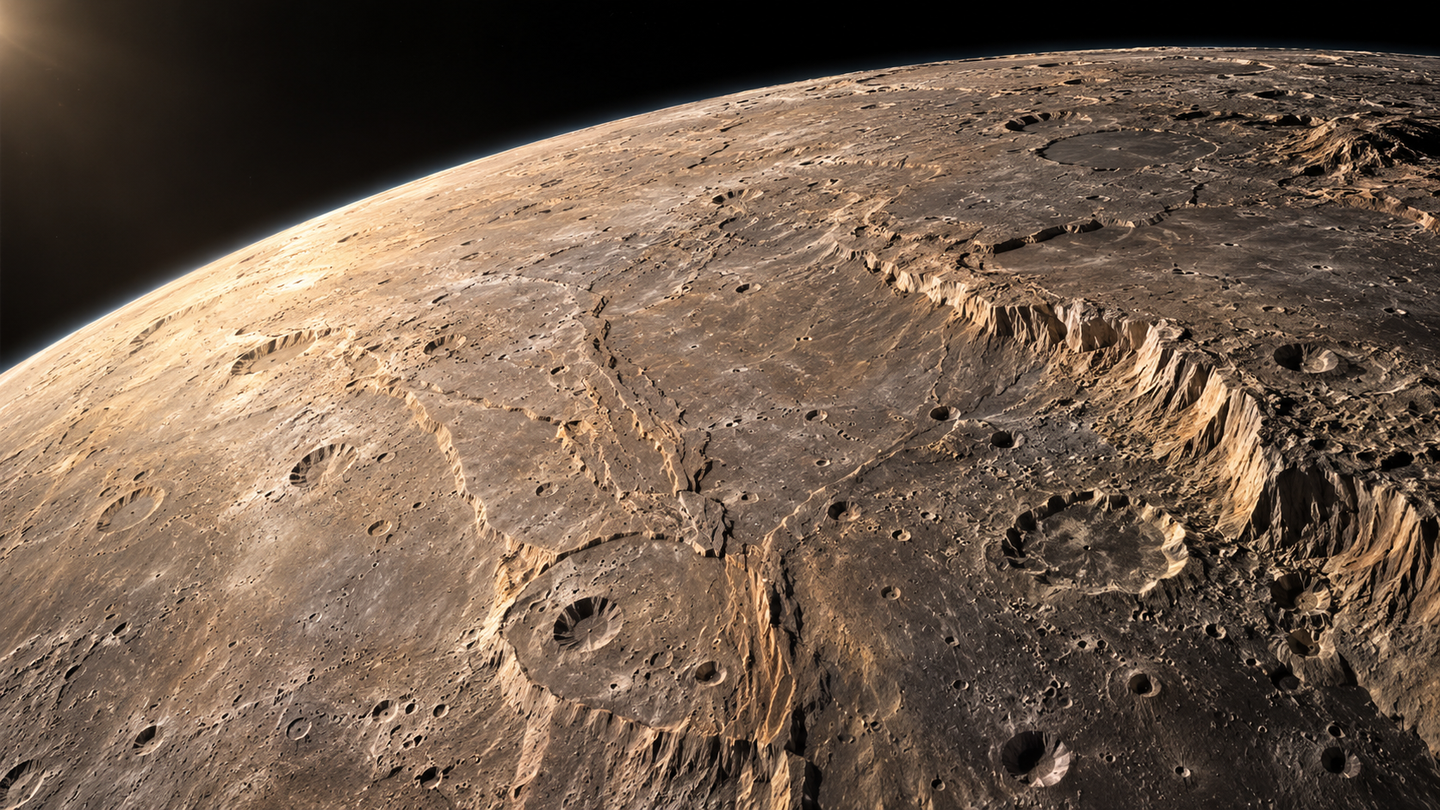
Mercury may have shrunk up to 30% more than estimated because crater debris hides wrinkles created as the planet cooled. (CREDIT: Shutterstock)
- Mercury may have contracted 10% to 30% more than previous tectonic estimates suggested because impact debris and rough terrain can hide the scarps and ridges created as the planet cooled and shrank.
- After correcting for this missing tectonic record, researchers estimate Mercury may have lost as much as 11.6 kilometers in radius, equivalent to roughly 23 kilometers, or 14.5 miles, from its diameter.
- The revised contraction could change models of Mercury’s enormous metallic core, chemical composition and thermal history, while upcoming BepiColombo observations should reveal smaller tectonic features that NASA’s MESSENGER mission could not resolve.
Mercury has spent billions of years slowly squeezing itself smaller. The evidence appears across its surface as towering scarps, ridges and other wrinkles created when the planet’s interior cooled and contracted.
Scientists have traditionally measured those features to estimate how much Mercury has shrunk. New research suggests part of that geological record has effectively disappeared beneath a landscape battered by later asteroid impacts.
A study published in Geophysical Research Letters finds that Mercury’s radial contraction may have been underestimated by 10% to 30%. Lead author Gaku Nishiyama of the Institute of Space Research, German Aerospace Center (DLR) and the Department of Cosmosciences, Hokkaido University and colleagues found that the planet’s roughest areas contain fewer identifiable contraction features, suggesting crater debris and other processes can obscure the evidence.
Their roughness-based correction raises one estimate of Mercury’s radial contraction from 8.3 kilometers to 11.6 kilometers. That corresponds to a loss of about 23 kilometers, or 14.5 miles, from the planet’s total diameter.
“30% is a little bit surprising, but the corrected amount of contraction actually makes sense to me,” Nishiyama said.
A cooling planet wrinkles as it gets smaller
Mercury formed about 4.5 billion years ago during the chaotic assembly of the Solar System. Collisions among early planetary bodies generated immense amounts of heat, leaving the young planet far hotter than it is today.
Mercury has been releasing that heat ever since. Cooling caused its interior to contract, including changes associated with its exceptionally large metallic core. The rigid outer layers could not simply disappear as the planet became smaller.
Instead, the crust was compressed.
That compression produced thrust faults, wrinkle ridges and enormous cliff-like structures known as lobate scarps. Some stretch for hundreds of kilometers. Together, these shortening structures provide a geological record of how much the planet contracted.
Previous studies produced a wide range of estimates. Depending on which structures were counted and how their geometry was interpreted, published values ranged from roughly one or two kilometers of radial contraction to around seven kilometers.
More recent global strain estimates have pushed that value higher. Yet one underlying assumption remained: enough of Mercury’s original contractional landscape has survived and can still be recognized.
The new study questions that assumption.
Craters may have buried part of the evidence
If global cooling squeezed Mercury more or less uniformly, researchers would expect contractional structures to be broadly distributed across the planet.
Instead, their distribution is patchy.
Some regions contain long and prominent scarps, while other areas seem unusually deficient in them. Nishiyama and his colleagues compared global maps of shortening structures with a recently developed map of Mercury’s surface roughness.
A striking pattern emerged.
The roughest landscapes generally contained fewer mapped contractional structures. That anti-correlation appeared across both smooth and cratered plains and persisted across regional scales extending hundreds of kilometers.
Large, comparatively young impact craters offered a possible explanation. When an asteroid strikes Mercury, it excavates material and throws debris across the surrounding landscape. Thick blankets of ejecta can bury older features beneath them.
Around craters including Rachmaninoff, the researchers found evidence consistent with this process. Some long contractional structures become less pronounced as they approach rough impact deposits, as though their relief has been progressively covered.
“It made us think that there’s a process obscuring shortening structures,” Nishiyama said.
Rough terrain creates more than one problem
Burial by crater ejecta is not the only possible explanation.
A tectonic ridge can also become difficult to recognize when the landscape surrounding it is already extremely rugged. Once the background topography becomes comparable to the ridge itself, identifying the feature in spacecraft imagery becomes harder.
The researchers considered a third possibility involving Mercury’s regolith. Heavily cratered terrain may contain thick, porous material capable of absorbing some contraction through collapsing pore spaces rather than forming large, easily visible faults.
More than one mechanism may be operating.
The team therefore did not simply assume every missing fault had been buried. Instead, it used the observed relationship between roughness and measured contraction to estimate how strongly rough terrain could bias global contraction measurements.
The correction suggested previous estimates based on visible tectonic structures could be low by roughly 10% to 30%.
When all mapped shortening structures were considered, a previous global estimate of 8.3 kilometers of radial contraction increased to 11.6 kilometers.
The researchers caution that this figure depends partly on whether smaller tectonic structures resulted from global cooling rather than local geological forces. Even so, analyses restricted to the most important primary structures showed the same underlying bias.
Mercury’s interior may need to be reconsidered
A few additional kilometers of contraction matter because Mercury’s shrinking surface records what happened deep inside the planet.
“More shrinking means Mercury could have a larger metal core, less light elements like silicon mixed into the metal core, or a higher starting temperature,” Nishiyama said.
Cooling models also depend on the abundance of radioactive, heat-producing elements, the thickness of insulating regolith and the composition of the core.
The revised contraction estimate may favor different combinations of those properties than older estimates did. The study suggests lower abundances of some heat-producing materials, a thinner regolith or lower sulfur concentrations in the core could better fit the larger amount of contraction.
The researchers describe their correction as a lower limit rather than a final answer. Volcanic deposits could have buried additional tectonic structures, while some contractional strain may never have produced easily recognizable surface faults.
BepiColombo could uncover Mercury’s missing wrinkles
Current understanding depends heavily on data returned by NASA’s MESSENGER spacecraft, which orbited Mercury from 2011 until 2015.
Its global topographic record cannot reliably expose the smallest tectonic structures across the entire planet. That leaves open the possibility that many contraction features remain undetected.
ESA and JAXA’s BepiColombo mission should dramatically improve that picture. Its BepiColombo Laser Altimeter, or BELA, will measure Mercury’s surface at far finer scales and provide new information about topography and roughness.
Those observations could reveal scarps hidden below the resolution of existing maps and help researchers distinguish genuinely fault-poor regions from places where the geological evidence has simply been masked.
The lesson may extend beyond Mercury. Rough surfaces on the Moon could likewise conceal part of its contractional history, while Mars may present a more complicated version of the same problem.
Mercury’s wrinkles have long told scientists that the planet shrank. The new findings suggest billions of years of impacts may have hidden enough of them to make the smallest planet considerably more contracted than it first appeared.
Dig deeper into Mercury’s shrinking surface
These studies explore Mercury’s contraction, surface roughness, tectonic structures and the BepiColombo measurements that could refine its geological history.
Mercury’s global contraction much greater than earlier estimates: Used MESSENGER observations to show that Mercury contained far more contractional deformation than earlier mapping revealed, raising its estimated radial contraction to as much as seven kilometers. (Nature Geoscience, 2014)
First Global Map of Mercury’s Surface Roughness Down to Kilometric Baselines: Implications for the Planet’s Geologic Evolution: Produced the global roughness dataset that allows scientists to compare Mercury’s impact-modified terrain with tectonic structures across the planet. (The Planetary Science Journal, 2026)
Mercury's Tectonic and Geodynamic History: 1. Contractional Tectonic Landform Analysis and Tectonic Strain Using Machine Learning: Uses global tectonic mapping and topographic analysis to quantify contractional strain, providing an important baseline for revised estimates of Mercury’s shrinking radius. (Journal of Geophysical Research: Planets, 2026)
Mercury has multiple, superposed global tectonic patterns: Analyzes nearly 42,000 fault segments and shows that Mercury’s tectonic record contains multiple overlapping global patterns rather than a single simple distribution. (Earth and Planetary Science Letters, 2025)
The BepiColombo Laser Altimeter: Details BELA’s design and scientific goals, including measurements of Mercury’s topography, surface roughness, tidal deformation and tectonic landforms. (Space Science Reviews, 2021)
Research findings are available online in the journal Geophysical Research Letters.
The original story "Mercury’s cratered surface has been hiding evidence of a much smaller planet" is published in The Brighter Side of News.
Related Stories
- Mercury’s surface chemistry reveals clues to a much hotter volcanic past
- Mercury’s polar water ice may have arrived in one giant impact
- Mercury has a 10-mile-thick layer of diamonds under its surface
Like these kind of feel good stories? Get The Brighter Side of News' newsletter.
Joseph Shavit
Writer, Editor-At-Large and Publisher
Joseph Shavit, based in Los Angeles, is a seasoned science journalist, editor and co-founder of The Brighter Side of News, where he transforms complex discoveries into clear, engaging stories for general readers. With vast experience at major media companies like The Los Angeles Times, Times Mirror and Tribune Publishing, he writes with both authority and curiosity. His writing focuses on space science, planetary science, quantum mechanics, geology. Known for linking breakthroughs to real-world markets, he highlights how research transitions into products and industries that shape daily life.