Nitrogen in 3I/ATLAS reveals an extremely cold birthplace beyond the solar system
Five ions detected in 3I/ATLAS reveal an unusually nitrogen-rich comet whose ices may preserve an extraordinarily cold birthplace.
 Northumbria University Writer: Lea Ferellec

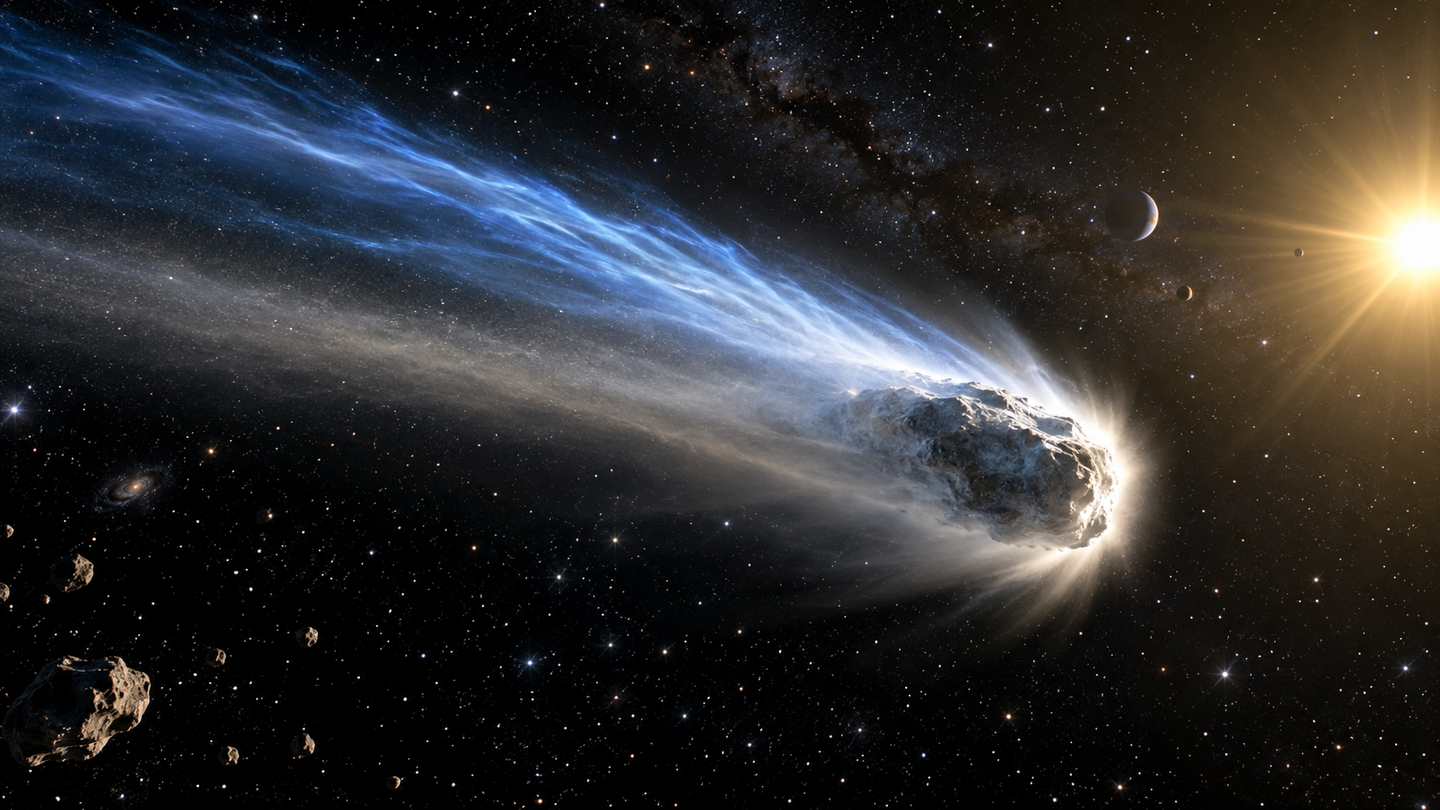
Nitrogen in 3I/ATLAS suggests the interstellar comet formed at roughly 30 kelvins or below in the icy outskirts of another star system. (CREDIT: Shutterstock)
- Astronomers detected five ion species simultaneously in the plasma tail of interstellar comet 3I/ATLAS, including ionized molecular nitrogen, using the WEAVE instrument on the William Herschel Telescope.
- The unusually strong nitrogen signature relative to carbon monoxide points to formation at temperatures of roughly 30 kelvins or below, suggesting the comet assembled in the frigid outer reaches of another planetary system.
- Measurements along the tail also showed that most ion ratios remained stable over the observed distances, while CH+ appeared to decrease slightly, offering an unusually detailed look at plasma chemistry in an interstellar comet.
The third known object to enter our solar system from interstellar space appears to have been born in an environment far colder than the region where many familiar comets formed.
Astronomers studying 3I/ATLAS detected an unusually strong signature of molecular nitrogen in its plasma tail, alongside four other ionized species. The chemical mixture points toward formation in temperatures around 30 kelvins or lower, roughly minus 243 degrees Celsius.
The findings come from researchers led by Northumbria University, with collaborators including the University of Edinburgh. Their paper, “Ion abundances in the plasma tail of 3I/ATLAS show that it is N2-rich,” was published in Monthly Notices of the Royal Astronomical Society.
“This object gives us a rare chance to study material that formed somewhere completely different from our own solar system,” said lead researcher Lea Ferellec of Northumbria University. “Finding that it's so rich in nitrogen tells us it likely formed in extremely cold conditions, far from its home star.”
Five ions appeared in the same interstellar tail
3I/ATLAS was discovered on July 1, 2025, becoming only the third confirmed interstellar object after 1I/‘Oumuamua and 2I/Borisov.
Unlike ‘Oumuamua, 3I showed obvious cometary activity. As sunlight heated its surface, gases escaped and created a coma surrounding the object. Charged particles interacted with the solar wind and were swept into a plasma tail pointing roughly away from the Sun.
Researchers observed that tail on Nov. 30 and Dec. 2, 2025, after the comet had passed perihelion.
They used the Large Integral Field Unit mode of WEAVE, the WHT Enhanced Area Velocity Explorer, installed on the 4.2-meter William Herschel Telescope. Each observing session consisted of three consecutive 1,020-second exposures.
Instead of recording a spectrum through a narrow slit, the integral-field instrument collects spectral information across a two-dimensional area. That allowed the team to separate the ion tail spatially from the dust and neutral gas surrounding the comet.
The observations revealed N2+, CO+, CO2+, H2O+ and CH+ at the same time. Individual ion species had not previously been spectroscopically characterized this way in an interstellar comet.
Nitrogen preserved a clue from another planetary system
The most revealing species was ionized molecular nitrogen, N2+.
Molecular nitrogen is difficult to retain in cometary ice because it is extremely volatile. How efficiently N2 becomes trapped relative to carbon monoxide depends strongly on temperature.
That makes the relative abundance of nitrogen and carbon monoxide a potential thermometer for the environment in which cometary ice originally formed.
The researchers measured an N2+/CO+ abundance ratio of about 2.3% in the plasma tail. Because ion production and coma chemistry are complicated, the measured ions cannot simply be treated as an exact copy of the original neutral ice composition.
Still, N2+ and CO+ provide a particularly useful comparison because their neutral parent molecules behave similarly during photoionization.
The resulting nitrogen enrichment places 3I/ATLAS among a small number of unusually nitrogen-rich comets. The researchers concluded that its ices likely formed under exceptionally cold conditions.
That interpretation agrees with other chemical evidence within the comet itself, while the new work reaches the conclusion through an independent part of its chemistry.
A birthplace far from its star
A temperature near or below 30 kelvins would place the comet's formation environment in an exceptionally cold region.
In a young planetary system, temperatures generally decrease with distance from the central star. The finding therefore suggests that 3I/ATLAS assembled in the remote outer portions of the disk of gas, dust and ice that surrounded its original star.
Such regions contain volatile compounds that would evaporate closer to a star.
The comet may consequently preserve material from a part of another planetary system that astronomers cannot directly sample. At some point after its formation, gravitational interactions presumably expelled the object into interstellar space, beginning the journey that eventually carried it through our solar system.
3I/ATLAS therefore functions as more than a passing visitor. Its ices are a physical sample of the chemical conditions that existed during planet formation around another star.
“Every one of these objects we study helps us understand a little more about how planets form around other stars,” Ferellec said.
The tail revealed another layer of chemistry
The researchers also investigated whether the chemical mixture changed as ions traveled farther from the nucleus.
They divided observations from Dec. 2 into regions closer to and farther from the comet, then compared the abundance ratios.
For N2+, CO+, CO2+ and H2O+, the team detected no significant changes within the uncertainties. That stability is particularly useful for the nitrogen-to-carbon-monoxide comparison because it suggests the measured ratio was not strongly dependent on where along the observed section of tail it was sampled.
CH+ behaved differently.
Its abundance appeared to decline relative to the other ions farther along the tail. The trend was only marginally significant, so the researchers do not regard it as a firm detection of chemical evolution.
Even so, the result demonstrates what spatially resolved spectroscopy could reveal about how cometary ions are created, destroyed and transported through plasma tails.
A new tool for studying interstellar visitors
Comet ion tails remain difficult observational targets. Bright dust, neutral gases, viewing geometry and weak emission lines can all hide the charged species astronomers want to measure.
WEAVE's wide integral-field view helped overcome that limitation by letting researchers compare a region containing the plasma tail with a corresponding region on the Sun-facing side of the coma. Subtracting those signals helped isolate the faint ion emissions.
“This discovery is a perfect example of the value of DDT, which is specifically designed to enable observations of exceptional and urgent scientific importance,” said Isaac Newton Group Director Rubén Sánchez-Janssen.
Only three confirmed interstellar objects have been found, making it impossible to know how representative any one of them is.
Yet every new visitor offers something unavailable from ordinary astronomical observations: matter that formed inside another planetary system and then arrived close enough for detailed examination.
For 3I/ATLAS, molecular nitrogen has now added an especially valuable clue. The comet appears to carry the chemical memory of an extraordinarily cold birthplace, preserved through its long journey between the stars.
Dig deeper into 3I/ATLAS and interstellar comets
These studies explore the composition, temperature history and discovery of 3I/ATLAS, along with what an earlier interstellar comet revealed about planet formation beyond our solar system.
Isotopic evidence for a cold and distant origin of 3I/ATLAS: Measurements of hydrogen and carbon isotopes independently indicate that 3I/ATLAS formed under extremely cold conditions in an environment chemically unlike the modern solar system. (Nature, 2026)
Water D/H in 3I/ATLAS as a probe of formation conditions in another planetary system: Uses the comet's unusually high water deuterium-to-hydrogen ratio to investigate whether its ices formed in a colder prestellar environment or the outer regions of its original planetary disk. (Nature Astronomy, 2026)
High nitrogen and carbon isotopic ratios in the interstellar comet 3I/ATLAS: Very Large Telescope measurements use nitrogen and carbon isotope ratios to support an origin in the outer disk of an older, lower-metallicity stellar system. (Nature Astronomy, 2026)
Research findings are available online in the journal Monthly Notices of the Royal Astronomical Society.
The original story "Nitrogen in 3I/ATLAS reveals an extremely cold birthplace beyond the solar system" is published in The Brighter Side of News.
Related Stories
- Interstellar comet 3I/ATLAS may come from a solar system much older than our own
- 12 billion years old interstellar comet 3I/ATLAS may be older than the solar system
- SETI checked 3I/ATLAS for alien signals — Here’s what they found
Like these kind of feel good stories? Get The Brighter Side of News' newsletter.
Joseph Shavit
Writer, Editor-At-Large and Publisher
Joseph Shavit, based in Los Angeles, is a seasoned science journalist, editor and co-founder of The Brighter Side of News, where he transforms complex discoveries into clear, engaging stories for general readers. With vast experience at major media companies like The Los Angeles Times, Times Mirror and Tribune Publishing, he writes with both authority and curiosity. His writing focuses on space science, planetary science, quantum mechanics, geology. Known for linking breakthroughs to real-world markets, he highlights how research transitions into products and industries that shape daily life.