NASA’s Juno spacecraft finds temperatures surging just below Io’s volcanic surface
Microwave readings show Io grows more than 40 degrees warmer within several feet of its volcanic surface.
 SWRI Writer: Mike W. Thomas

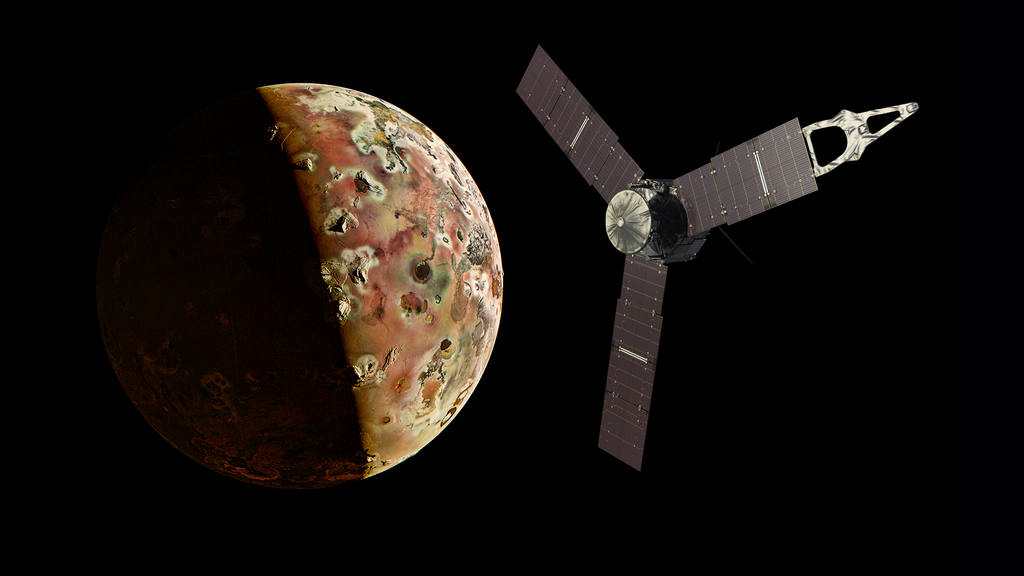
NASA’s Juno spacecraft made the first direct measurements of the temperature beneath the surface of Jupiter’s moon Io using the Microwave Radiometer, (MWR), invented and designed by Southwest Research Institute’s Dr. Scott Bolton. (CREDIT: NASA/JPL-Caltech/SwRI/MSSS/Thomas Thomopoulos)
- NASA’s Juno spacecraft measured heat beneath Io’s surface for the first time, finding temperatures rise sharply within just a few feet.
- The data suggest heat may move through Io’s crust far faster than on Earth, or come from widespread lava flows buried beneath solid rock.
- The measurements could help scientists understand tidal heating, a process that powers volcanoes and may also sustain oceans inside icy moons.
Io’s surface may look frozen in place from afar, but just below it, temperatures climb sharply. NASA’s Juno spacecraft has now measured that buried heat directly, exposing a world still being reshaped from within.
Data from Juno’s Microwave Radiometer, or MWR, show temperatures rising by more than 40 degrees Fahrenheit within only a few feet of the surface. The measurements came from two close flybys in late 2023 and early 2024.
The results, published in the Journal of Geophysical Research: Planets, mark the first direct measurements of Io’s subsurface temperature. They also offer a new way to examine how the moon releases the enormous heat generated inside it.
Southwest Research Institute’s Scott Bolton, Juno’s principal investigator and a co-author of the paper, designed the radiometer to probe beneath Jupiter’s cloud tops. During Juno’s extended mission, the instrument also examined Ganymede, Europa and Io.
“The Juno microwave radiometer directly observed Io’s heat output by looking below the surface,” Bolton said. “The discovery that we could see below the surface of a rocky moon was a surprise with potentially important implications for the study of Earth’s volcanoes.”
Heat rises beneath a thin surface layer
Io is the most volcanically active body in the solar system. Its heat comes from tidal forces created as Jupiter’s gravity repeatedly stretches and squeezes the moon along its elliptical orbit.
That process is intensified by Io’s orbital relationship with Europa and Ganymede. The constant deformation produces far more internal heating than Earth experiences.
Earlier observations mostly relied on infrared instruments. Those measurements could detect surface temperatures, including lava fountains hotter than 1,400 kelvins, but they usually reached only millimeters or centimeters below the ground.
Juno’s radiometer uses six microwave frequencies between 0.6 and 22 gigahertz. Each frequency penetrates to a different depth, from inches to tens of feet.
“At Ganymede and Europa, we probed tens of miles into their ice shells. At Io, the MWR measured thermal emissions at depths ranging from a few inches down to tens of feet,” Bolton said.
Juno passed within 1,494 kilometers of Io on Dec. 30, 2023, then within 1,506 kilometers on Feb. 3, 2024. Together, the flybys sampled much of the Jupiter-facing side.
Everywhere the instrument looked, temperatures increased sharply beneath the surface.
“That is a gradient far steeper than solar heating alone can explain,” said Shannon Brown, a senior research scientist at NASA’s Jet Propulsion Laboratory and the paper’s lead author.
A surface closer to ash than rock
The microwave data also revealed an unexpectedly smooth surface at large scales. Its reflective behavior resembled a specular surface, meaning it reflected microwave energy in a more mirror-like way than a rough, diffusely scattering landscape would.
The measurements produced dielectric values lower than expected for solid rock. From those values, the team estimated a bulk density of about 0.7 to 1.1 grams per cubic centimeter in the upper surface layer.
That range is consistent with volcanic ash, pumice or scoria, all porous materials formed during eruptions. Solid basalt would be much denser.
The upper layer may also be extremely porous. The analysis suggests porosity near 85% for pure basalt or about 75% for pure sulfur under the model assumptions.
Lower microwave frequencies appeared to encounter denser material deeper below the surface. That pattern suggests a loose, low-density layer may rest on a more compact substrate several meters down.
The shallowest microwave channel showed little variation with local time. Unlike infrared measurements, it did not record a sharp warming after sunrise.
That supports earlier evidence from ALMA and ground-based eclipse observations that Io has a very thin surface coating with low thermal inertia. Such a layer heats and cools quickly, while the microwaves pass through it and record the steadier temperatures below.
Two possible paths for Io’s escaping heat
The strongest temperature increase appeared between the two lowest microwave frequencies. Those channels can sample several meters below the surface, with some of the signal coming from the upper tens of meters.
The team considered two main explanations.
One possibility is that heat moves steadily upward through the crust by conduction. Under the model assumptions, that process would produce heat flows of roughly 1 to 3 watts per square meter.
That range fits estimates of Io’s global tidal heat output, which place the moon’s average surface heat flux near 2 to 3 watts per square meter. Earth’s average is about 0.06 watts per square meter.
The conductive model also suggested heat flow may increase toward higher latitudes. However, the calculation depends on uncertain values for thermal conductivity and microwave absorption.
The second possibility involves cooling lava flows. In one example, lava covered about 8.5% of the observed area beneath an 11-meter-thick crust that had cooled for three years.
This model reproduced much of the measured microwave pattern. It also matched estimates that fresh lava flows cover about 8% of Io’s surface.
Neither model fully explained the data. Both predicted a smoother temperature increase across the frequencies than Juno observed.
The mismatch could mean the temperature gradient changes with depth. It could also mean the material absorbs microwaves differently at different frequencies.
Practical implications of the research
The measurements give scientists a new tool for studying heat below the surfaces of rocky and icy worlds. Microwave radiometry can reach depths that infrared instruments cannot.
For Io, future observations could map where heat escapes and test whether conduction or cooling lava dominates in different regions. Higher-resolution instruments with more frequencies and dual polarization could sharpen those comparisons.
The technique may also help researchers investigate tidal heating on ocean worlds. The same process that powers Io’s volcanoes can maintain buried oceans inside moons such as Europa and Enceladus.
“Io provides a unique window into learning how tidal heating works throughout the cosmos, a fundamental process that provides energy and heat to worlds that are far from their parent star,” Bolton said.
Research findings are available online in the journal Journal of Geophysical Research: Planets.
The original story "NASA's Juno spacecraft finds temperatures surging just below Io’s volcanic surface" is published in The Brighter Side of News.
Related Stories
- Jupiter’s volcanic moon, Io, hides intense heat beneath its porous crust
- NASA spots colossal eruptions shaking Io — Jupiter’s most volcanic moon
- Jupiter's volcanic moon Io is burning much hotter than expected
Like these kind of feel good stories? Get The Brighter Side of News' newsletter.
Joseph Shavit
Writer, Editor-At-Large and Publisher
Joseph Shavit, based in Los Angeles, is a seasoned science journalist, editor and co-founder of The Brighter Side of News, where he transforms complex discoveries into clear, engaging stories for general readers. With vast experience at major media companies like The Los Angeles Times, Times Mirror and Tribune Publishing, he writes with both authority and curiosity. His writing focuses on space science, planetary science, quantum mechanics, geology. Known for linking breakthroughs to real-world markets, he highlights how research transitions into products and industries that shape daily life.