New cosmic simulation recreates the Universe’s earliest moments in unprecedented detail
The Lumina simulation follows galaxies, gas and radiation across the early universe, helping astronomers test how hydrogen and helium were transformed by light.
 Smithsonian Writer: Benjamin Marcus

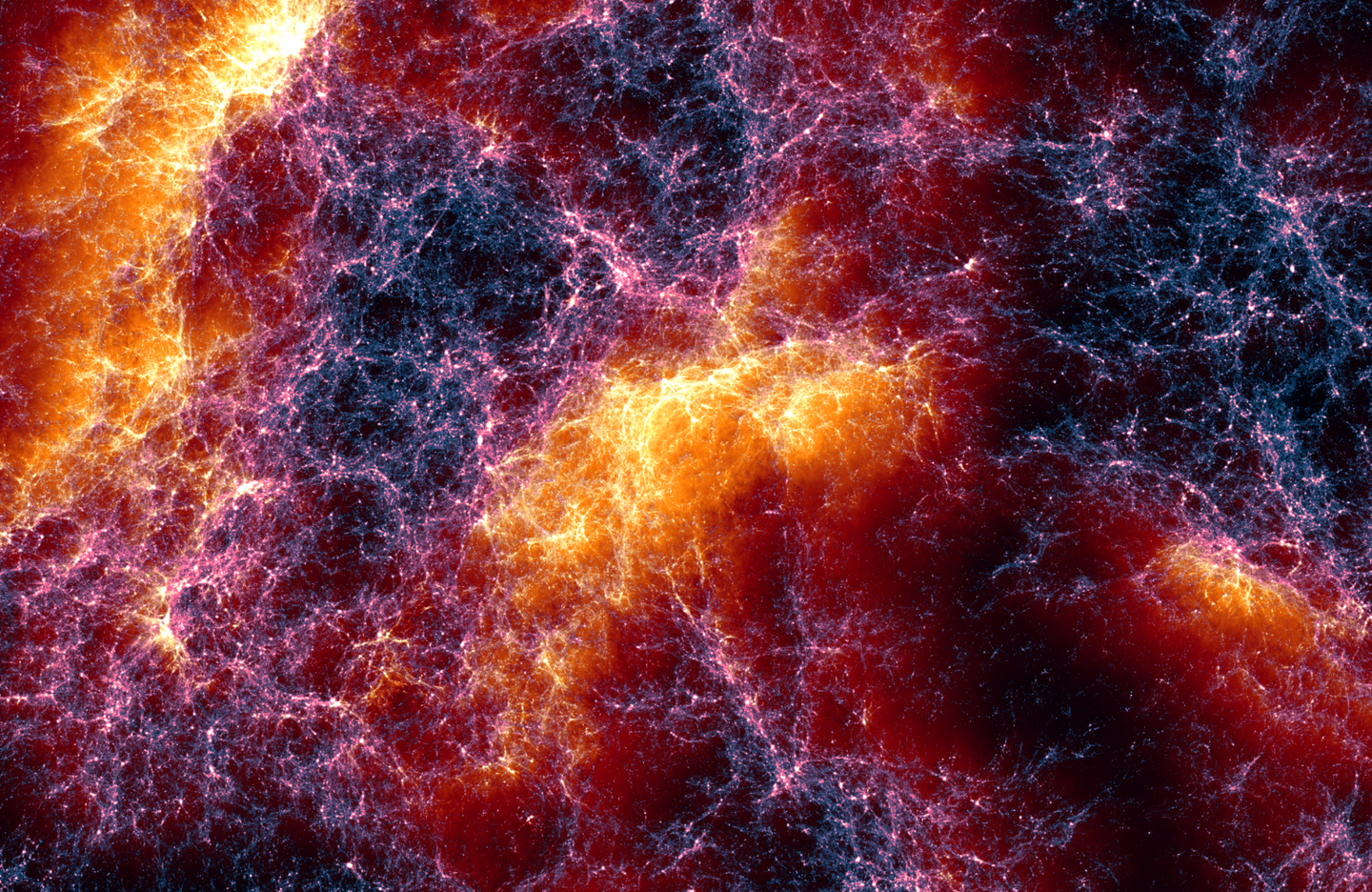
A Lumina simulation reveals 650 million light-years of the cosmic web, with dark matter filaments connecting galaxy clusters and orange-yellow regions highlighting the fastest-moving gas. (CREDIT: Oliver Zier, Center for Astrophysics | Harvard & Smithsonian)
- Lumina models how galaxies and radiation transformed the universe during its first 2 billion years.
- The simulation follows gas and dark matter across a cube 500 comoving megaparsecs wide, including hydrogen and helium reionization.
- Comparisons with telescope observations could test its predictions, although its results depend on calibrated models and computational approximations.
Light from the first galaxies did more than illuminate a dark universe. It stripped electrons from surrounding gas, heated enormous regions of space and changed the conditions in which later galaxies grew. A simulation called Lumina now follows those connected changes across a volume large enough to include widely different cosmic neighborhoods.
Developed by an international team led by researchers at the Center for Astrophysics | Harvard & Smithsonian, Lumina traces roughly the first 2 billion years of cosmic history. The study appears in Monthly Notices of the Royal Astronomical Society. Its purpose is to turn ideas about galaxy formation into predictions astronomers can compare with observations.
Those comparisons matter as the James Webb Space Telescope examines increasingly distant galaxies. NASA’s Nancy Grace Roman Space Telescope will eventually add broad surveys, although it remained in commissioning in the agency’s October update. Lumina offers a framework for interpreting these complementary views without assuming that every unexpected observation requires new physics.
Following matter and light together
The simulation combines gravity, gas motion and radiation transport, the movement of light through matter. Dark matter contributes gravitational attraction, while ordinary matter supplies the gas from which stars form. Radiation from stars and material falling toward black holes then alters that gas.
These processes influence one another throughout cosmic evolution. Galaxies produce light that heats nearby material, while changes in gas temperature affect how that material behaves. Calculating radiation alongside the evolving matter allows those effects to feed back into the simulation as it runs.
Lumina uses the AREPO simulation code and a galaxy formation framework developed for IllustrisTNG. The team added radiation calculations designed to run efficiently on graphics processors. Together, these tools connect the formation of luminous objects with changes in the much larger spaces between them.
The model does not start with the Big Bang itself. It begins later, before the first galaxies have transformed their surroundings, and continues until the universe is about 2 billion years old. That interval includes major changes in hydrogen and helium, the two most abundant elements.
A bigger patch of the early universe
Lumina’s simulated cube measures 500 comoving megaparsecs on each side, equivalent to about 1.6 billion light-years. Comoving distances account for cosmic expansion, allowing researchers to compare the same region across different epochs. The number therefore does not describe its physical width at every moment in the calculation.
Within that volume, the flagship run begins with 432 billion computational elements representing gas and dark matter. These are numerical building blocks, not individually simulated atoms or stars. Each gas element initially represents millions of solar masses, requiring models for processes occurring below the simulation’s resolution.
The volume is about 144 times that of the flagship Thesan reionization simulations, an important predecessor. However, Lumina’s mass resolution is coarser than Thesan’s highest-resolution run. Its advance lies in combining a much larger region with evolving radiation, rather than improving every measure of detail simultaneously.
That larger region helps researchers include environments that smaller boxes might miss. Crowded galaxy concentrations and sparsely populated regions need not undergo the same changes at the same time. Sampling both makes it easier to study large patterns without mistaking one unusual neighborhood for the universe as a whole.
The broader view also helps connect calculations with surveys covering substantial areas of sky. Rare, bright objects can have effects that extend far beyond their host galaxies. A simulation needs enough room to include such sources while still tracking how their surroundings respond.
Two elements with different histories
After the early universe cooled, much of its hydrogen existed as neutral atoms, each carrying an electron. Energetic radiation from early stars could knock those electrons free. Astronomers call this transformation reionization because matter had also been ionized much earlier in cosmic history.
In Lumina, hydrogen reionization spreads unevenly. Ionized regions grow around galaxies and merge, while some remote areas remain neutral longer. The resulting pattern reflects both the locations of light sources and the obstacles their radiation encounters.
Helium adds another stage to the story because its atoms can lose two electrons. The first is removed broadly alongside hydrogen reionization. Removing the second requires more energetic radiation, supplied mainly by active galactic nuclei, where gas falling toward supermassive black holes releases intense light.
Lumina follows this later helium transformation within the same evolving calculation, including its heating effects on surrounding gas. Earlier comparable simulations often stopped before this stage could develop. Tracking both elements connects different periods of cosmic history instead of treating each transformation as an isolated event.
What a successful comparison would mean
The model produces a patchwork of temperatures, densities and ionization states that astronomers can test against evidence. Light from distant objects carries information about intervening gas because atoms absorb particular wavelengths. These absorption patterns provide a way to investigate material too faint to image directly.
Lumina’s predicted thermal history and radiation background broadly agree with existing constraints. Its calculation of how free electrons scatter ancient background light also agrees with measurements from the Planck mission. Such comparisons help assess whether the simulation gives a plausible account of the early universe.
However, agreement does not make every result an independent prediction. The researchers calibrated aspects of the model, including how much ionizing radiation escapes galaxies, using observational constraints on hydrogen reionization. Other ingredients describe unresolved processes through simplified rules rather than following every physical interaction directly.
Computational shortcuts introduce additional uncertainties. For example, the calculation uses a reduced speed of light, an approximation that can affect when distant neutral regions become ionized. A disagreement with observations would therefore require researchers to examine these assumptions before concluding that fundamental laws need revision.
Realistic comparisons also require distinguishing simulated properties from observable quantities. A telescope measures light filtered by distance, intervening material and the instrument itself. Researchers must calculate those effects before comparing a model’s galaxy population or gas distribution with a particular dataset. That step helps establish whether an apparent discrepancy concerns the physics or the measurement.
Building tests for the next surveys
Running Lumina required 1,884 nodes of the Frontier supercomputer at Oak Ridge National Laboratory in Tennessee. The configuration included 105,504 CPU cores and 7,536 AMD Instinct MI250X accelerators. That computing capacity made it practical to combine a large cosmic volume with repeated radiation calculations.
Project leader Oliver Zier and colleagues envision Lumina as a platform for further investigations. Researchers can examine gas around galaxies, the distribution of ionized regions and how black hole activity changes their surroundings. Different comparisons will test different parts of the model rather than deliver a single verdict on cosmology.
Future work includes producing simulated observations that account for what real instruments can measure. These could support comparisons with galaxy surveys, absorption measurements and radio experiments seeking signals from neutral hydrogen. The next challenge is to determine whether the same modeled universe can explain those distinct measurements together.
Dig deeper into cosmic reionization
These resources explain the observing tools, earlier simulations and intergalactic gas physics behind the research.
NASA’s Roman Space Telescope Enters Final Commissioning Phase
NASA’s mission update explains Roman’s preparation for science operations, providing context for its future survey role. (NASA, October 2026)
Record-breaking run on Frontier sets new bar for simulating the universe in the exascale era
This account of a separate cosmological simulation explains how Frontier enables calculations combining ordinary matter and dark matter. (Oak Ridge National Laboratory, November 2024)
Introducing the thesan project: radiation-magnetohydrodynamic simulations of the epoch of reionization
The predecessor project demonstrates how galaxy formation and hydrogen reionization can be calculated together, providing a useful comparison with Lumina’s larger volume. (Monthly Notices of the Royal Astronomical Society, December 2021)
The Evolution of the Intergalactic Medium
This review explains how gas between galaxies records the influence of stars, black holes and cosmic expansion. (Annual Review of Astronomy and Astrophysics, July 2016)
The Lumina Project
The project website provides visualizations and an overview of the simulation’s hydrogen and helium reionization research. (Lumina collaboration)
Research findings are available online in the journal Monthly Notices of the Royal Astronomical Society.
The original story "New cosmic simulation recreates the Universe’s earliest moments in unprecedented detail" is published in The Brighter Side of News.
Related Stories
- MEGATRON simulations connect the first stars with the universe’s smallest galaxies
- Supercomputer simulations may finally explain Webb’s mysterious Little Red Dots
- Scientists narrow the search for dark matter using new galaxy simulations
Like these kind of feel good stories? Get The Brighter Side of News' newsletter.
Joseph Shavit
Writer, Editor-At-Large and Publisher
Joseph Shavit, based in Los Angeles, is a seasoned science journalist, editor and co-founder of The Brighter Side of News, where he transforms complex discoveries into clear, engaging stories for general readers. With vast experience at major media companies like The Los Angeles Times, Times Mirror and Tribune Publishing, he writes with both authority and curiosity. His writing focuses on space science, planetary science, quantum mechanics, geology. Known for linking breakthroughs to real-world markets, he highlights how research transitions into products and industries that shape daily life.