New large-sized telescope array in Spain ushers in a new era in exploring the extreme universe
CTAO’s four Large-Sized Telescopes mark construction completion, with commissioning ahead and distant explosions among their targets.
 CTA Observatory Writer: Alba Fernández-Barral

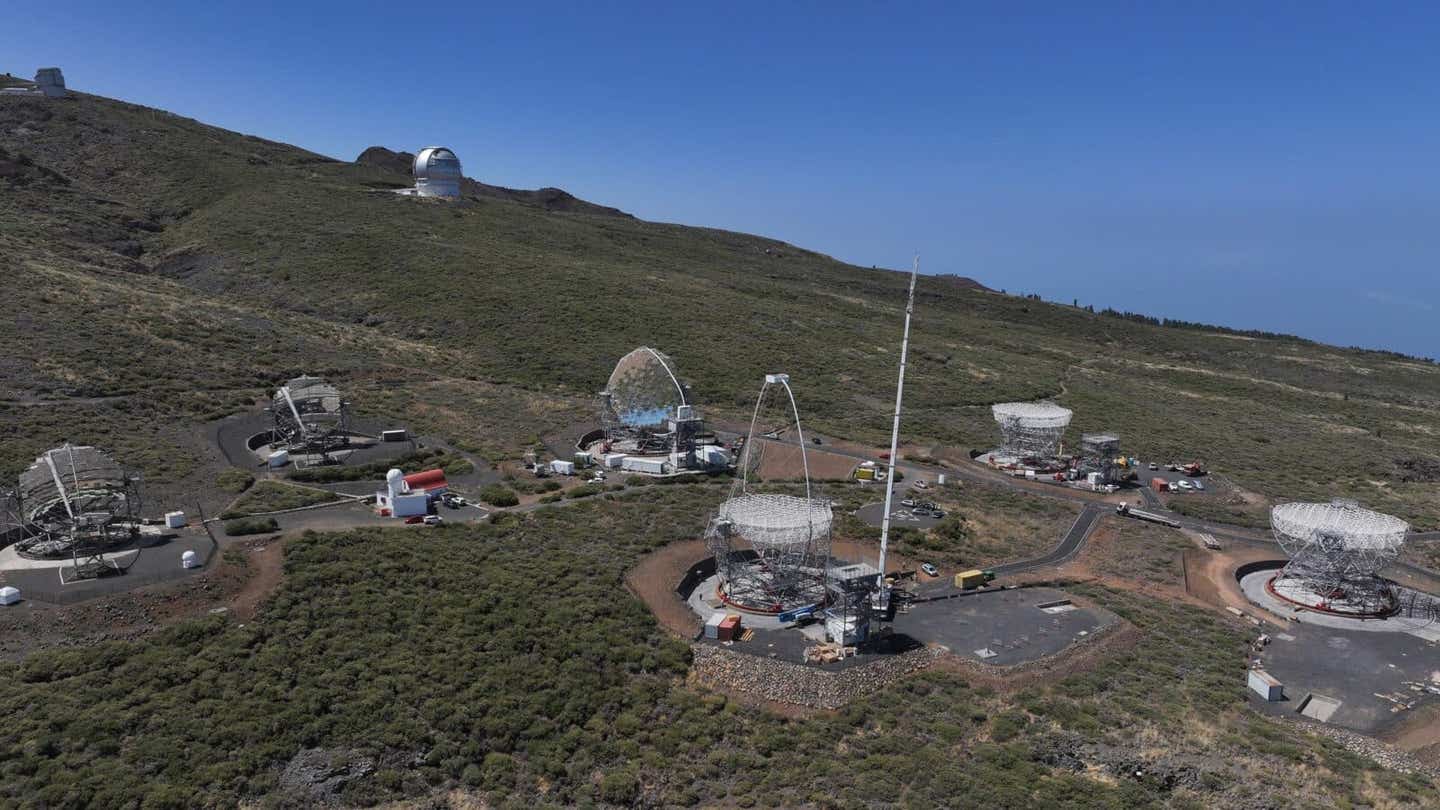
LSTs under construction at the CTAO-North site in La Palma, Spain. (CREDIT: CTAO LST Collaboration)
- Four 23-meter telescopes on La Palma mark the completion of construction for CTAO-North’s Large-Sized Telescope sub-array.
- Their large mirrors and rapid response are designed to capture faint atmospheric flashes from energetic cosmic sources.
- Commissioning and formal acceptance remain ahead, while the first telescope has already produced scientific results.
A brief flash high above a mountain can carry evidence of an explosion billions of years ago. Catching that faint signal requires enormous mirrors, fast cameras and the ability to turn toward a changing sky. Four telescopes on La Palma are bringing that combination to a new stage of development.
The Large-Sized Telescope collaboration marked the inauguration of its four-telescope sub-array on October 15 at Spain’s Roque de los Muchachos Observatory. Around 250 scientists and institutional representatives were expected for the celebration. Each telescope carries a reflector 23 meters across, forming the low-energy core of the Cherenkov Telescope Array Observatory’s northern site.
The milestone completes construction of the four instruments, but does not mean the entire observatory has begun full operations. Technical testing, commissioning and formal acceptance remain necessary. Three new telescopes join LST-1, a prototype that has already demonstrated its scientific value during commissioning.
Reading gamma rays through the atmosphere
The telescopes do not capture cosmic gamma rays directly at ground level. When a high-energy gamma ray enters Earth’s atmosphere, it creates a cascade of secondary particles. Those particles produce a faint flash of Cherenkov light that the mirrors collect and focus onto a camera.
Researchers use those images to infer the original gamma ray’s direction and energy. The atmosphere therefore becomes part of the detection system, rather than simply an obstacle between the telescope and space. The cameras must record a fleeting optical signal instead of making a conventional photograph of a distant object.
Lower-energy gamma rays generate less Cherenkov light, making large collecting areas particularly important. The LSTs are designed to give CTAO sensitivity from approximately 20 gigaelectronvolts to around 3 teraelectronvolts. In that context, “low energy” means the lower end of ground-based gamma-ray astronomy, rather than weak radiation by everyday standards.
Each parabolic reflector provides roughly 400 square meters of reflecting surface. Its camera uses 1,855 photomultiplier tubes to convert arriving light into electrical signals. Together, the optics and electronics allow the instruments to investigate sources too faint or short-lived for less sensitive observations.
Four viewpoints sharpen the picture
LST-1 has operated as a single telescope while the other three instruments were being built. Adding LST-2, LST-3 and LST-4 changes how researchers can observe an atmospheric particle shower. Several telescopes can record the same event from different positions on the ground.
Combining those views helps reconstruct where the shower developed and which direction its initiating gamma ray came from. It also improves estimates of energy and the separation of gamma-ray events from unwanted backgrounds. The collaboration expects substantially better sensitivity and angular resolution than a single instrument can provide.
Speed matters alongside precision. Each telescope stands about 45 meters tall and weighs approximately 100 tonnes, yet can reposition across the sky within 20 seconds. That agility helps it respond when another instrument announces a sudden cosmic event.
Gamma-ray bursts are particularly demanding targets because their brightness can change rapidly. Delayed observations may miss the most informative phase. Rapid movement and a low energy threshold therefore address two different problems: getting to the source quickly and collecting its faintest accessible gamma-ray signal.
The prototype has already delivered results
The first LST was inaugurated in 2018 and began astronomical observations during commissioning in 2019. Its published performance assessment used observations of the Crab Nebula and its pulsar, familiar reference sources in gamma-ray astronomy. The work showed that the prototype reached its expected performance under the conditions studied.
That assessment also illustrates why an instrument’s advertised energy threshold needs context. Researchers estimated a threshold around 20 GeV when events triggered the instrument, rising to approximately 30 GeV after analysis. Useful scientific performance depends on event selection and observing conditions, alongside the telescope’s design.
More distant targets have demonstrated its reach. LST-1 detected very-high-energy emission from the quasar OP 313 during a bright flare in December 2023. Subsequent work, published in Astronomy & Astrophysics in 2026, combined observations with the nearby MAGIC telescopes to investigate the source and its emission.
OP 313 has a redshift of 0.997, and the detected radiation traveled for roughly eight billion years. Those observations provide a demonstrated example of the prototype’s ability to investigate distant activity. They also offer a foundation for the more ambitious observations planned with the complete LST sub-array.
Why a lower threshold opens a deeper view
Distance creates a particular difficulty for gamma-ray astronomy. High-energy gamma rays can interact with background light between galaxies and be absorbed before reaching Earth. The effect increasingly limits which distant sources remain observable at very high energies.
Access to lower energies helps astronomers work around that barrier. The LST collaboration hopes to detect sufficiently bright gamma-ray bursts at redshifts around four. Such sources would probe an era roughly 12 billion years ago, when the universe was less than two billion years old.
That reach is a scientific goal, rather than a guaranteed distance limit or a completed observation. Success will depend on a burst’s brightness, spectrum, timing and visibility from La Palma. It would nevertheless extend studies of energetic explosions into a much earlier period of cosmic history.
Other targets include supermassive black holes, neutron stars and environments that accelerate cosmic particles. The wider observatory will also search for possible signals associated with dark matter. Those searches test hypotheses about unseen matter rather than assuming that a detectable gamma-ray signature must exist.
Commissioning comes before routine observations
The next stage is to verify the instruments and integrate them into CTAO operations. The observatory’s central organization must formally accept the telescopes after the required technical work. Their inauguration marks progress toward that process rather than its completion.
The four LSTs are also only one part of the planned observatory. CTAO envisages more than 60 telescopes across northern and southern sites, with the southern array in Chile’s Atacama Desert. Different telescope sizes will cover complementary portions of its planned 20 GeV–300 TeV range.
The project intends to operate through observing proposals and provide public access to high-level scientific data and software. That approach will allow researchers beyond the construction collaborations to pursue their own questions. For now, the immediate task is to turn four completed instruments into a calibrated array that can reliably distinguish cosmic signals from the atmosphere’s fleeting flashes.
Dig deeper into ground-based gamma-ray astronomy
These resources explain the instrument design, demonstrated performance and science behind the new array.
Observations of the Crab Nebula and Pulsar with the Large-Sized Telescope Prototype of the Cherenkov Telescope Array: Presents the prototype’s measured performance and explains how energy thresholds depend on analysis. (The Astrophysical Journal, 2023)
Performance of the joint LST-1 and MAGIC observations evaluated with Crab Nebula data: Demonstrates analysis methods that combine observations from several Cherenkov telescopes. (Astronomy & Astrophysics, 2023)
A detailed study of the very high-energy Crab pulsar emission with the LST-1: Examines the prototype’s observations of a rapidly rotating neutron star. (Astronomy & Astrophysics, 2024)
LST-1 and MAGIC Telescopes Shatter Distance Record for the Very High-Energy Blazar OP 313: Explains the distant-quasar observations and their implications for light traveling across the universe. (CTAO LST Collaboration, 2026)
Science with the Cherenkov Telescope Array: Sets out the observatory’s science program, including cosmic accelerators, transient events and searches for new physics. (World Scientific, 2019)
The original story "New large-sized telescope array in Spain ushers in a new era in exploring the extreme universe" is published in The Brighter Side of News.
Related Stories
- Canadian radio telescope (CHIME) is turning hydrogen into a map of cosmic expansion
- Before MeerKAT, South Africa's Karoo telescope had its own ways of reading the stars
- NASA’s Roman Space Telescope launches to map billions of galaxies and hunt distant worlds
Like these kind of feel good stories? Get The Brighter Side of News' newsletter.
Joseph Shavit
Writer, Editor-At-Large and Publisher
Joseph Shavit, based in Los Angeles, is a seasoned science journalist, editor and co-founder of The Brighter Side of News, where he transforms complex discoveries into clear, engaging stories for general readers. With vast experience at major media companies like The Los Angeles Times, Times Mirror and Tribune Publishing, he writes with both authority and curiosity. His writing focuses on space science, planetary science, quantum mechanics, geology. Known for linking breakthroughs to real-world markets, he highlights how research transitions into products and industries that shape daily life.