
Silicon spin qubits reach 99.99% fidelity bringing larger quantum processors into reach
A five-qubit silicon experiment tackles microwave interference, helping quantum processors work accurately in parallel.
 RIKEN Writer: Jens Wilkinson

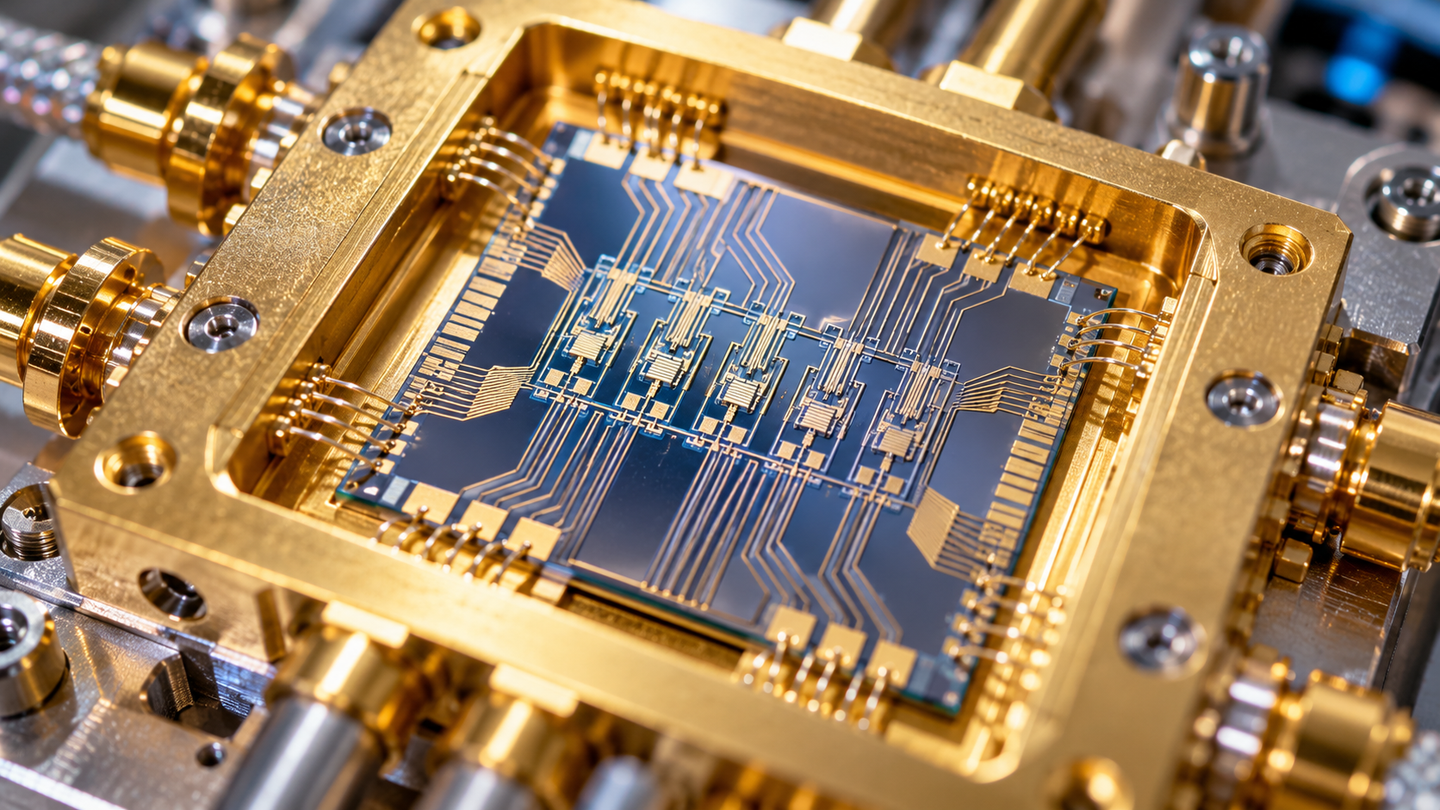
Five silicon spin qubits share a microwave line, with new calibration preserving high accuracy during simultaneous operations. (CREDIT: The Brighter Side of News)
- A five-qubit silicon device maintained highly accurate single-qubit operations while several qubits ran simultaneously.
- Pairwise calibration corrected unwanted phase shifts caused by microwave signals traveling through a shared control line.
- Three qubits exceeded 99.99% gate fidelity in parallel, while all-five operation achieved approximately 99.9%.
A quantum processor can perform beautifully when its qubits take turns, then stumble when several work together. That problem threatens efforts to build useful machines, which must coordinate many operations before fragile quantum information fades. A five-qubit silicon experiment now shows how to preserve much of that accuracy during simultaneous control.
Researchers at the RIKEN Center for Emergent Matter Science and collaborating institutions traced a major source of interference to the microwave signals controlling the qubits. They then developed a calibration method that compensates for unwanted changes in quantum phase.
Their results, published in Nature Physics, support a simpler wiring approach for larger silicon quantum processors.
Why taking turns becomes a problem
Silicon spin qubits store information in electron spins confined within tiny structures called quantum dots. Microwave signals rotate those spins, performing the operations that make computation possible. Unlike ordinary bits, qubits can occupy quantum combinations of their two basis states, making precise control especially important.
Silicon offers a practical attraction because it fits within the broader semiconductor technology used for conventional chips. However, manufacturing compatibility alone cannot deliver a useful quantum computer. Engineers also need to control large numbers of qubits without introducing unacceptable errors or overwhelming the processor with wiring.
Operating qubits sequentially creates another difficulty: waiting qubits can lose the phase relationships that preserve quantum information. In this device, characteristic coherence times under driving were about 100 microseconds, compared with idle dephasing times around 10 microseconds. Parallel control helps reduce waiting, but overlapping signals can disturb neighboring qubits.
The team built its device using isotopically purified silicon-28 in a silicon-germanium structure. Overlapping aluminum gates defined five quantum dots, while nearby charge sensors supported readout. A small cobalt magnet created differences in the qubits’ resonance frequencies, allowing separate microwave tones to address them individually.
A shared line introduces hidden interference
All five qubits received microwave control through one shared line, reducing the need for separate microwave connections. Each qubit responded primarily to its own frequency, much as different radios select different stations. The device still needed other electrodes and connections for functions including confinement, tuning and measurement.
Frequency separation did not make the qubits completely independent. A signal aimed at one could change another qubit’s effective energy splitting without intentionally rotating it. This effect, called the AC Stark shift, altered the timing of its quantum phase and undermined the accuracy of subsequent operations.
The researchers identified these shifts as the dominant source of degradation during parallel operation in their array. Importantly, this was not simply accidental excitation of the wrong qubit. Carefully shaped microwave pulses already suppressed much of that direct interference, while the less obvious phase shifts remained.
Phase errors matter because quantum operations depend on well-defined relationships between states. A rotation applied after an unnoticed phase change can act along the wrong direction. Even a device with excellent isolated-qubit performance can therefore accumulate additional errors when several control tones overlap.
Pairwise measurements make correction manageable
An exhaustive approach could calibrate every possible combination of simultaneously active qubits. That becomes increasingly cumbersome as an array grows, because the number of combinations rises exponentially. The RIKEN-led team instead measured how driving one qubit affected the phase of another.
These pairwise measurements supplied correction values that could be combined for larger groups. Tests showed that phase shifts from separate drives added together in the combinations examined. That allowed the researchers to compensate for the combined disturbance without starting a separate calibration for every group.
The distinction matters for scaling. In the worst case, the number of directed pairwise calibrations grows quadratically with qubit count, rather than exponentially with all possible subsets. Larger processors would still require substantial calibration, but this approach offers a more manageable route for the error mechanism demonstrated here.
Phase correction worked alongside other improvements, including tailored pulse shapes and calibration of drive amplitudes during simultaneous operation. Together, these measures helped the qubits retain accurate control when sharing the microwave line. The result depended on understanding the device’s behavior, rather than applying one universal correction to every source of noise.
What the accuracy figures actually mean
When operated individually, each of the five qubits achieved single-qubit gate fidelities above 99.99%, with the best approaching 99.999%. After compensation, fidelities stayed above 99.99% when up to three qubits operated simultaneously. Running all five together produced fidelities around 99.9%, showing both the progress and the remaining penalty for parallel operation.
The team assessed performance using randomized benchmarking, which measures how errors accumulate across sequences of quantum operations. The reported values describe average fidelities for the tested single-qubit rotations. They do not mean that an entire quantum algorithm would return the right answer with the same percentage probability.
Nor did simultaneous operation turn these rotations into a single five-qubit entangling gate. The experiment demonstrated independent control of several qubits at once. A complete processor must also perform accurate interactions between qubits, prepare and measure their states, and protect information throughout longer computations.
Values around 99.9% are widely discussed as practical targets for fault-tolerant quantum computing, but no single percentage guarantees success. Error-correction requirements depend on the code, the types of errors and the performance of other operations. These measurements strengthen one necessary capability within that larger engineering challenge.
The next limit comes from microwave power
As more qubits operated together, the required microwave power increased. The remaining loss of accuracy was associated with drive-induced decoherence, which destroys quantum coherence rather than merely shifting phase. Heating or microwave-related noise may contribute, but the study did not establish a complete microscopic explanation.
That distinction sets the next task. Correcting a predictable phase offset cannot recover coherence already lost to the environment. Changes to device geometry and magnetic-field gradients could reduce the microwave power needed for control, potentially easing this limitation in future devices.
The broader significance is a demonstrated way to preserve accurate parallel control while sharing microwave hardware. The experiment remains a small laboratory array, but it identifies an obstacle and supplies a correction with more favorable scaling. Testing larger arrays will show how well those corrections survive the additional interactions and control demands of more complex devices. Turning that advance into a large processor will require extending the approach while improving the other operations that reliable quantum computing needs.
Dig deeper
These papers explain related advances in silicon processors, manufacturing, benchmarking and quantum error correction.
- Universal control of a six-qubit quantum processor in silicon: Demonstrates control of a larger silicon array, including the operations needed to work with interacting qubits. (Nature, 2022)
- Fast universal quantum gate above the fault-tolerance threshold in silicon: Reports fast, accurate two-qubit operations, an essential counterpart to individual-qubit control. (Nature, 2022)
- Probing single electrons across 300-mm spin qubit wafers: Examines quantum-dot devices using industrial-scale semiconductor wafers and cryogenic testing. (Nature, 2024)
- Characterization of Addressability by Simultaneous Randomized Benchmarking: Describes how simultaneous benchmarking can reveal interference between qubits. (Physical Review Letters, 2012)
- Surface codes: Towards practical large-scale quantum computation: Explains an influential approach to protecting quantum information through error correction. (Physical Review A, 2012)
Research findings are available online in the journal Nature Physics.
The original story "Silicon spin qubits reach 99.99% fidelity bringing larger quantum processors into reach" is published in The Brighter Side of News.
Related Stories
- Strange behavior in focused laser light could change how quantum computers control qubits
- New quantum chip design uses phonons to link distant qubits
- Quantum bath keeps distant qubits entangled without human control
Like these kind of feel good stories? Get The Brighter Side of News' newsletter.
Shy Cohen
Writer