New skyrmion chip could enable more reliable quantum networks
Penn engineers transferred a topological pattern called a skyrmion onto two entangled photons, and it held its shape after the entanglement had vanished.
 UPenn Writer: Ian Scheffler

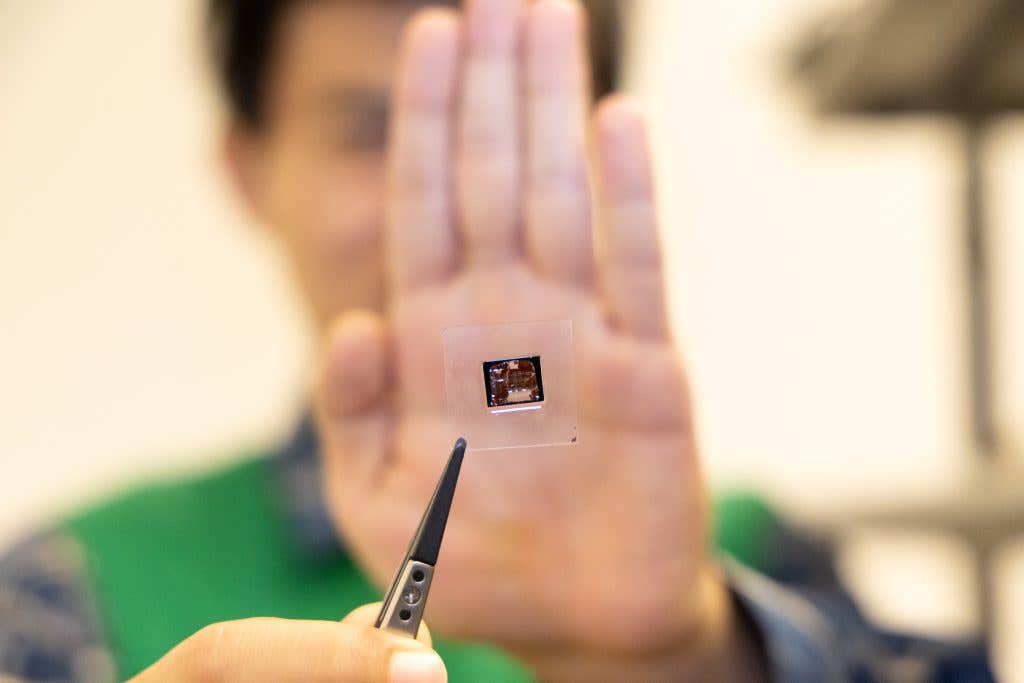
Researcher Haoqi Zhao displays a quantum skyrmion chip that preserved the structure of a light pattern despite noise, even after quantum entanglement disappeared during laboratory tests. (CREDIT: Bella Ciervo, Penn Engineering)
- A silicon nitride chip stamped a topological pattern called a skyrmion onto one photon, then transferred that pattern to the shared state of two entangled photons.
- When researchers added noise until the entanglement between the photons measured zero, the topological number survived, breaking only when the noise grew stronger still.
- The result suggests quantum information might be protected by patterns rather than by fragile entanglement, though the team states plainly that no practical advantage has been demonstrated.
Entanglement is the resource that quantum networks are supposed to run on, and it is also the thing most easily destroyed. Engineers at the University of Pennsylvania have found something that outlasts it. A pattern encoded in light held its shape after the entanglement carrying it had measurably vanished.
The pattern is called a skyrmion, and it is topological in the sense that mathematicians use the word. Topology concerns properties that survive stretching and bending, the reason a doughnut and a coffee mug count as the same object.
The motivation is a practical bottleneck. Linking quantum computers into larger systems needs optical interconnects, but quantum states degrade with the slightest loss of coherence, and the error correction that could fix this demands resources that limit how far it scales.
What persists in this case is a number. The work appears in Nature Physics, from a team led by Liang Feng, a professor of materials science and engineering at Penn with a secondary appointment in electrical and systems engineering.
"It's as if one dancer's unique movement suddenly became part of a duet, and persisted even when the dancers were separated," Feng said of the transfer. He added that encoding information in such resilient patterns could lay the groundwork for more reliable quantum networks.
A pattern made of polarization
An optical skyrmion is not a shape you could photograph. It lives in how the light's polarization, the direction its waves oscillate, varies from point to point across the beam.
"The light oscillates in different directions depending on where you inspect it," said Haoqi Zhao, the paper's first author, now a postdoctoral fellow at Yale and formerly a member of Feng's lab. He compared it to the way patches of hair on a head grow in different directions.
Across the beam those variations sweep through every possible polarization state a whole number of times. That integer is the skyrmion number, and it is what topology protects.
Zhao offered a second comparison for why. Think of a swirl in someone's hair, he said, where individual strands can be pushed out of place without changing the overall pattern.
Building it on a chip
The device is a photonic circuit built on a silicon nitride layer 310 nanometres thick, fabricated at Penn's Singh Center for Nanotechnology. A femtosecond laser pulse pumps two spiral waveguides, which occasionally convert pump light into a pair of photons through a process called spontaneous four-wave mixing.
From there the two photons take different routes. Tunable interferometer arrays steer one photon toward microring resonators that encode the skyrmion, and send the other to a grating coupler that converts its path into a polarization.
The resonators do the distinctive work. Each ring carries gratings etched along both its inner and outer walls, which emit light with opposite handedness and different amounts of orbital twist, and the superposition of those two outputs forms the skyrmion.
Transferring the pattern then requires a measurement rather than a transmission. The team performs a joint measurement on the first photon that projects it onto one of four possible correlated states, which heralds a matching skyrmion now shared between both photons.
"It's a bit like building an entire factory in miniature," said Yichi Zhang, a doctoral student in materials science and engineering and a co-author. One section makes the entangled photons, another routes them, and a third creates the pattern, he said, with the difficulty lying in getting the parts to work together.
What the measurements showed
Reconstructing these states takes tomography, a procedure that rebuilds a quantum state from many repeated measurements. The single-photon skyrmion came back with a fidelity of 86 percent, and the entanglement between the two photons with 91 percent.
After the transfer the four heralded states averaged 89 percent fidelity. Their skyrmion numbers came out at 1.981, 1.981, 1.979 and 1.9798, against a target of 2.
Those numbers describe correlations rather than a visible texture. The authors stress that the entangled skyrmion number is extracted from the relationship between one photon's orbital twist and the other's polarization, not from any pattern a camera could record.
Nearly half a decade of development went into reaching that point, according to the team. Earlier groups had made skyrmions on single photons and skyrmions shared between entangled photons, but had not moved one into the other on a chip.
The routing hardware matters for a reason beyond convenience. Because the interferometer arrays are tunable, the same circuit can in principle apply different operations to the photons, which is what would allow more elaborate topological protocols on the same device.
Noise that should have ruined it
The interesting part came from deliberately wrecking the state. The researchers added background and white-light noise of adjustable strength, approximating a channel that depolarizes a quantum state uniformly in every direction.
Fidelity and purity fell as expected. Entanglement, measured by a quantity called concurrence, dropped to exactly zero. The skyrmion number did not move.
It held across a finite range beyond that point, then collapsed once the noise became overwhelming, falling from 1.93 to essentially zero. Two other kinds of noise, which scramble the phase of one photon rather than depolarizing both, produced the same pattern of resilience up to their own thresholds.
Something else survived alongside the topology. A measure called quantum discord, which captures correlations that are not entanglement, stayed above zero exactly where the skyrmion number held, and the topology broke down before the discord reached zero.
"Previous work suggested that these structures depended on entanglement," Zhao said. "Our findings show that the relationship is more complicated than we thought."
What this does not yet deliver
The authors are direct about the gap between the finding and a use for it. Their experiment does not establish any operational advantage for quantum state transfer based on the skyrmion number, they write, and they frame the work as a basis for future protocols rather than a protocol itself.
The earlier claim being revised was narrower than it may appear. Entanglement was thought necessary for preserving the skyrmion number under pure-state conditions, and what this work shows is that the requirement lifts in the mixed-state regime that noise creates.
Scale is the other constraint. This is two photons on one chip in a laboratory, not a network, and the fidelities in the eighties and nineties leave room before such components could carry real traffic.
The replacement explanation also needs testing. The authors attribute the topology's survival to the persistence of enough non-classical, phase-coherent correlation to keep the winding structure smoothly deformable, which is a hypothesis their data support rather than a mechanism they have isolated.
Feng frames the appeal in terms of understanding rather than engineering. The patterns can survive without entanglement, he said, revealing a deeper role for quantum correlations beyond entanglement in processing quantum information.
Dig deeper into quantum skyrmions and topological light
These resources cover the topology of structured light, the chips that carry it, and the correlations this experiment turned on.
Optical skyrmions and other topological quasiparticles of light
A preprint review of the structured-light patterns this work manipulates, including how they are classified and measured. (arXiv, January 2024)
Integrated photonic quantum technologies
Explains how chips like this one generate, route and measure single photons, and where the approach runs into limits. (Nature Photonics, October 2019)
Topological Photonics
The preprint of a standard review on using topology to protect light, the broader idea this experiment extends into the quantum regime. (arXiv, April 2019)
Introducing Quantum Discord
The preprint that defined the measure of non-classical correlation which outlasted entanglement in these experiments. (arXiv, May 2001)
What Is Entanglement and Why Is It Important?
A plain-language explainer on entanglement and what makes it so easily destroyed. (Caltech Science Exchange)
Research findings are available online in the journal Nature Physics.
The original story "New skyrmion chip could enable more reliable quantum networks" is published in The Brighter Side of News.
Related Stories
- Light-powered neural network could transform future quantum communications
- Researchers discover a new way to control light in empty space
- AI and quantum computers revolutionize discovery of quantum materials
Like these kind of feel good stories? Get The Brighter Side of News' newsletter.
Shy Cohen
Writer