White dwarf’s intense gravity rips asteroids apart without grinding them into fine dust
Asteroids torn apart near white dwarfs may leave large fragments rather than immediate dust, revealing a missing stage in the evolution of planetary debris.

 Edited By: Joseph Shavit

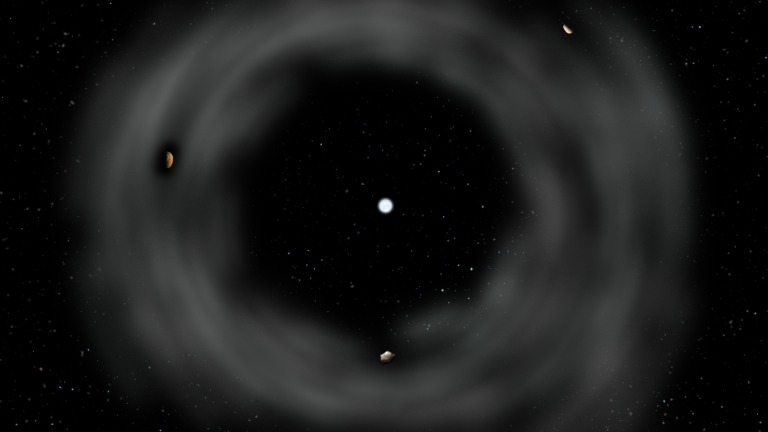
This artist’s illustration shows a white dwarf star surrounded by a debris disk with three asteroids orbiting in the disk. (CREDIT: Pamela L. Gay / PSI)
- Asteroids torn apart near white dwarfs may leave most of their mass in fragments about 100 meters to 1 kilometer across.
- A physical model shows that weak attractions between grains can halt repeated tidal breakup before the debris becomes dust.
- Collisions or rotational breakup must further process these fragments, adding an intermediate step to models of stellar debris disks.
An asteroid can survive its own destruction in surprisingly large pieces. Near a white dwarf, gravity may tear the original body apart while leaving most of its mass in fragments hundreds of meters across. Turning that wreckage into the dust astronomers observe requires another stage of destruction.
Research led by Planetary Science Institute senior scientist Jordan Steckloff identifies this intermediate stage as a “kilometer-size barrier.” Published in The Astrophysical Journal Letters, the study examines how even extremely weak internal strength changes asteroid breakup. Co-authors include Dimitri Veras of the University of Warwick and Kathryn Volk of PSI.
The findings concern the debris disks surrounding some white dwarfs, the dense stellar remnants left after stars exhaust their nuclear fuel. These disks contain material from disrupted planetary bodies. Understanding how that material becomes dust is essential for reconstructing what happens to planetary systems after their stars die.
Why weak rubble still holds together
Many previous models treated asteroids as rubble piles without internal strength. In that picture, gravity holds the original collection together, but its individual components have no additional cohesion. A close encounter can therefore initiate repeated fragmentation without accounting for forces that bind neighboring grains.
Real rubble piles are more complicated. Tiny attractions called van der Waals forces act between their particles, giving even loose material some resistance to being pulled apart. These forces are weak, yet their contribution becomes increasingly important as an object breaks into smaller pieces.
“Nothing is truly strengthless,” Steckloff said. “Tiny attractions between grains called Van der Waals forces give comets and asteroids a minimum strength 10 to 100 times weaker than pulling apart freshly fallen snow.” Such modest cohesion can substantially change the outcome of a destructive encounter.
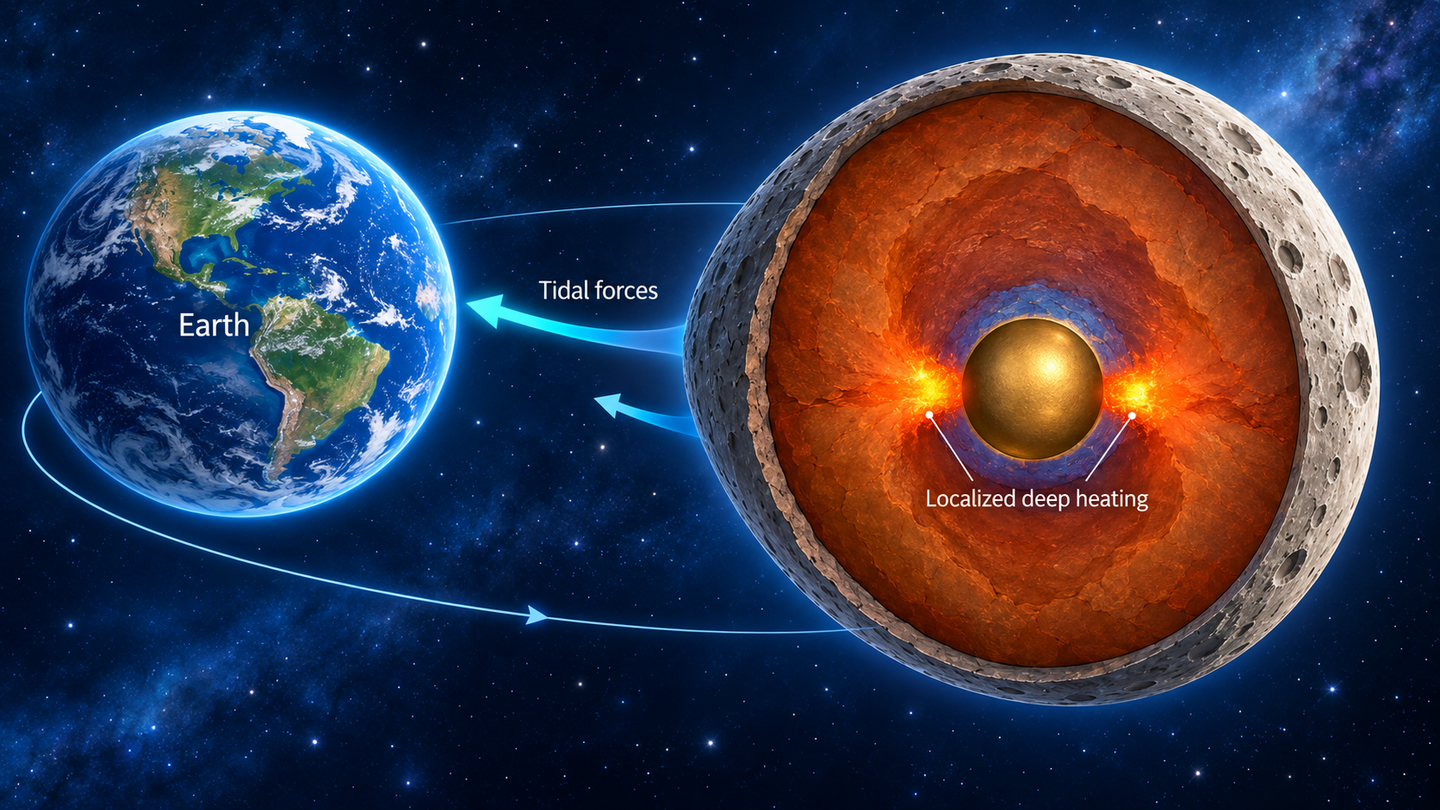
The destructive force comes from a difference in gravitational pull. The side of an asteroid nearer the white dwarf feels a stronger attraction than the far side. These tidal forces stretch the body, and it breaks when that stretching overcomes its self-gravity and internal strength.
Calculating where fragmentation stops
The team built a physical model balancing those competing forces. It represents an elongated body as two joined cubes, allowing the researchers to calculate the pull separating its halves. They then determine which fragment sizes can remain stable at different distances from the star.
For the main calculations, the researchers used a white dwarf with 60% of the Sun’s mass. They tested material densities spanning ice to iron and cohesive strengths of 10 and 1,000 pascals. A pascal measures stress, or force applied across an area, in this case the resistance to separation.
The calculations produced characteristic fragment sizes of roughly 100 meters for the weaker material and 1 kilometer for the stronger material. Most of the disrupted body’s mass would remain in pieces around these sizes. The result concerns where the mass resides, rather than a claim that no smaller particles form.
The “barrier” also is not a universal minimum size. Stable sizes depend on material properties and distance from the white dwarf, with stronger tides permitting smaller surviving fragments closer in. At sufficiently high temperatures, material can instead be destroyed by sublimation, the direct transition from solid to gas.
The calculation assumes the body spends enough time near its closest approach for breakup to occur. It also aligns the long axis toward the star, maximizing the tidal pull. These choices help isolate the physics, but they do not reproduce every possible asteroid shape, orientation or encounter history.
Dust needs another destructive step
This distinction matters because large fragments and fine dust respond differently to starlight. Poynting-Robertson drag gradually removes orbital energy from small particles, drawing them inward. Fragments hundreds of meters across are too large for that process to significantly shape their immediate evolution.
Models therefore need to include the stage between tidal breakup and dust migration. Collisions could grind the larger pieces down, producing particles that radiation can influence more effectively. Another possibility is rotational breakup, in which fragments spin fast enough to pull themselves apart.
The relative importance of these mechanisms remains uncertain. Radiation and escaping gas can alter an object’s spin, but their effectiveness depends on conditions such as stellar luminosity and material composition. The study identifies the need for further processing without establishing one route for every debris disk.
Old, cool white dwarfs provide an important constraint. Some retain dusty disks despite being too faint for strongly heating-driven processes to remain equally effective. Their existence supports the importance of mechanisms such as collisions that can continue after the stellar remnant has cooled substantially.
A familiar example near Jupiter
A related breakup happened much closer to home. Comet Shoemaker-Levy 9 passed near Jupiter in 1992, when the planet’s tidal forces tore it into large fragments. Those pieces later struck Jupiter in 1994, giving astronomers an unusually detailed view of a disrupted small body.
Estimates placed the comet’s major fragments at approximately 100 to 1,000 meters across. That range is consistent with the characteristic sizes in the white dwarf calculations. The comparison offers a useful physical parallel, although a comet encountering Jupiter does not directly verify the model around another star.
The researchers also discuss the Kreutz family of comets that pass extremely close to the Sun. Many known members are tiny, but most of the family’s mass resides in larger bodies. That distinction reinforces why counting fragments alone can give a misleading impression of how thoroughly an object was destroyed.
The white dwarf study remains a theoretical investigation. Its simplified geometry makes the force balance tractable, and its breakup calculations omit rotation, which could assist disruption. The authors expect that omission to change characteristic sizes by a modest factor rather than erase the central result.
Fragments can share nearly the same path
Internal strength also affects where the wreckage goes. In calculations for nonrotating bodies, fragment speeds changed by only about one part per million to one part per 100 million during breakup. Such small differences leave the pieces on nearly identical orbits immediately after separation.
This does not mean the fragments remain motionless beside one another. They can occupy different positions along similar paths, while subsequent processes continue changing the system. Nevertheless, the model predicts less radial spreading than strengthless treatments, potentially influencing how frequently fragments collide and how their debris evolves.
For observers, the distinction affects how a dusty disk is interpreted. The dust may record the later processing of a larger reservoir of fragments that telescopes cannot directly resolve. Future models must connect that unseen population with observable debris, including how long dust production lasts and how material eventually reaches the star.
“This will help us understand what happens to the small bodies in orbit around a star as it undergoes the end stages of its life,” Volk said. The next challenge is to determine how those concentrated fragments collide, spin apart and finally supply the dust surrounding white dwarfs.
Dig deeper into white dwarf debris
These studies connect asteroid cohesion, tidal destruction and observations of disrupted planetary systems.
Catastrophic tidal disruption of heterogeneous rubble piles: A tale of two regimes
Simulations examine how particle shapes and size distributions alter rubble-pile breakup during close encounters with Earth. (Astronomy & Astrophysics, October 2026)
Producing planetary debris exterior to white dwarf Roche radii through sublimative rotational fission
Models investigate how escaping gas can spin small bodies apart outside the region normally associated with tidal destruction. (Monthly Notices of the Royal Astronomical Society, May 2026)
A planetesimal orbiting within the debris disc around a white dwarf star
Periodic changes in gas emission were interpreted as evidence for a solid planetary fragment held together by internal strength. (Science, April 2019)
A disintegrating minor planet transiting a white dwarf
Observations of recurring dimming linked a disintegrating planetary body with dusty material around the white dwarf WD 1145+017. (Nature, October 2015)
The strength of regolith and rubble pile asteroids
This foundational work explains how van der Waals attractions can give loose asteroid material measurable cohesion. (Meteoritics & Planetary Science, May 2014)
Research findings are available online in The Astrophysical Journal Letters.
The original story "White dwarf’s intense gravity rips asteroids apart without grinding them into fine dust" is published in The Brighter Side of News.
Related Stories
- Astronomers discover four nearby white dwarfs hiding in plain sight
- A white dwarf’s unusual atmosphere gives it a ghostly green glow
- Gamma Cassiopeiae may be hiding a magnetic white dwarf companion
Like these kind of feel good stories? Get The Brighter Side of News' newsletter.
Joshua Shavit
Writer and Editor
Joshua Shavit is a NorCal-based science and technology writer with a passion for exploring the breakthroughs shaping the future. As a co-founder of The Brighter Side of News, he focuses on positive and transformative advancements in technology, physics, engineering, robotics, and astronomy. Having published articles on AOL.com, MSN, Yahoo News, and Ground News, Joshua's work highlights the innovators behind the ideas, bringing readers closer to the people driving progress.