Recycled plastic and moon dust become 3D-printed parts and structures for future lunar missions
Recycled plastic mixed with simulated lunar dust produced printable parts, with benefits and trade-offs that need further testing.
 Concordia University Writer: Patrick Lejtenyi

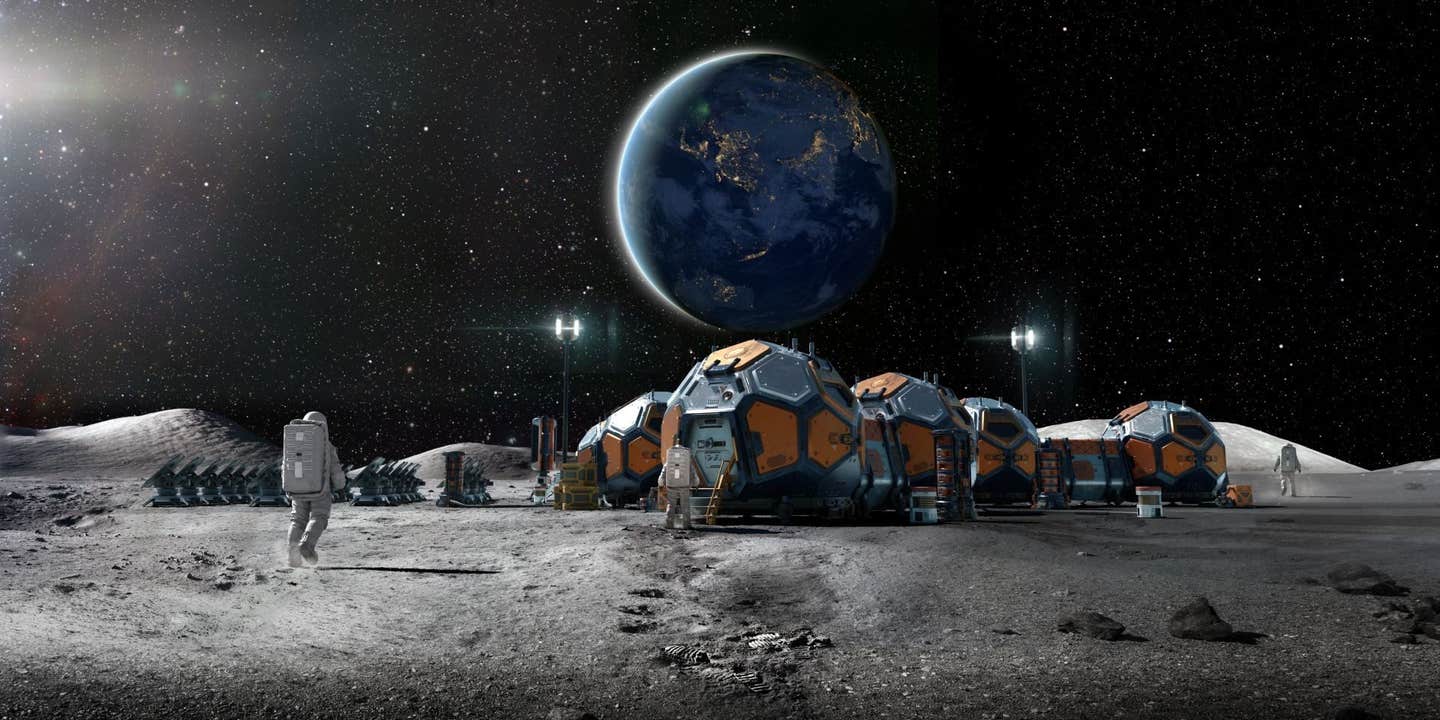
Engineers 3D printed recycled PEKK and simulated moon dust into lattices and a wrench, testing a route toward lunar manufacturing. (CREDIT: University of Concordia)
- Recycled PEKK plastic mixed with 30% simulated lunar regolith was successfully 3D printed into energy-absorbing lattices and a wrench.
- The approach could stretch supplies sent from Earth, while regolith reduced shrinkage and warping during heat treatment.
- Performance varied with loading direction and processing; the laboratory study did not test lunar conditions or landing impacts.
A discarded plastic part could become raw material for another tool on the moon. In laboratory experiments, engineers turned recycled high-performance plastic and simulated lunar dust into printable filament, then manufactured cellular structures and a wrench.
The experiment at Concordia University tested a route toward making useful components while consuming less material delivered from Earth. Farshad Malekpour and Mehdi Hojjati, a professor of mechanical, industrial and aerospace engineering, reported the work in Composites Part B: Engineering.
Their mixture contained 30% lunar regolith simulant by weight and 70% recycled poly(ether ketone ketone), or PEKK. It retained useful compression behavior in some configurations and improved dimensional stability during heat treatment. However, the added particles also increased internal voids and reduced several mechanical properties.
Turning used parts into printable feedstock
The researchers began with PEKK scrap from earlier printed specimens and sacrificial components. These are parts intended to absorb mechanical energy through controlled deformation or failure, protecting other equipment. Their limited service life makes them candidates for recovery and remanufacturing.
Earlier work had found no significant deterioration in PEKK’s mechanical or thermomechanical properties through three recycling cycles. For this experiment, the team selected scrap that had undergone no more than two previous cycles. That left room for another processing round within the range already investigated.
The preparation required several steps. Workers shredded the scrap, milled it into powder, and dried both the polymer and regolith simulant at 125 degrees Celsius for eight hours. They then mixed the powders and used a twin-screw extruder to produce filament.
The simulant, Lunar Mare Simulant-1D, came from Space Resource Technologies, associated with the University of Central Florida’s Exolith Lab. Its particles averaged about six micrometers across. Microscopy showed an even distribution through the plastic, without large clusters or visible settling.
The resulting filament fed a printer that deposited melted material layer by layer. The team printed standardized specimens for stretching, bending and thermal tests, alongside cellular structures for compression experiments. Printing used a nozzle temperature of 380 degrees Celsius and a bed temperature of 160 degrees Celsius.
Parts designed to deform
The cellular specimens used a Schwarz-G gyroid geometry, a repeating arrangement of curved surfaces and interconnected spaces. Such architecture can absorb energy as its cells progressively collapse. The engineering goal differs from that of a beam or wall expected to remain intact under sustained loads.
The researchers compressed these structures slowly at room temperature, comparing the composite with PEKK containing no regolith. They applied force both perpendicular and parallel to the printed layers. They also compared specimens as printed with specimens that received additional heat treatment.
Without that treatment, the composite performed particularly well when compressed perpendicular to the layers. Its peak compressive strength reached 29 megapascals, compared with 30.2 megapascals for unfilled PEKK. That represents a reduction of approximately 4%.
Both materials continued carrying load as their cells progressively deformed and compacted. This sustained response is useful for an energy absorber. It does not mean that crushed sacrificial parts return undamaged to their original shapes.
The result changed when force acted parallel to the layers. Composite strength fell to 17.3 megapascals, compared with 32.6 megapascals for unfilled PEKK. Cracks and separation between layers became more pronounced, and energy absorption was substantially lower in that orientation.
Heat treatment brings a trade-off
Some specimens underwent annealing, a controlled heating process that changes the polymer’s internal crystalline structure. The treatment reached 210 degrees Celsius, held that temperature for 30 minutes, and then cooled the parts. The entire cycle took approximately one hour.
Annealing increased compressive stiffness but produced brittle failure in the gyroid specimens. Instead of sustaining extensive deformation after reaching their peak load, the treated structures fractured abruptly. Thermal processing therefore changed the way they absorbed energy, as well as their resistance to compression.
For loading perpendicular to the layers, annealed unfilled PEKK reached a compressive strength of 44 megapascals. The annealed composite reached 23.8 megapascals, approximately 46% lower. Adding regolith and applying heat treatment did not provide a universal improvement.
Thermal analysis nevertheless showed that the recycled polymer retained its underlying thermal response. Regolith lowered the temperature at which crystallization began during heating. The researchers attributed this to improved heat transport and particle surfaces that help crystals form, potentially easing subsequent thermal processing.
A wrench reveals another advantage
The team also printed a NASA-style ratchet wrench using both materials. This demonstrator showed that recovered polymer could move beyond test specimens into a different component design. It did not establish the tool’s performance under lunar operating conditions.
After annealing, the composite wrench showed less shrinkage and warping than the unfilled version. The rigid mineral particles constrained changes in the plastic during heating. Better dimensional stability could matter where access to machining and other finishing equipment is limited.
That benefit came alongside substantial porosity. Printed composite specimens contained approximately 25% internal voids before annealing and 37.6% afterward. Corresponding values for unfilled PEKK were 3.4% and 5.1%.
The researchers linked these voids to thicker melt flow, trapped air and incomplete consolidation during extrusion and printing. Particle-related stress concentrations and layer bonding also affected performance. The analysis pointed to manufacturing defects and microstructure, rather than degradation of the recycled polymer, as the main explanation for reduced strength.
What remains before lunar use
Replacing 30% of the feedstock with regolith offers a measurable reduction in the polymer required for a given composite mass. On the moon, locally collected material could provide that fraction. The polymer and manufacturing equipment would still require a supply strategy.
The study demonstrated this material route on Earth using a commercial simulant. It did not reproduce lunar vacuum, reduced gravity or repeated temperature changes. Those conditions could influence printing, heat treatment and the behavior of finished parts.
Nor did the slow compression tests establish protection during an actual landing impact. The researchers identify rapid-loading experiments and validated simulations as necessary next steps. A quantitative life-cycle assessment would also be needed to establish energy and environmental benefits.
For now, the evidence supports a laboratory manufacturing approach with specific strengths and trade-offs. Recovered PEKK can accept simulated lunar material and become new printed components. Whether those components meet mission requirements will depend on their design, processing history and performance in further testing.
Dig deeper into lunar manufacturing and material recycling
These resources explore regolith composites, polymer reuse and the challenges of manufacturing beyond Earth.
On the resistance of PEKK to degradation during multiple recycling cycles for additive manufacturing: Examines how repeated processing affects the thermal, chemical and mechanical integrity of PEKK. (Polymer Degradation and Stability, 2026)
Sustainable lunar additive manufacturing of high regolith-loaded PEKK composites for space infrastructure: Investigates higher regolith concentrations and the relationships between particle loading, porosity and mechanical performance. (Composites Part B: Engineering, 2026)
A comprehensive review of lunar-based manufacturing and construction: Reviews manufacturing techniques, local resources, energy requirements and the effects of lunar gravity and vacuum. (Progress in Aerospace Sciences, 2024)
Additive manufacturing of polyether ether ketone (PEEK)/Lunar regolith composites via fused filament fabrication: Reports experiments with a related high-performance polymer and the strength trade-offs introduced by simulated lunar material. (Concordia University, 2024)
Solving the Challenges of Long Duration Space Flight with 3D Printing: Explains space-station printing experiments and efforts to recycle plastic into reusable printer feedstock. (NASA, 2019)
Research findings are available online in the journal Composites Part B: Engineering.
The original story "Recycled plastic and moon dust become 3D-printed parts and structures for future lunar missions" is published in The Brighter Side of News.
Related Stories
- 3D printed moon dust structures could be the future of lunar construction
- Scientists create space bricks for moon base using microwaves and lunar soil
- ISS test finds that moon dust could be effective as a lunar building material
Like these kind of feel good stories? Get The Brighter Side of News' newsletter.
Joshua Shavit
Writer and Editor
Joshua Shavit is a NorCal-based science and technology writer with a passion for exploring the breakthroughs shaping the future. As a co-founder of The Brighter Side of News, he focuses on positive and transformative advancements in technology, physics, engineering, robotics, and astronomy. Having published articles on AOL.com, MSN, Yahoo News, and Ground News, Joshua's work highlights the innovators behind the ideas, bringing readers closer to the people driving progress.