Stephen Colbert’s trapdoor spider connects comedy, chromosomes and conservation
Stephen Colbert’s namesake trapdoor spider has a repeat-rich genome that offers clues to chromosome evolution and could guide California coastal conservation.
 UC Davis Writer: Amy Quinton

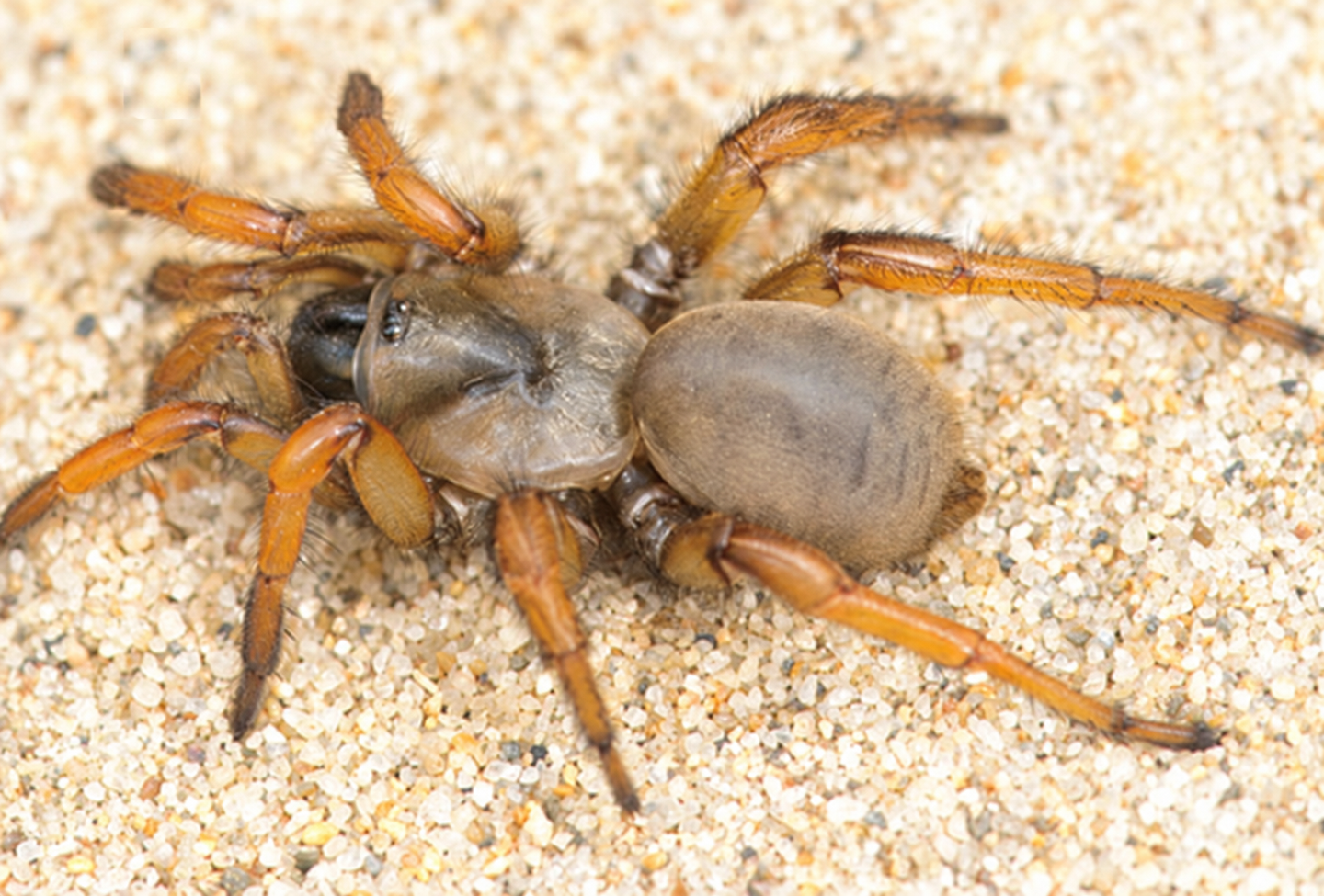
A. stephencolberti adult female in sand habitat, body length ~ 1.4 cm. (CREDIT: Jason Bond et al, Journal of Heredity 2026)
- Researchers assembled the first reference genome for Stephen Colbert’s namesake trapdoor spider and its family, Euctenizidae.
- Repeated DNA accounts for about 77.7% of the primary assembly, while searches found no standard arthropod telomere repeat.
- The resource could help identify genetically distinct coastal populations, but chromosome counts and chromosome-end protection need further investigation.
Beneath California’s coastal dunes, a quarter-sized spider waits behind a camouflaged door while carrying billions of DNA letters. Most of its newly assembled genetic sequence consists of repeated material. Researchers now have a detailed starting point for understanding that genetic architecture and protecting the narrow habitat where the animal lives.
The spider, Aptostichus stephencolberti, bears comedian Stephen Colbert’s name. A University of California, Davis-led team describes its first reference genome in the Journal of Heredity, providing an organized DNA sequence for future comparisons. The project also supplies the first such resource for the spider family Euctenizidae.
A hidden hunter with a famous name
The species lives in coastal dunes between the San Francisco Bay Area and Monterey. It builds deep, silk-lined burrows on steep dune faces and near coastal vegetation. A hinged lid made from silk and surrounding material conceals the entrance, making these homes difficult to spot.
Females spend their lives underground, waiting for vibrations from passing prey. When an insect or another small arthropod approaches, the spider emerges to seize and envenomate it. Its venom is not considered dangerous to humans, despite the formidable appearance associated with trapdoor spiders.
The celebrity connection began in 2008, after Colbert learned that biologist Jason Bond had named another trapdoor spider for Neil Young. On “The Colbert Report,” he demanded similar recognition in his “Who’s Not Honoring Me Now?” segment. Bond obliged, giving the coastal predator its unusually recognizable scientific name.
Building a genome from one spider
For the DNA assembly, researchers used one female collected at Marina Dunes Preserve in Monterey County in May 2020. They combined long-read sequencing with a method that records which DNA regions sit near one another inside cells. Together, these approaches helped organize individual sequence fragments into longer stretches.
The resulting primary assembly spans about 3.63 billion DNA base pairs. Base pairs are the paired chemical units that form DNA’s sequence. A separate computational estimate placed the genome at about 3.87 billion base pairs, emphasizing the distinction between estimated total size and assembled sequence.
The genome assembly remains unfinished at some boundaries and contains 551 connected sequence blocks, called scaffolds. It is not a continuous, end-to-end account of every chromosome. Nevertheless, a standard quality check recovered about 95.6% of the conserved arthropod genes used to assess completeness.
Automated annotation identified 14,067 genes, using sequence comparisons and RNA data to help locate them. Annotation assigns likely features to the assembled DNA rather than experimentally establishing every gene’s function. The team included collaborators from UC Santa Cruz, UCLA and Virginia Tech alongside UC Davis researchers.
A reference provides a shared framework for those later investigations, allowing researchers to compare corresponding DNA regions across animals. Because the assembly came from one female, it cannot capture all variation across the species. Its conservation value will grow as additional population data reveal which differences occur within individual dunes and which separate populations along the coast.
Repeated DNA accounts for most of the sequence
About 77.7% of the primary assembly consists of repetitive DNA, sequences present in many copies. DNA transposons formed the largest annotated category, accounting for about 40.6% of the assembly. These belong to a broader class of genetic elements that can move or spread within genomes.
That finding explains why a large genome does not necessarily contain a correspondingly large collection of genes. Repeated sequences can occupy enormous amounts of space without adding new protein-making instructions. The spider’s genetic size therefore cannot be read as a measure of intelligence, complexity or hunting ability.
Nor does identifying noncoding DNA establish that every repeated segment lacks a biological role. This study cataloged sequence composition rather than testing the function of each repeat. Comparisons with other spider assemblies placed the species among those with particularly high proportions of repeated material.
An unanswered question at chromosome ends
Another finding concerned telomeres, structures that help protect chromosome ends. Many arthropods carry a repeated DNA pattern written as TTAGG at those ends. The researchers did not find the expected concentration of that pattern in the trapdoor spider’s assembly.
They expanded the search across a broad sample of spider genomes and again failed to find the standard repeat. Control searches detected the expected patterns in honeybees and vertebrates. Those checks supported the interpretation that spiders lost the usual arthropod repeat early in their evolutionary history.
This does not mean spider chromosomes have no protection. The missing feature is a particular sequence pattern, and the mechanisms protecting their chromosome ends remain unresolved. The authors propose that different end-protection arrangements might help explain chromosome changes during evolution, but that possibility needs direct investigation.
Chromosome numbers also remain provisional because the team lacked a directly measured chromosome inventory for this species. The paper estimates roughly 52 chromosomes in one set, corresponding to about 104 in the paired complement. Further work must establish the actual count and identify the sex chromosomes.
DNA could reveal populations worth protecting
The project belongs to the state-funded California Conservation Genomics Project, which develops genetic resources for conservation. Trapdoor spiders are especially useful subjects because they rarely disperse far from home. Their limited movement can preserve differences among neighboring populations that wider-ranging animals might obscure.
Researchers can use the reference to compare genetic diversity across separate dune populations. Those comparisons could reveal boundaries between populations, clarify species identities and identify locally distinctive lineages. The assembly itself does not yet provide a coastwide map of those differences or measure current population declines.
Habitat pressures make that work urgent. Development, shoreline modification and invasive species affect the fragmented dunes, while sea-level rise threatens their narrow coastal setting. A spider strongly tied to one patch of sand has limited options when that patch changes or disappears.
“We Californians love our beaches and trapdoor spiders share them with us,” said Bond, the study’s corresponding author and a UC Davis professor of entomology and nematology. “We’re hoping to understand how things like climate change, fire and urbanization might be impacting the genetic diversity of species.” Those questions require comparisons across additional animals and locations.
Venom possibilities remain a separate research goal
The genome could also support future searches for venom-derived compounds with medical or agricultural potential. Bond points to pain relief and pest control as possible applications of spider venom research. This sequencing study, however, did not demonstrate a new drug, pesticide or therapeutic effect from this species.
“We don’t really know what’s out there in terms of untapped natural product diversity for venoms,” Bond said. Identifying promising molecules would require work beyond locating sequences in a reference. Researchers would need to determine what those molecules do and whether they have useful properties.
The immediate next step is closer to the spider’s burrow: comparing genomes across Aptostichus populations. The team is already pursuing population sequencing through the conservation project. Those data could show how much distinct evolutionary history survives in separate dunes and where protecting habitat would preserve otherwise overlooked diversity.
Dig deeper into spider genomes and conservation
These studies connect modern spider genomics with population boundaries and the foundations of conservation genetics.
Genomic signature of repeated transitions to diurnality in spiders
Comparisons across spider genomes investigate genetic changes associated with repeated shifts toward daytime activity. (Molecular Biology and Evolution, July 2026)
Big Spider, Big Genome: Chromosome-Level Genome of a North American Tarantula (Aphonopelma marxi) and Comparative Genomics Across 300 Million Years of Spider Evolution
A tarantula reference genome provides context for repeated DNA and chromosome rearrangements across spider lineages. (Genome Biology and Evolution, April 2026)
Speciation Pattern and Process in the California Coastal Dune Endemic Trapdoor Spider Aptostichus simus (Mygalomorphae: Euctenizidae) and Description of a New Cryptic Species
Genetic and anatomical evidence reveal hidden species diversity among related coastal dune trapdoor spiders. (Ecology and Evolution, October 2025)
Landscape Genomics to Enable Conservation Actions: The California Conservation Genomics Project
The project’s foundational overview explains how statewide genomic data can inform habitat protection and wildlife management. (Journal of Heredity, April 2022)
An integrative method for delimiting cohesion species: finding the population-species interface in a group of Californian trapdoor spiders with extreme genetic divergence and geographic structuring
This foundational study examines how to distinguish species from deeply differentiated populations in poorly dispersing trapdoor spiders. (Systematic Biology, August 2008)
Research findings are available online in the journal Journal of Heredity.
The original story "Stephen Colbert’s trapdoor spider connects comedy, chromosomes and conservation" is published in The Brighter Side of News.
Related Stories
- Jumping spiders show REM-like sleep, but do they dream?
- Hairy legs and red eyes: Two bizarre new sea spiders found in British Columbia’s Salish Sea
- 518-million-year-old fossil reveals where spider fangs came from
Like these kind of feel good stories? Get The Brighter Side of News' newsletter.
Hannah Shavit-Weiner
Medical & Health Writer
Hannah Shavit-Weiner is a Los Angeles–based medical and health journalist for The Brighter Side of News, an online publication focused on uplifting, transformative stories from around the globe. Having published articles on AOL.com, MSN and Yahoo News, Hannah covers a broad spectrum of topics—from medical breakthroughs and health information to animal science. With a talent for making complex science clear and compelling, she connects readers to the advancements shaping a brighter, more hopeful future.