Strong electron pairs offer new hope for room-temperature superconductivity
Sensitive electrical-noise measurements connect electron pairing to a disputed feature in cuprate superconductors, sharpening the search for higher operating temperatures.
 Utrecht University Writer: Moniek Verstegen

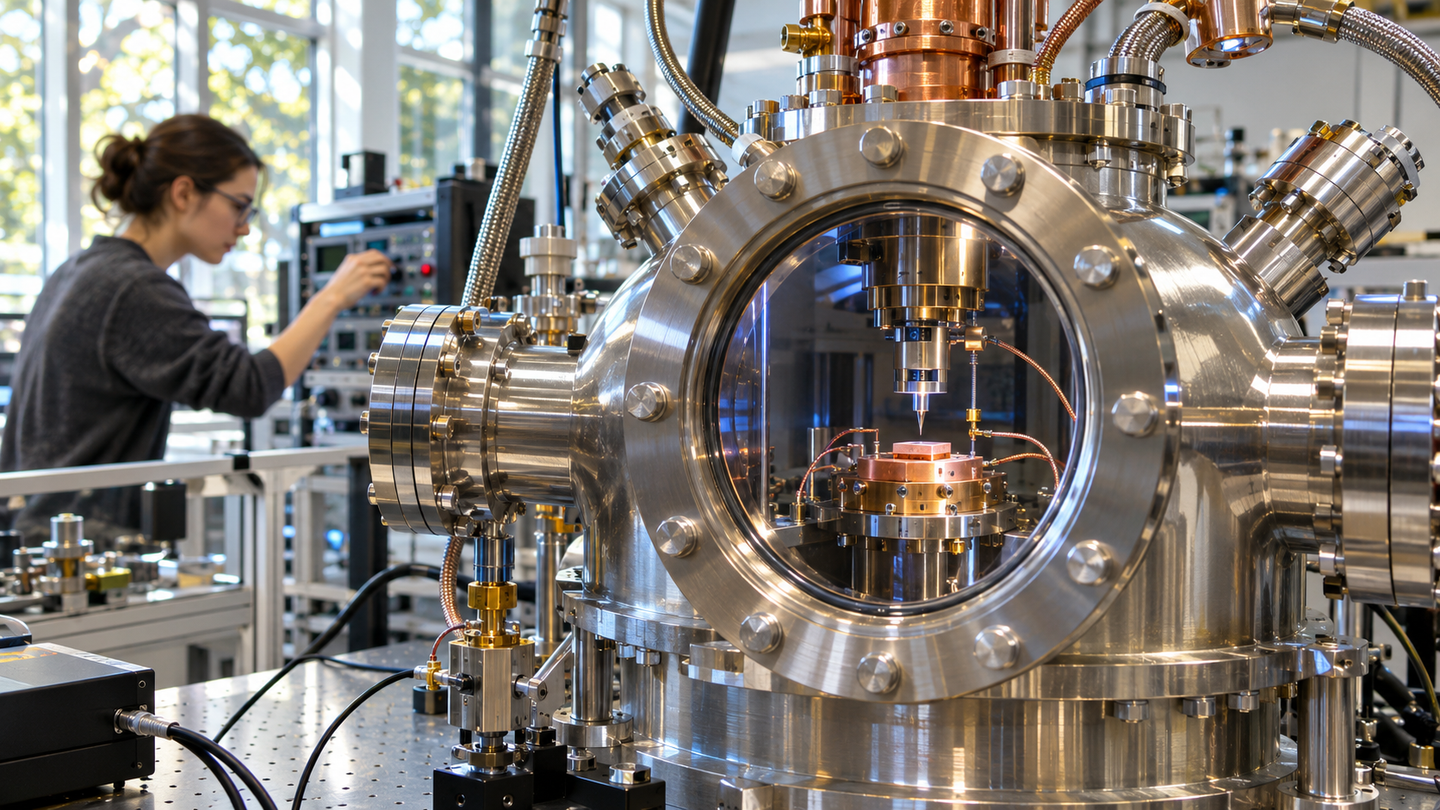
An illustrative laboratory scene shows precision equipment used to investigate electron pairing, helping researchers understand what limits superconductivity at higher temperatures. (CREDIT: The Brighter Side of News)
- Measurements connect electron pairing to the mysterious pseudogap in a copper-oxide superconductor.
- The results suggest collective coordination, rather than weak pairing, limits its superconducting temperature.
- Researchers measured the material under extreme cooling; they did not demonstrate room-temperature superconductivity.
Electricity can lose energy as heat even when heating serves no useful purpose. Superconductors eliminate electrical resistance, but keeping them cold creates another expense. A new experiment points toward why certain promising materials lose their remarkable behavior long before their electron pairs should become too weak.
Researchers from Utrecht University, Leiden University and Ludwig Maximilian University of Munich investigated a copper-oxide material called Bi-2212. Their findings, published in Science, connect a disputed electronic feature to the formation of electron pairs. The work adds evidence to a long-running superconductivity mystery.
The researchers found pairing energies far larger than the material’s superconducting transition temperature would suggest. Their interpretation puts the spotlight on phase coherence, the collective quantum coordination needed for resistance-free current. Strong pairs alone cannot deliver that shared behavior across a material.
That distinction matters for the search for room-temperature superconductivity. It could help scientists decide which properties to improve in future superconducting materials. However, the experiment itself took place at very low temperatures. It did not show an ordinary-temperature wire carrying current without resistance.
Why strong electron pairs need a shared rhythm
In a toaster, resistance provides the heat that browns bread. In a power cable, the same conversion wastes energy. Superconductivity removes resistance below a material’s critical temperature, called Tc. Raising that threshold could reduce cooling demands, although useful devices would still face engineering challenges.
Superconductivity requires electrons to form Cooper pairs and establish a coordinated quantum state. A dance-floor comparison helps: finding a partner is one requirement, while keeping the entire group in rhythm is another. Phase coherence describes the shared relationship among the pairs’ quantum waves, rather than literal dancers moving together.
Conventional superconductors have a well-established explanation involving interactions between electrons and lattice vibrations. Copper-oxide superconductors, or cuprates, remain harder to explain. Research on electron pairing and magnetism continues to reveal how differently superconducting materials can behave.
“If we understand phase coherence, it may point to a path toward superconductivity at higher temperatures,” said Ingmar Swart, one of the research leaders. The new findings strengthen that direction by separating the energy associated with pairing from the temperature at which the material becomes superconducting.
A disputed gap in the electronic picture
Cuprates contain a puzzling electronic feature called the pseudogap. Measurements show fewer available electronic states within a particular energy range. That feature can persist above the superconducting transition, making its relationship to superconductivity difficult to untangle. Different experimental techniques also define and measure electronic gaps somewhat differently.
One explanation attributes the pseudogap to electrons organizing into local patterns, such as charge-density waves. Another involves pairs that form before achieving collective coherence. Earlier work on the pseudogap and charge-density waves illustrates the variety of behaviors researchers must distinguish.
Ordinary tunneling measurements reveal the gaps, but identifying their cause requires another kind of evidence. The researchers therefore asked where the signature of paired charge first appeared. If it matched the larger pseudogap energy, pairing would have to be part of the explanation for that feature.
Their measurements found that match. The result rules out an explanation based solely on local ordering for the measured pseudogap. It does not exclude a mixture of pairing and other electronic orders. Nor does it settle every question about the broader pseudogap phenomenon across all cuprates.
Listening to electrical fluctuations
The team used scanning tunneling microscopes equipped to detect shot noise. This noise comes from the discrete nature of electrical charge. Instead of flowing as a perfectly smooth stream, charge crosses a tiny tunneling junction through individual events. The resulting fluctuations carry information about the transport process.
Pair-related transport can produce a different noise signature from single-electron transport. In these cuprates, both processes contribute, making the signal harder to interpret than a simple doubling of charge. The team combined sensitive measurements with simulations to identify the energy where the pairing contribution began.
Such methods complement other efforts to observe quantum vibrations and detect faint signals with quantum detectors. Here, the advantage was local information: researchers could compare the electronic spectrum and noise at the same position on the sample surface.
Measurements used temperatures of 4.3 kelvin, 2.2 kelvin and, in some experiments, 0.36 kelvin. All are extremely cold. Magnetic-field tests reduced the pairing-related noise toward the single-electron level, supporting the interpretation. Additional controls helped distinguish the signal from other possible sources of electrical fluctuations. The researchers also compared samples with different carrier concentrations, a property adjusted through doping. This let them check whether the pairing signature followed the pseudogap across different versions of the same material.
What the room-temperature possibility means
The pairing energy varied across the surface, reaching more than 70 millielectronvolts at some locations. Wherever researchers checked, its onset tracked the pseudogap energy. This spatial variation suggests that pairing strength differs across nanoscale regions, adding another detail that a successful theory must explain.
Meanwhile, the tested samples had superconducting transition temperatures ranging from 58 to 91 kelvin. Those values remain far below room temperature. The mismatch between strong pairing and comparatively low transition temperatures led the researchers to conclude that losing collective coherence limits superconductivity in these materials.
The paper also identifies an important experimental limit. Its noise technique could not access the relevant temperatures above Tc with sufficient sensitivity. Evidence for pairing at high energy therefore supports a higher-temperature possibility, rather than directly demonstrating pairs at room temperature. Distinguishing an energy scale from a measured operating temperature is essential.
Researchers also did not identify the microscopic mechanism that would keep the pairs coherent at higher temperatures. Other quantum states can show collective behavior under different conditions, but they cannot establish superconductivity in this material. Each proposed state requires its own experimental tests. That caution also applies to proposed explanations of the pseudogap: a successful model must account for the measured pairing without ignoring other patterns that experiments have detected.
Practical implications for superconductivity research
The immediate payoff is a clearer research target. Instead of treating stronger pairing as the only route forward, scientists can investigate what disrupts coordination among existing pairs. They can also test how chemical composition and local variations influence that coordination, then compare the results with theoretical predictions.
Better superconductors could eventually benefit magnets, power equipment and some quantum computers. However, this study did not demonstrate improved devices or reduced cooling costs. Its contribution is a measurement-based explanation for why a promising material falls short of what its pairing strength might suggest.
Further progress will require both new measurements and better models of quantum materials. Extending the noise technique above the superconducting transition would directly address a limitation of this experiment. Understanding how pairing interacts with competing orders could also clarify which material changes would help.
Room-temperature superconductivity remains a goal. The new evidence makes the search more focused by showing that strong electron pairing and a high superconducting temperature are different achievements. Finding a way to preserve the pairs’ shared quantum rhythm is the next challenge this work brings into view.
Dig deeper into electron pairing and superconductivity
These resources provide context on the pseudogap, paired charge and the obstacles to higher superconducting temperatures, listed newest first.
Experiment Reveals Quantum Tug-of-War Limiting Higher-Temperature Superconductivity
Laser experiments and simulations investigate competition between superconductivity and the pseudogap in a cuprate. (Simons Foundation, October 2026)
Hidden Order in Quantum Confusion: The Pseudogap
An ultracold-atom quantum simulator examines magnetic correlations associated with pseudogap behavior. (Simons Foundation, January 2026)
Mysteries of the Bizarre ‘Pseudogap’ in Quantum Physics Finally Untangled
Computational research explores how the pseudogap emerges in a model of interacting electrons. (Simons Foundation, September 2024)
Direct evidence for Cooper pairing without a spectral gap in a disordered superconductor above Tc
Earlier noise measurements investigate electron pairing above the superconducting transition in a different material. (Science, October 2021)
Electron pairing in the pseudogap state revealed by shot noise in copper oxide junctions
A related experiment uses current fluctuations to study paired charge carriers in copper-oxide junctions. (Nature, August 2019)
Research findings are available online in the journal Science.
The original story "Strong electron pairs offer new hope for room-temperature superconductivity" is published in The Brighter Side of News.
Related Stories
- Scientists may have found the key to one of quantum physics’ biggest mysteries: superconductivity
- Researchers may have observed triplet superconductivity - the holy grail in quantum computing
- Superconductivity and magnetism can co-exist in some materials, MIT study finds
Like these kind of feel good stories? Get The Brighter Side of News' newsletter.
Shy Cohen
Writer