University of Helsinki student finds a previously unknown comet in Euclid’s images
Euclid spotted its first previously unknown comet in galaxy survey images, testing a discovery process that could help identify future spacecraft targets.

 Editor: Joshua Shavit

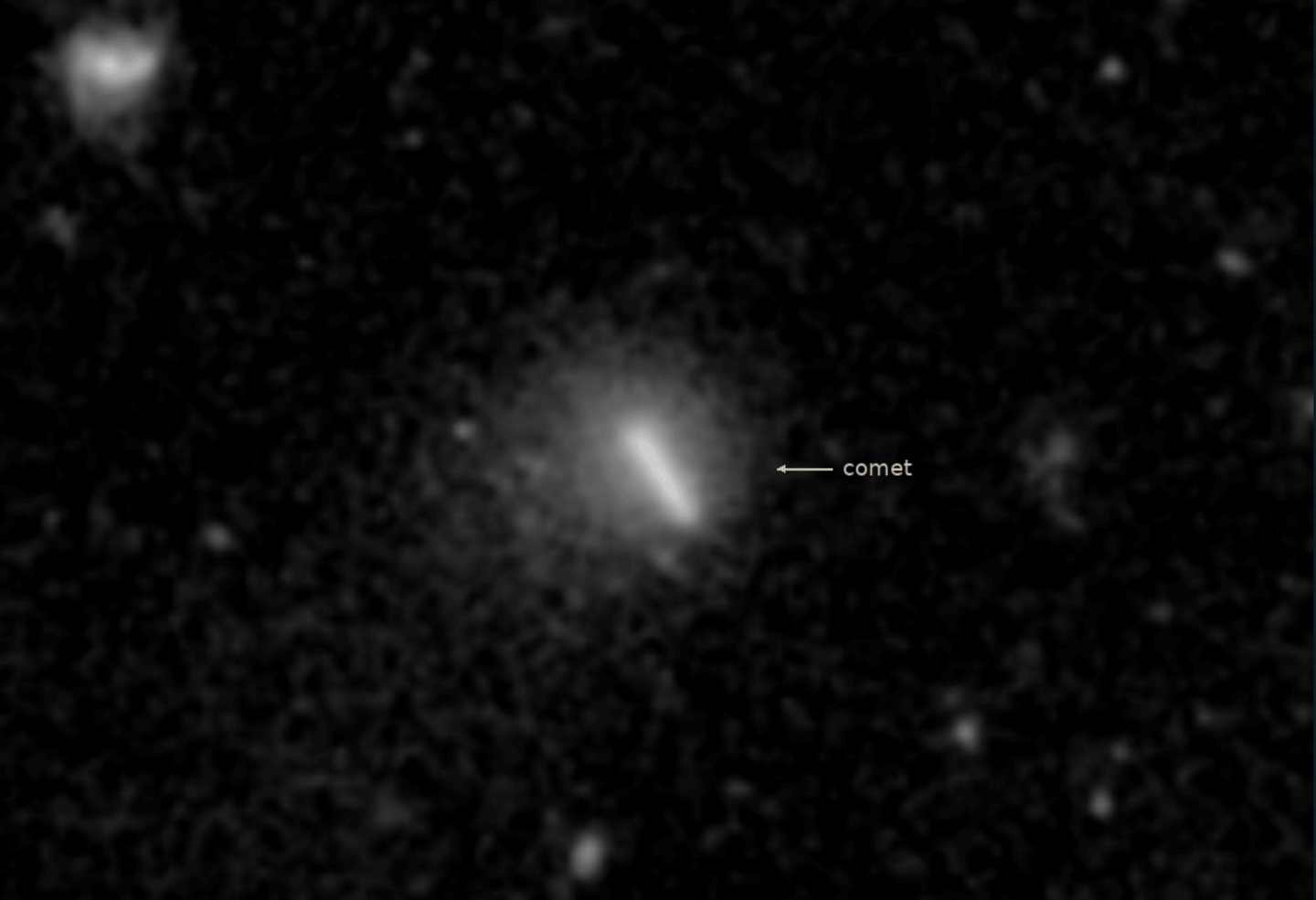
Euclid discovered comet C/2026 S1 in galaxy survey images, testing a detection process that could help future comet missions. (CREDIT: ESA/Euclid/Euclid Consortium/NASA, M. Pöntinen et al. 2026)
- Euclid has discovered its first previously unknown comet, C/2026 S1 (Euclid), in images captured during September 2026.
- Detection software identified the moving object across 16 exposures, while its surrounding fuzzy cloud indicated cometary activity.
- The discovery tests a process that could help identify future spacecraft targets, although this comet is unsuitable for Comet Interceptor.
A faint streak crossing images of distant galaxies has given Europe’s Euclid space telescope an unexpected discovery: its first previously unknown comet. The object appeared in observations taken between September 16 and 24, 2026. Its movement and surrounding cloud of material helped distinguish it from the distant objects Euclid normally studies.
Now designated C/2026 S1 (Euclid), the comet was confirmed on October 8 by the International Astronomical Union’s Minor Planet Center. The European Space Agency announced the discovery on October 19. Euclid had detected known comets before, but this marks its first discovery of one absent from existing catalogues.
The finding also provides a practical test for identifying distant comets and alerting other astronomers. That process could eventually help ESA find a destination for its future Comet Interceptor mission. This particular comet, however, is not a suitable target.
A moving streak among distant galaxies
Mikko Pöntinen, a doctoral student at the University of Helsinki, developed software to identify small Solar System objects in Euclid’s images. Working with the Euclid Consortium’s Solar System Objects Science Working Group, he used it to flag the comet’s trail. An object moving during an exposure can leave an elongated mark instead of a compact point.
The initial detection became more convincing when Pöntinen predicted where the object should appear in other observations. He located it across five separate image sets. Closer inspection showed a fuzzy cloud surrounding the object, evidence consistent with a comet releasing dust and gas.
Those observations came from Euclid Deep Field North, one of the mission’s dedicated deep-survey regions. The comet appeared in five different fields of view over several days. Each field contained between two and four exposures, producing 16 exposures altogether.
That sequence mattered because a single unexplained streak would provide a more limited basis for identification. Multiple observations allowed the team to follow the object’s movement and examine its appearance repeatedly. The discovery depended on both the detection software and the fortunate overlap between the comet’s path and Euclid’s observations.
From candidate to confirmed comet
Before reporting a discovery, the team checked catalogues of known comets and asteroids. No listed object matched the observations. Pöntinen then submitted the measurements to the Minor Planet Center on behalf of the working group.
The center serves as the international clearinghouse for observations of these small Solar System bodies. It collects reports, supports orbit calculations, confirms discoveries, and assigns official designations. The submission also alerted ground-based astronomers, who could contribute follow-up observations.
Confirmation on October 8 turned the candidate into an officially recognized comet. Yet confirmation does not mean every property of its orbit is settled. Additional measurements will refine its orbital period and improve astronomers’ understanding of its route through the Solar System.
The distinction is important for an object expected to take thousands of years to complete an orbit. A short observing interval samples only a small portion of that journey. Continued tracking can strengthen the orbital picture without changing the significance of the initial identification.
A distant visitor above the planetary plane
At the time of ESA’s announcement, the comet was approximately 1.3 billion kilometres from Earth. That distance is comparable in scale to the Sun’s distance to a location between Jupiter’s and Saturn’s orbits. It does not mean the comet sits between those planets along their shared orbital plane.
Instead, the comet occupies a position far above that plane, viewed from the Sun. Its path arches over the Solar System rather than following the relatively flat arrangement of the planets. That geometry helped bring it into a region Euclid was observing.
Comets contain ice and dust left over from the Solar System’s formation about 4.6 billion years ago. As they approach the Sun, escaping gas can carry dust away from their surfaces. The resulting cloud, called a coma, gives an active comet its characteristic fuzzy appearance.
Such objects preserve clues to the materials involved in planet formation. Their study can also inform questions about the origins of Earth’s water and organic ingredients. Discovering this comet does not answer those questions directly, but it adds another object that astronomers can investigate.
Why Euclid was an unlikely discoverer
Euclid’s primary assignment concerns the distant Universe, particularly the influence of dark matter and dark energy. Its planned six-year survey will observe billions of galaxies across cosmic history. The mission needs sensitive, stable observations rather than a schedule built around following nearby moving targets.
Its observing strategy reflects those priorities. Euclid points at a patch of sky, collects measurements, and then moves to another position. This “step-and-stare” approach builds a large survey from individual observations rather than continuously tracking a comet.
The mission also avoids regions where foreground stars and dust would interfere with galaxy measurements. Dust near the Solar System’s plane scatters sunlight, creating an unwanted foreground glow. Avoiding that region reduces interference but also limits opportunities to encounter the many small bodies concentrated near it.
The deep survey provides an important distinction from Euclid’s broad sky coverage. Its selected fields receive repeated observations, helping reveal fainter distant objects. Even there, however, the mission’s schedule serves its cosmological goals rather than offering immediate follow-up whenever a moving object appears.
Finding small Solar System bodies nevertheless supports the main survey. Astronomers must recognize moving trails and additional foreground light to prevent them from contaminating galaxy measurements. Software designed to identify those features can therefore improve the survey while producing discoveries beyond its central purpose.
A rehearsal for a future comet encounter
The discovery’s wider importance lies partly in how quickly observations became an alert that other astronomers could use. A distant comet can offer more time for follow-up than one detected only after approaching the Sun. That opportunity matters when scientists are evaluating potential spacecraft destinations.
ESA’s Comet Interceptor is designed to wait in space before departing toward a suitable comet. Its scientific goal is to examine material preserved from the early Solar System. The challenge includes finding an appropriate object with a trajectory the mission can reach.
C/2026 S1 (Euclid) does not meet the requirements for that encounter. Its discovery therefore represents a test of coordination, rather than the selection of a destination. Euclid’s team can identify a candidate, report its observations, and help initiate the follow-up needed to assess it.
For now, astronomers have another comet to track and an orbit to refine. The broader opportunity is to repeat that process when a suitable target appears. Whether Euclid’s next unexpected streak can become a spacecraft destination will depend on the object’s path and the speed of the response.
Dig deeper into Euclid and comet exploration
These resources explain comet origins, Euclid’s observing strategy, and the mission that could visit a future discovery.
- Comets
Introduces comet composition, activity, and the distant reservoirs containing many of the Solar System’s icy bodies. NASA, updated September, 2026. - Euclid’s wide and deep surveys
Explains the difference between Euclid’s broad survey and its repeatedly observed deep fields, including the northern discovery region. European Space Agency, February, 2024. - Where do comets come from?
Compares comet pathways and explains the distinction between Solar System comets and visitors from interstellar space. European Space Agency, December, 2023. - How Euclid scans the sky
Illustrates the step-and-stare observing method that shapes Euclid’s opportunities to detect moving objects. European Space Agency, February, 2023. - Comet Interceptor
Describes the mission’s waiting strategy and its planned investigation of a suitable comet using a spacecraft and two probes. European Space Agency
The original story "University of Helsinki student finds a previously unknown comet in Euclid’s images" is published in The Brighter Side of News.
Related Stories
- JWST detected an icy world beyond Jupiter transforming into a comet
- Astronomers spot signs of comets transporting water to a young solar system PDS 70
- Interstellar comet 3I/ATLAS may come from a solar system much older than our own
Like these kind of feel good stories? Get The Brighter Side of News' newsletter.
Joseph Shavit
Writer, Editor-At-Large and Publisher
Joseph Shavit, based in Los Angeles, is a seasoned science journalist, editor and co-founder of The Brighter Side of News, where he transforms complex discoveries into clear, engaging stories for general readers. With vast experience at major media companies like The Los Angeles Times, Times Mirror and Tribune Publishing, he writes with both authority and curiosity. His writing focuses on space science, planetary science, quantum mechanics, geology. Known for linking breakthroughs to real-world markets, he highlights how research transitions into products and industries that shape daily life.