JWST detected an icy world beyond Jupiter transforming into a comet
A Saturn encounter sent 450P onto a warmer orbit, where buried ice and carbon dioxide may now be awakening the tiny Centaur.
 UCF Writer: Mikita Nayee

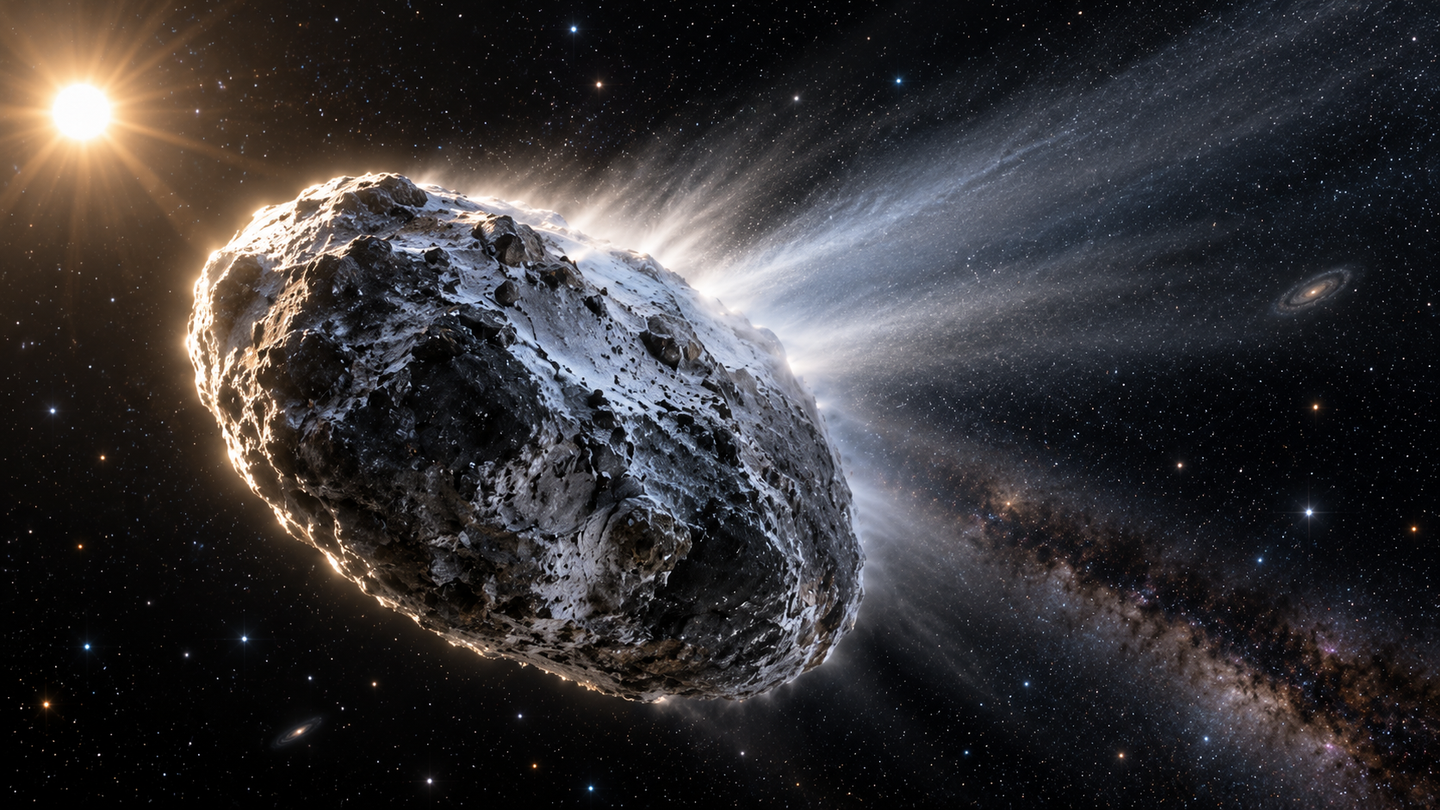
JWST detected CO₂ and icy dust around Centaur 450P/LONEOS, revealing how a frozen outer solar system body may become comet-like. (CREDIT: Shutterstock)
- JWST detected carbon dioxide gas around the active Centaur 450P/LONEOS while finding no detectable water-vapor or carbon-monoxide emission, pointing to CO₂ as an important driver of its distant activity.
- A close encounter with Saturn in 1992 shifted 450P onto a warmer orbit, and thermal modeling favors carbon dioxide released as buried amorphous water ice crystallizes.
- The object may offer astronomers a rare view of a Centaur undergoing the physical changes that can eventually turn members of this population into Jupiter-family comets.
More than 3 billion miles from Earth, a small frozen world is showing what may happen when an ancient object from the solar system's deep freeze begins a journey toward becoming a comet.
The object, 450P/LONEOS, belongs to the Centaurs, icy bodies whose unstable orbits generally carry them among the giant planets. Observations with NASA's James Webb Space Telescope and the Gemini North telescope reveal a growing cloud of dust, carbon dioxide gas and water-rich icy grains around its nucleus.
The UCF-led team, headed by planetary scientist Charles Schambeau, argues that 450P offers an unusually detailed view of how stronger solar heating can activate a primitive outer-solar-system body.
Saturn gave the icy body a gravitational shove
Centaurs are thought to represent an evolutionary bridge between trans-Neptunian objects and Jupiter-family comets. Only about 15% show periods of visible activity, and ordinary water-ice sublimation cannot easily explain that behavior because these objects remain too cold at their typical distances from the Sun.
450P provides a particularly useful natural experiment. A close encounter with Saturn in 1992 sharply changed its orbit, moving it from a more distant trans-Saturnian path to one with a perihelion closer to Jupiter. Such abrupt changes in semimajor axis, called “a-jumps,” expose Centaurs to greater solar heating.
“Centaurs are scientifically important because they are thought to be transitional objects that originated farther out in the solar system and are slowly evolving toward becoming Jupiter-family comets,” Schambeau said.
Earlier research found similar recent orbital jumps among all 39 active Centaurs examined in one study, supporting the idea that encounters with Jupiter or Saturn can trigger comet-like behavior by rapidly changing a body's thermal environment.
A faint coma appeared as 450P warmed
Gemini North observations initially showed little evidence of activity. When astronomers recovered 450P in August 2022 after it had gone undetected for about 15 years, it appeared essentially point-like, allowing them to estimate a nucleus radius of about 1.8 plus or minus 0.5 kilometers.
That changed as the Centaur approached the Sun. Gemini images showed its coma switching on somewhere between 7.83 and 7.23 astronomical units from the Sun. One astronomical unit is the average Earth-Sun distance.
Dust activity then increased substantially. Measurements from July 2023 and January 2024 suggest dust production rose from roughly 4 kilograms per second to about 8 kilograms per second as the object moved inward.
“That increased solar heating can warm the surface and subsurface layers of the nucleus,” Schambeau said. “As those layers heat up, volatile ices or trapped gases can be released, which can drag dust away from the surface and produce a coma.”
Webb found carbon dioxide but no water vapor
JWST supplied the crucial chemical evidence on Sept. 3, 2023, when 450P was 7.16 astronomical units from the Sun.
Its Near-Infrared Spectrograph detected a strong carbon dioxide emission feature at 4.26 micrometers. The team calculated a CO₂ production rate of about 6.99 × 10²⁴ molecules per second. Neither gaseous water nor carbon monoxide was detected, although the observations established upper limits for both.
That matters because 450P is far too cold for vigorous water-ice sublimation, the process that drives much of the activity seen in comets closer to the Sun. Carbon dioxide can become active at lower temperatures and therefore provides a more plausible source of the gas lifting dust from 450P's surface.
“The carbon dioxide detection was important because it directly identified one of the gases likely driving the activity,” Schambeau said.
Webb also detected absorption features attributed to solid water ice in the coma. Modeling favored relatively large grains around 5.9 micrometers across, containing an estimated 33% water ice by volume. A subtle spectral feature at 3.1 micrometers provides additional evidence that some of this material may be crystalline water ice.
Buried ice may be releasing trapped gas
The carbon dioxide does not necessarily come from exposed deposits of pure frozen CO₂.
Thermal modeling showed that temperatures capable of sublimating pure carbon dioxide could have reached more than 200 meters into parts of 450P before its 1992 encounter with Saturn. Much of that accessible ice could therefore have been depleted earlier.
The researchers favor another mechanism involving amorphous water ice. Unlike crystalline ice, amorphous ice has a disordered molecular structure capable of trapping volatile gases inside microscopic spaces.
As incoming solar energy warms this material, it can reorganize into crystalline ice. The model indicates that temperatures associated with efficient crystallization, roughly 140 to 160 kelvins, became more relevant after 450P's orbital shift. Trapped carbon dioxide could then escape through the porous nucleus and carry dust into space.
The evidence favors this explanation but does not prove it. Only one JWST gas measurement was available, and the researchers acknowledge that more sophisticated thermal models would be poorly constrained without repeated observations.
Watching a cometary transition unfold
450P therefore offers something unusual: an object with a relatively well reconstructed orbital history, measurable carbon dioxide, changing dust activity and potentially primitive ice responding to a new thermal environment.
The paper's orbital calculations also predicted that 450P would pass about 0.5 astronomical units from Jupiter in July 2026, an encounter expected to stabilize its orbit for roughly the next 200 years. Because those calculations preceded the encounter, its longer-term physical consequences remain a prediction rather than an observed result.
“Studying objects like 450P helps us connect different stages of small-body evolution,” Schambeau said. “Centaurs are likely related to trans-Neptunian objects, and some will eventually become short-period comets.”
Long-term Webb observations could now track whether its carbon dioxide and dust production continue to increase and whether water vapor or carbon monoxide eventually becomes detectable.
450P has not suddenly become an ordinary inner-solar-system comet. Instead, astronomers may be observing something more revealing: the slow physical awakening of an icy body as planetary gravity pushes it into a warmer, more active phase of its existence.
Dig deeper into active Centaurs and comet evolution
These studies examine how volatile chemistry, orbital changes and ice transformations can turn distant Centaurs into active comet-like bodies.
First Detection of CO₂ Emission in a Centaur: JWST NIRSpec Observations of 39P/Oterma: Reports JWST's first detection of carbon dioxide emission from a Centaur and shows how CO₂ can drive activity where water sublimation is weak. (The Planetary Science Journal, 2023)
Semimajor-axis Jumps as the Activity Trigger in Centaurs and High-perihelion Jupiter-family Comets: Finds recent rapid orbital changes among active Centaurs and connects those shifts with increased solar heating and comet-like activity. (The Astrophysical Journal Letters, 2024)
Heterogeneous outgassing regions identified on active centaur 29P/Schwassmann–Wachmann 1: Uses JWST molecular mapping to reveal CO and CO₂ outgassing from distinct active regions on one of the best-studied active Centaurs. (Nature Astronomy, 2024)
29P/Schwassmann–Wachmann 1: A Rosetta Stone for Amorphous Water Ice and CO ↔ CO₂ Conversion in Centaurs and Comets?: Explores how amorphous water ice crystallization could release trapped gases and power distant cometary activity. (The Planetary Science Journal, 2022)
A Survey of CO, CO₂, and H₂O in Comets and Centaurs: Compares major volatile production across comets and Centaurs and examines how CO and CO₂ contribute to activity at different solar distances. (The Planetary Science Journal, 2022)
Research findings are available online in the journal Planetary Science.
The original story "JWST detected an icy world beyond Jupiter transforming into a comet" is published in The Brighter Side of News.
Related Stories
- Astronomers spot signs of comets transporting water to a young solar system PDS 70
- Interstellar comet 3I/ATLAS may come from a solar system much older than our own
- JWST solves a longstanding cosmic mystery about comet crystals
Like these kind of feel good stories? Get The Brighter Side of News' newsletter.
Joseph Shavit
Writer, Editor-At-Large and Publisher
Joseph Shavit, based in Los Angeles, is a seasoned science journalist, editor and co-founder of The Brighter Side of News, where he transforms complex discoveries into clear, engaging stories for general readers. With vast experience at major media companies like The Los Angeles Times, Times Mirror and Tribune Publishing, he writes with both authority and curiosity. His writing focuses on space science, planetary science, quantum mechanics, geology. Known for linking breakthroughs to real-world markets, he highlights how research transitions into products and industries that shape daily life.