Life in the universe may have formed less than 300 million years after the Big Bang
Water-rich worlds may have begun forming only a few hundred million years after the Big Bang, far earlier than once expected.

 Edited By: Joshua Shavit

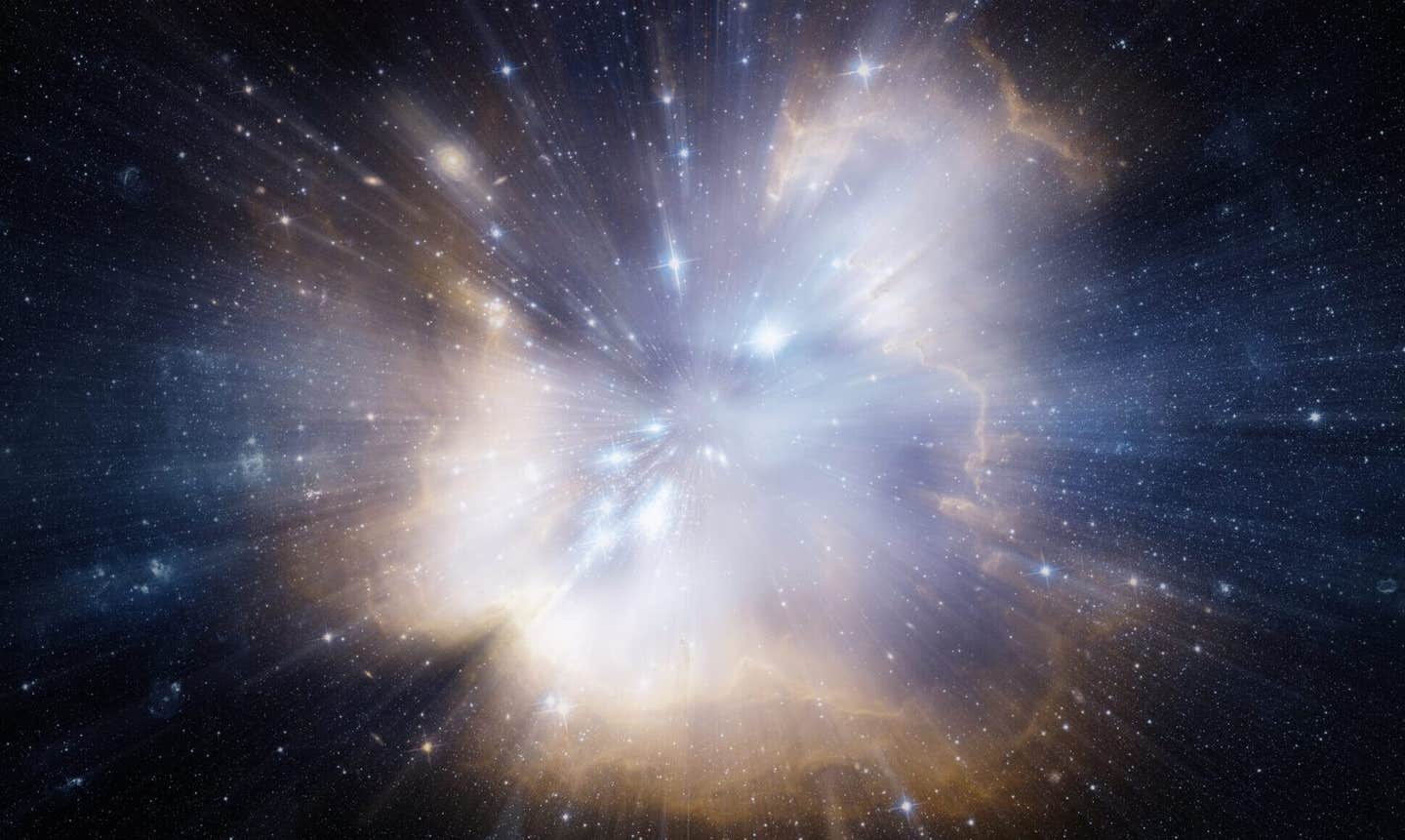
Simulations suggest water and rocky worlds may have appeared within 300 million years of the Big Bang, opening an earlier window for life. (CREDIT: Shutterstock)
- Water-rich environments capable of forming stars and planets may have existed only 100 million to 200 million years after the Big Bang.
- Simulations suggest explosions from the universe’s first stars could have created dense pockets containing water at levels approaching those found in the solar system.
- The findings do not show that life existed that early, but they greatly widen the period when potentially habitable worlds could have begun forming.
Life on Earth has existed for at least 3.7 billion years, but the universe had already been around for billions of years before our planet formed. That leaves a much older question hanging over astrobiology: How soon after the Big Bang could the ingredients for life have appeared?
Computer simulations now suggest one crucial ingredient, water, may have emerged astonishingly early. A 2025 study in Nature Astronomy found that supernova explosions from the first generation of stars could have produced water-rich pockets of gas only 100 million to 200 million years after the Big Bang.
In some of those dense regions, the simulated amount of water approached levels found in the solar system today. The same pockets could later collapse into stars and planet-forming disks.
“What our simulations showed was that you could get sites for planet formation already enriched with water levels similar to [those in] the solar system today only 200 million years after the big bang,” said Daniel Whalen, an astrophysicist at the University of Portsmouth and lead author of the study.
That finding pushes a basic requirement for habitable worlds deep into cosmic history.
Before there was water
The universe began about 13.8 billion years ago. In its first few minutes, nucleosynthesis produced mostly hydrogen and helium, with traces of lithium and beryllium.
Water could not form yet because oxygen did not exist in meaningful quantities. Carbon, nitrogen, oxygen, phosphorus and other heavier elements needed for life as we know it had to wait for stars.
The first stars eventually formed from primordial hydrogen and helium. They were probably far more massive than the Sun, and many lived short lives before exploding as supernovae.
Those stellar furnaces changed the chemistry of the cosmos. Fusion inside stars created heavier elements, while their explosions scattered that material into surrounding space.
“For 100 million years, the universe did not have the building blocks of life, like oxygen or carbon. Once nuclear fusion started in stellar interiors, the universe became far more interesting,” said Avi Loeb, an astrophysicist at Harvard University.
Once oxygen existed, it could combine with abundant hydrogen to make water. The difficult question was whether enough water could form and survive in the harsh environment of the early universe.
Supernovae became cosmic water factories
Whalen and his colleagues modeled the explosions of two primordial stars, one 13 times the mass of the Sun and another 200 times its mass.
The smaller simulated star lived for about 12 million years before exploding and ejecting 17,000 Earth masses of oxygen. The much larger star survived only about 2.5 million years and produced 55 solar masses of oxygen, more than 18 million Earth masses.
As each simulated supernova expanded, its shock wave created density variations in nearby gas. Some regions condensed into clumps and became enriched with oxygen and other elements carried outward by the explosion.
Those dense clumps made all the difference.
Earlier work had suggested that warmer, denser gas could accelerate chemical reactions that create water, helping them overcome both low oxygen concentrations and destructive ultraviolet radiation.
“At high gas temperatures, a set of very efficient chemical reactions that lead to water formation kick in,” said Shmuel Bialy of the Technion–Israel Institute of Technology.
NASA/WMAP Science Team)
The simulations found that although the total amount of water produced by a supernova remained modest, particular dense clumps could become surprisingly water-rich.
“While the total water production in a given supernova explosion is modest, the water mass fraction in dense clumps created by the explosion can approach those that exist in the solar system today,” Whalen said.
Could planets have followed?
Water alone does not make a living world. It still needs a suitable environment, and for life resembling Earth’s, that likely means a rocky planet.
A related simulation study led by Whalen examined whether enriched gas left behind by primordial supernovae could eventually produce such worlds.
The model followed one dense clump as it collapsed into a low-mass star about 70% the mass of the Sun. A protoplanetary disk formed around it, along with several Earth masses of planetesimals, the small building blocks from which rocky planets can grow.
That simulation placed planetesimals between 0.46 and 1.66 astronomical units from the star. Their water abundance was only a few times lower than that of material in today’s solar system.
The work suggests rocky, water-bearing worlds could have begun forming roughly 200 million years after the Big Bang, before recognizable galaxies became common.
Another 2025 study reached a related conclusion from a different direction. Simulations published in Monthly Notices of the Royal Astronomical Society found that vortices in early protoplanetary disks could concentrate dust enough to form planetesimals even when heavy elements were scarce.
How early could life actually begin?
The jump from water and rocky worlds to life remains enormous.
Earth offers the only confirmed example. Life was established here at least 3.7 billion years ago, and some hypotheses place the earliest self-replicating chemistry even earlier.
Defining life itself is difficult. More than 200 definitions have been published, and borderline cases such as viruses and prions show why the boundary remains disputed. One broad definition treats life as anything capable of Darwinian evolution.
Under that definition, the first living systems may have been far simpler than modern cells. Today’s organisms use DNA, RNA and proteins in an elaborate molecular partnership, but those systems must have emerged from earlier chemistry.
The early-universe simulations do not show that life existed hundreds of millions of years after the Big Bang. They show something narrower but still striking: Some of the materials and environments needed for potentially habitable planets may have appeared extraordinarily early.
Whalen also cautioned that the models remain incomplete. The simulations treated individual first-generation stars, even though many stars may have formed close together. Astronomers also remain uncertain about the typical masses of those first stars.
Still, the cosmic timetable has widened. The universe may not have needed billions of years before it could begin assembling wet, rocky places where biology might eventually take hold.
If some low-mass stars formed in that era, they could even still exist today. Their planets, if they formed and survived, would be relics from a time when the universe itself was only beginning to light up.
Dig deeper into primordial water, early planets and the origins of life
These resources explore how early planets could form, how water survives through star and planet formation, and how scientists define and search for life beyond Earth.
Habitable Worlds Formed at Cosmic Dawn: This simulation study examines whether metal-enriched debris from the first supernovae could form low-mass stars, protoplanetary disks and planetesimals only about 200 million years after the Big Bang. It provides a direct theoretical bridge between primordial water production and the possible formation of rocky worlds. (arXiv preprint, 2025)
Planets and planetesimals at cosmic dawn: vortices as planetary nurseries: This study tests whether dust-trapping vortices in very metal-poor protoplanetary disks could concentrate enough solid material to form the first planetesimals and planets. The simulations identify conditions under which Mercury- and Mars-mass worlds could begin forming at cosmic dawn. (Monthly Notices of the Royal Astronomical Society, 2025)
Pristine ices in a planet-forming disk revealed by heavy water: Observations of heavy water in a planet-forming disk indicate that water ice can survive from the earliest stages of star formation into protoplanetary disks. The findings strengthen the idea that some planetary water can be inherited from material that existed before a planet itself formed. (Nature Astronomy, 2025)
Agnostic Biosignatures: Expanding the Search for Life in the Solar System: This review examines ways to search for life without assuming it must use the same molecules, metabolism or chemistry found on Earth. It is especially relevant to broader definitions of life based on universal properties rather than familiar terrestrial biology. (Annual Review of Earth and Planetary Sciences, 2026)
Reconstructing Early Microbial Life: This review explores what can be reconstructed about Earth’s earliest microorganisms and the environments in which they evolved. It provides useful context for separating evidence about when life existed from hypotheses about when simpler evolutionary systems may first have emerged. (Annual Review of Microbiology, 2024)
Research findings are available online in the journal Nature Astronomy.
The original story "Life in the universe may have formed less than 300 million years after the Big Bang" is published in The Brighter Side of News.
Related Stories
- CERN physicists recreate matter from the early universe using ‘Little Big Bangs’
- New study reveals how dark matter formed shortly after the Big Bang
- Scientists use Einstein’s equations to reveal what came before the Big Bang
Like these kind of feel good stories? Get The Brighter Side of News' newsletter.
Joseph Shavit
Writer, Editor-At-Large and Publisher
Joseph Shavit, based in Los Angeles, is a seasoned science journalist, editor and co-founder of The Brighter Side of News, where he transforms complex discoveries into clear, engaging stories for general readers. With vast experience at major media companies like The Los Angeles Times, Times Mirror and Tribune Publishing, he writes with both authority and curiosity. His writing focuses on space science, planetary science, quantum mechanics, geology. Known for linking breakthroughs to real-world markets, he highlights how research transitions into products and industries that shape daily life.