New global atlas reveals where rare Earth elements form deep inside Earth
Scientists map rare earth deposits worldwide, linking them to thick ancient lithosphere deep beneath continents.

 Edited By: Joseph Shavit

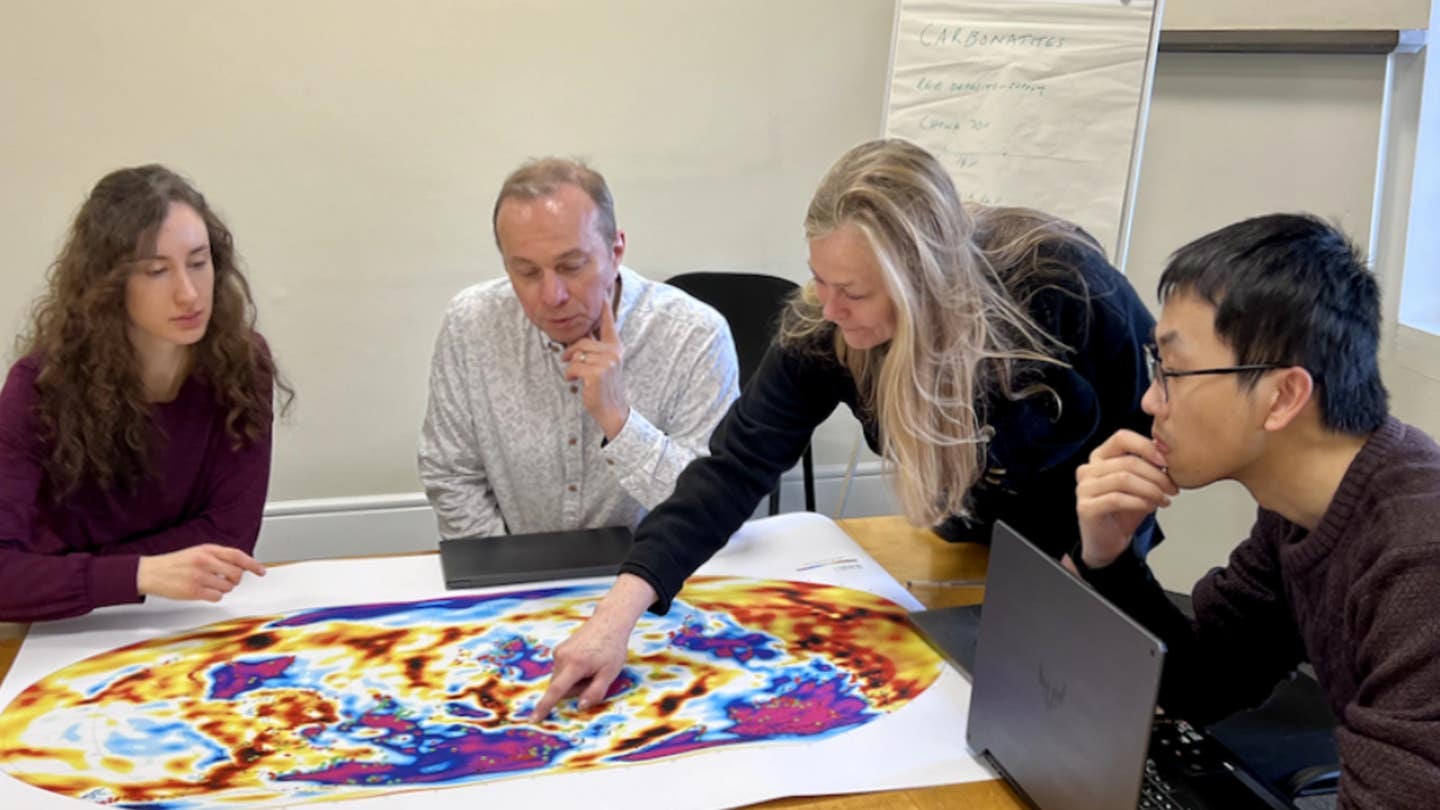
A new study reveals how Earth’s deep structure controls the formation of rare earth elements, offering clues for future discovery. (CREDIT: Cambridge Earth Sciences)
A new global study is offering a clearer view of how some of the world’s most valuable mineral deposits form, tracing their origins deep beneath Earth’s surface. Scientists have created an atlas of unusual, carbon-rich igneous rocks and discovered that they tend to cluster near the thickest and oldest parts of continents.
The research, led by scientists at the University of Cambridge, links these rocks to the structure of Earth’s lithosphere, the rigid outer shell of the planet. The findings could help guide the search for rare earth elements, which are essential for modern technologies.
Rare earth elements power smartphones, wind turbines, and electric vehicles. Yet global supply remains uneven, with many countries relying heavily on imports. This new research offers a way to better predict where these resources may be found.
A Hidden Pattern Beneath Continents
The study focused on a special group of rocks rich in carbon dioxide. These rocks are known to host rare earth elements, making them critical for both industry and clean energy.
Researchers analyzed chemical data from about 9,000 rock samples collected worldwide. They then compared these locations with detailed maps of Earth’s interior.
The results revealed a clear pattern. These rocks appear most often near the edges of thick, ancient continental cores. These regions, sometimes called cratons, are the oldest and most stable parts of continents.
Dr Emilie Bowman, lead author of the study, said the findings offer new predictive power. “Our research is beginning to provide a kind of predictive power for where we can expect these rocks and, by extension, their associated rare earth element deposits, to form.”
The Role Of The Lithosphere
The lithosphere plays a central role in shaping this pattern. It varies in thickness across the globe, from less than 100 kilometers to more than 200 kilometers in some regions.
Thicker lithosphere creates unique conditions deep underground. It keeps the underlying mantle cooler and under higher pressure. This limits how much rock melts and produces small pockets of magma.
These small magma pockets often become trapped at depth. Over time, they evolve chemically and concentrate metals.
Professor Sally Gibson, a senior author of the study, explained the process. Only small amounts of mantle rock melt under these conditions, creating isolated magma pockets. These pockets can later be re-melted, allowing metals to become more concentrated.
This slow, repeated heating process acts like a natural refining system.
Seeing Inside The Earth
To understand where these processes occur, scientists combined rock chemistry with seismic data. Seismic waves from earthquakes travel differently depending on the structure of the Earth.
By studying these waves, researchers can map the thickness of the lithosphere. This method works much like sonar mapping in the ocean.
Professor Sergei Lebedev described the approach. “Using seismic waves from earthquakes, we can create a slice-through image of the lithosphere, much like a sonar can pick out features on the seabed.”
When the team overlaid this data with rock locations, the connection became clear. The right types of rocks formed mainly along steep boundaries between thick and thinner lithosphere.
Why Thickness Matters
The thickness of the lithosphere determines how magma forms and evolves. In thinner regions, melting happens more easily and produces larger amounts of magma. These magmas tend to be less enriched in rare elements.
In thicker regions, melting is limited. Only small amounts of magma form, but they are richer in carbon dioxide and metals.
Because these magmas are trapped at depth, they have time to evolve. Over millions of years, they become enriched in rare earth elements and other valuable materials.
This explains why the most important deposits are often found near ancient continental cores.
From Curiosity To Critical Resource
For decades, these unusual rocks puzzled geologists. They were often studied as scientific curiosities rather than economic resources.
Professor Gibson noted that their complexity made them difficult to understand. “The terminology is so sprawling that you could almost make a new language from these rock names,” she said.
However, their importance has grown in recent years. As demand for rare earth elements has increased, these rocks have become a focus of intense study.
The new atlas brings clarity to this once confusing field. By organizing global data, it reveals consistent patterns that were previously hidden.
Linking Surface Rocks To Deep Processes
One of the study’s key achievements is connecting surface geology with deep Earth processes. By combining chemical data with seismic imaging, researchers created a more complete picture of how these rocks form.
Dr Siyuan Sui, a co-author, helped integrate these datasets. The work shows that surface deposits are closely tied to deep structures.
This connection allows scientists to look beyond individual sites. Instead of studying deposits one by one, they can now understand the larger system that controls their formation.
A Global Perspective On Mineral Formation
Previous research often focused on specific regions or individual deposits. This study takes a broader approach by examining patterns across the entire planet.
The researchers focused on rocks formed within the last 200 million years. These younger rocks are easier to study because they have been less altered by tectonic processes.
However, most major rare earth deposits are older. The team plans to extend their work to include these ancient rocks.
Professor Gibson said this next step will be more challenging. Older rocks have been reshaped by mountain building and continental movement. Despite this, she believes the same patterns may apply.
Implications For Resource Security
The findings have important implications for global resource supply. Rare earth elements are essential for modern technology, yet their production is concentrated in a few regions.
By identifying where these deposits are likely to form, the study could help countries develop their own sources. This would reduce reliance on imports and improve supply security.
It could also lead to more sustainable mining practices. By targeting the most promising areas, exploration efforts can become more efficient and less disruptive.
Understanding Earth’s Carbon Cycle
The research also sheds light on Earth’s carbon cycle. Carbon-rich magmas play a role in moving carbon from the deep Earth to the surface.
Understanding where these magmas form helps scientists track how carbon moves over long timescales. This has implications for climate studies and Earth system science.
The study shows that deep Earth processes are closely linked to surface conditions. Changes in the lithosphere can influence both mineral formation and carbon movement.
Practical Implications Of The Research
This research could transform how scientists and industries search for critical minerals. By linking rock formation to lithospheric thickness, it provides a roadmap for identifying new deposits.
For governments and companies, this means more targeted exploration. Instead of searching broadly, efforts can focus on regions with the right geological conditions. This can reduce costs and limit environmental impact.
The findings also support the transition to clean energy. Rare earth elements are essential for technologies like electric vehicles and renewable energy systems. A more reliable supply can accelerate this transition.
For researchers, the study opens new pathways for understanding Earth’s interior. It shows how combining seismic data with geochemistry can reveal hidden patterns.
In the long term, this approach could improve predictions not only for mineral deposits but also for volcanic activity and carbon movement. It highlights the importance of studying Earth as an interconnected system, where deep processes shape the world at the surface.
Research findings are available online in the journal Nature Geoscience.
The original story "New global atlas reveals where rare Earth elements form deep inside Earth" is published in The Brighter Side of News.
Related Stories
- Physicists discover the upper limit of electrical resistance in metals
- Schrödinger’s anthill: Quantum entanglement detected inside a centimeter-sized strange metal
- Life depended on a rare metal for survival - billions of years ago
Like these kind of feel good stories? Get The Brighter Side of News' newsletter.
Rebecca Shavit
Writer
Based in Los Angeles, Rebecca Shavit is a dedicated science and technology journalist who writes for The Brighter Side of News, an online publication committed to highlighting positive and transformative stories from around the world. Having published articles on MSN, AOL News, and Yahoo News, Rebecca's reporting spans a wide range of topics, from cutting-edge medical breakthroughs to historical discoveries and innovations. With a keen ability to translate complex concepts into engaging and accessible stories, she makes science and innovation relatable to a broad audience.