Robot submarine exploring the Mariana Trench discovers explosive volcanic activity
A robotic expedition recovered the deepest known pyroclastic deposits on the Mariana Trench wall, revealing unexpected volcanism near Challenger Deep.

 Editor: Joseph Shavit

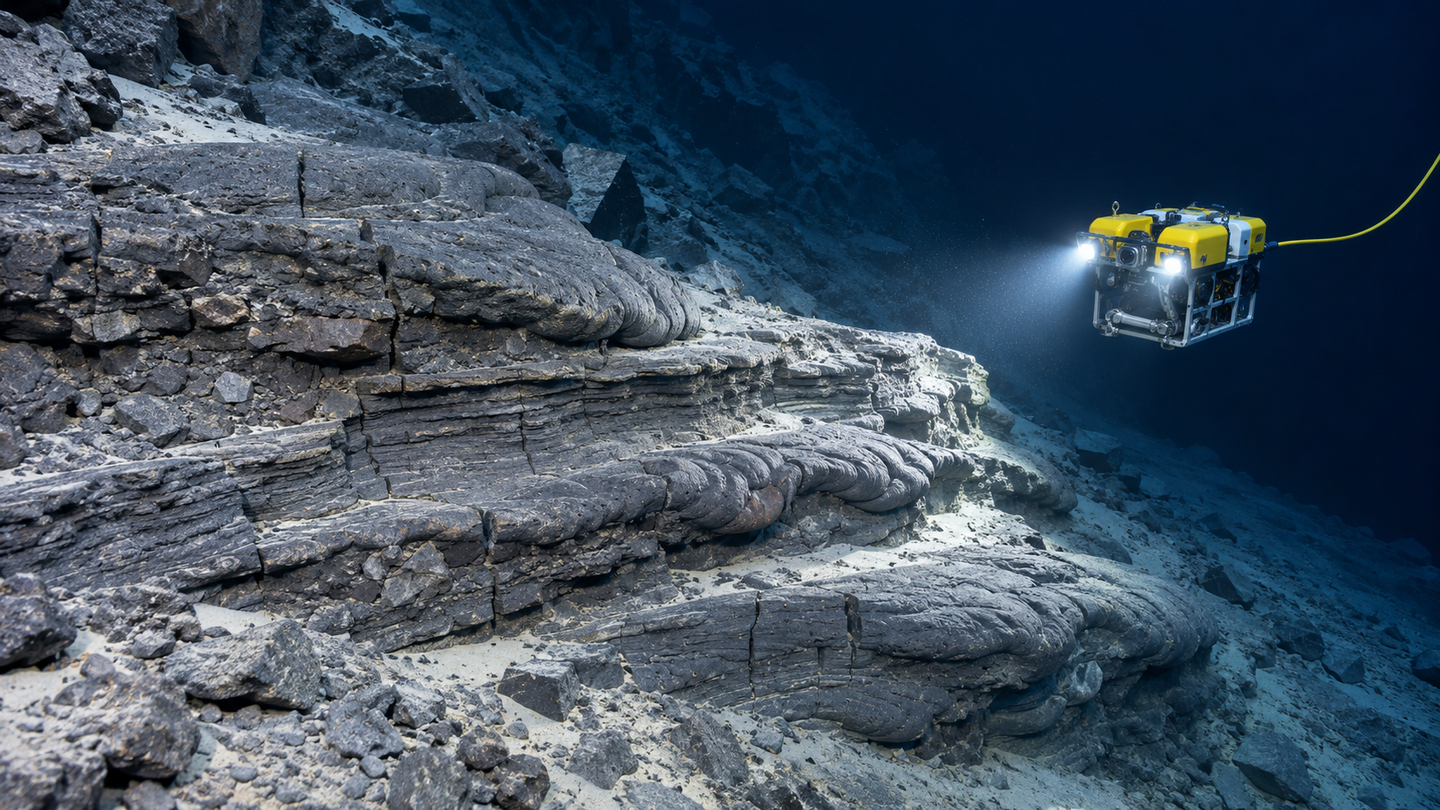
An illustrative reconstruction shows a research robot illuminating layered volcanic deposits near Challenger Deep, where scientists found the deepest known evidence of explosive underwater eruptions. (CREDIT: The Brighter Side of News)
The climb took place on a slope in the Mariana Trench, where sheets of thin rock abutted the ocean floor. Some samples showed rounded edges, whereas others had been broken up into large rectangular slabs. For geologists studying the trench wall around Challenger Deep, these physical characteristics signaled a rare event in the world of trenches: the occurrence of explosive volcanism.
The rocks are found at depths greater than 6,000 meters below sea level, a range where hydrostatic pressure limits the expansion of volcanic gasses. The scientists took samples in order to understand why this section of the ocean reaches such depths. The subduction of the Pacific plate in this area began approximately 52 million years ago. The stratigraphy on the western wall seems to represent a much more recent stage of that tectonic history. As the dives continued, parts of the exploration turned out to be a study of volcanism in an extremely deep ocean.
The research was conducted by Robert J. Stern of the University of Texas at Dallas and published in Frontiers in Earth Science. “Explosive volcanism near trenches is unusual, so we were very surprised,” says Stern. “These are the deepest pyroclastic rocks recorded so far in the ocean."
Trench-wall transect
Late in 2024, the research team sent the remotely operated vehicle Jason/Medea along the trench wall. The ROV was capable of exploring at depths of 6,500 meters, putting it in the hadal zone, which begins at 6,000 meters and includes the ocean’s deepest trenches. The Challenger Deep seafloor lies nearly 4,500 meters below this line.
Seven dives included sites scattered along roughly 300 kilometers of a 550-kilometer stretch of the Mariana forearc. Forearcs are the areas between the trench and the volcanic arc, where deformation is transferred to the overriding plate. In the southern Marianas, the forearc wall gives scientists access to rock stratigraphy otherwise out of reach, including rocks from the upper mantle.
During one western dive, the ROV climbed from a depth of about 6,400 meters to just below 6,000 meters. At a depth of 6,148 meters, the cameras on the vehicle captured thin laminae with rounded edges, which are believed to be distal fronts of pyroclastic flows. At 6,334 meters, the observations showed flat slabs broken into roughly rectangular blocks.
The scientists believe that these slabs broke up as the hot material cooled and shrank. Analysis of samples revealed angular volcanic fragments embedded in a coherent hard-rock matrix. Both the physical characteristics of the deposits and the texture of the samples provide two pieces of evidence for reconstructing an unseen event. One sample can indicate how the fragments fit together. Combined with video, the shape and position of the rock layer can be used to help determine whether the fragments gathered by the robot came from a deposit still in its original cooled state.
How an eruption behaves under pressure
On land, the escape of gases causes rapid expansion as ascending magma experiences a drop in pressure. This can fragment the molten rock and propel hot material downslope. Seawater adds a braking influence to this process, especially in the ocean’s deepest zones, where only sequences of volcanic rocks may provide a record of an eruption.
The scientists believe that water separated from the magma went through a supercritical phase. When under the right combination of heat and pressure, water loses the distinct boundary between liquid and gas. In this phase, its expansion is much smaller than that of the steam formed at shallow water depths or at the surface. Pressure affects the interpretation of other geological phenomena in the Pacific Ocean.
Even this reduced expansion could fragment the magma. The researchers believe that the reduced fragmentation could cause less seawater to be mixed with the debris, which helped keep the fragments hot enough to fuse after downslope migration.
This fusion can provide a clue as to how to pursue further investigations. According to Stern and colleagues, the flows covered a short distance, as a longer path would have allowed the material to cool more. The source vents are still unknown, and the supercritical-fluid theory needs testing. Sampling a vent and its surrounding stratigraphy could give researchers an opportunity to compare material near the source with deposits located farther downslope.
One trench wall, two paths of interpretation
The discovery is all the more surprising considering the location of the deposits. At the Mariana Trench, the Pacific Plate subducts beneath the Philippine Sea Plate system. In the area near the trench, the temperature of the overriding plate is too low to allow for mantle melting, which makes volcanic rocks uncommon in that area. The movements of tectonic plates create the trench and rock formations along its walls.
Eastern sites showed the exposure of comparatively older mantle rocks, including peridotite. The crust-mantle boundary in this area was relatively close to the surface. A large amount of exposed mantle supports a model in which forearc thinning takes place due to extension, a process different from the plate tearing described in other sections of the Pacific.
In contrast, western sites show more volcanic rocks of relatively younger appearance. This means that magma rising from great depths occupies some of the space left as the forearc thins. If this interpretation is correct, then there are two ways in which one section of the trench wall can widen: the extensional tearing of the existing rock towards the east and the accumulation of new rocks to the west.
Further sampling and radiometric dating will be necessary to test this interpretation. While the freshly created volcanic glass indicates that the eruptions occurred geologically recently, it does not give any calendrical date. Improved age determination could reveal whether the eruptions took place in a brief period of time or repeatedly over a longer time frame.
Why Challenger Deep descends to such depths
The differences between the eastern and western sections bring the discussion back to the main question of the expedition. The eastern section of Challenger Deep contains larger depths and steeper walls. This difference is important, as the force of the tectonic movements can change greatly along one plate boundary.
The data of the team support the explanation based on the degree of bending of the Pacific plate during subduction. The coupling in this area is rather weak, and the descending segment is rather short and narrow. These conditions allow for the bending of the segment and the deepening of the trench. Therefore, the physical characteristics of the seafloor contain information about the geometry of the plate.
The volcanic deposits answer a different question about the processes taking place on the wall above the bend. They show that hot, fragmented material reached the ocean floor in the depths of western slope despite having kilometers of water column above it. Identifying the sources of the vent would help to understand the extent of migration of debris and the extent to which the rocks show conditions during the eruption.
Jason/Medea could not continue operations below 6,500 meters, which is beyond the range of the current exploration. A vehicle capable of operations at greater depths could extend the research into that unsampled zone.
At the moment, the strongest evidence for these eruptions is a series of fractured layers on the wall continuing to go down for kilometers after them.
Dig deeper into Challenger Deep and underwater volcanism
These studies examine trench geometry, depth measurements and volcanic behavior under water.
Full-ocean-depth EM124 mapping of the Challenger Deep by R/V Hakuho-maru and depth-estimate sensitivity tests: This mapping study examines full-ocean-depth measurements and the factors affecting estimates of Challenger Deep's depth. (Scientific Data, 2026)
Unusually tight bending of subducting Pacific plate causes the extreme depth of Challenger Deep: This modeling study investigates how slab geometry, strength and buoyancy contribute to the trench's extraordinary depth. (Earth and Planetary Science Letters, 2026)
Why Deep-Water Eruptions Are So Different From Subaerial Eruptions: This review explains how pressure, volatile expansion and seawater interaction change submarine eruption behavior. (Frontiers in Earth Science, 2018)
A Recent Volcanic Eruption Discovered on the Central Mariana Back-Arc Spreading Center: This study documents lava flows at depths of 4,050–4,450 meters, providing a comparison with the newly described deeper pyroclastic deposits. (Frontiers in Earth Science, 2018)
Bathymetry of Mariana trench-arc system and formation of the Challenger Deep as a consequence of weak plate coupling: This foundational study explores how weak attachment between plates could allow the descending slab to steepen and deepen the trench. (Tectonics, 2004)
Research findings are available online in the journal Frontiers in Earth Science.
The original story "Robot submarine exploring the Mariana Trench discovers explosive volcanic activity" is published in The Brighter Side of News.
Related Stories
- The Earth is tearing itself apart near Vancouver Island in the Pacific Northwest
- New ocean predator found living in one of the deepest trenches on Earth
- Tectonic forces near Japan may have helped pull Baja California from Mexico
Like these kind of feel good stories? Get The Brighter Side of News' newsletter.
Joshua Shavit
Writer and Editor
Joshua Shavit is a NorCal-based science and technology writer with a passion for exploring the breakthroughs shaping the future. As a co-founder of The Brighter Side of News, he focuses on positive and transformative advancements in technology, physics, engineering, robotics, and astronomy. Having published articles on AOL.com, MSN, Yahoo News, and Ground News, Joshua's work highlights the innovators behind the ideas, bringing readers closer to the people driving progress.