Tectonic forces near Japan may have helped pull Baja California from Mexico
Tectonic forces near Japan may have helped pull Baja California from mainland Mexico, revealing how distant plate interactions can accelerate continental rifts.
 UT Austin Writer: Aaron Nieto

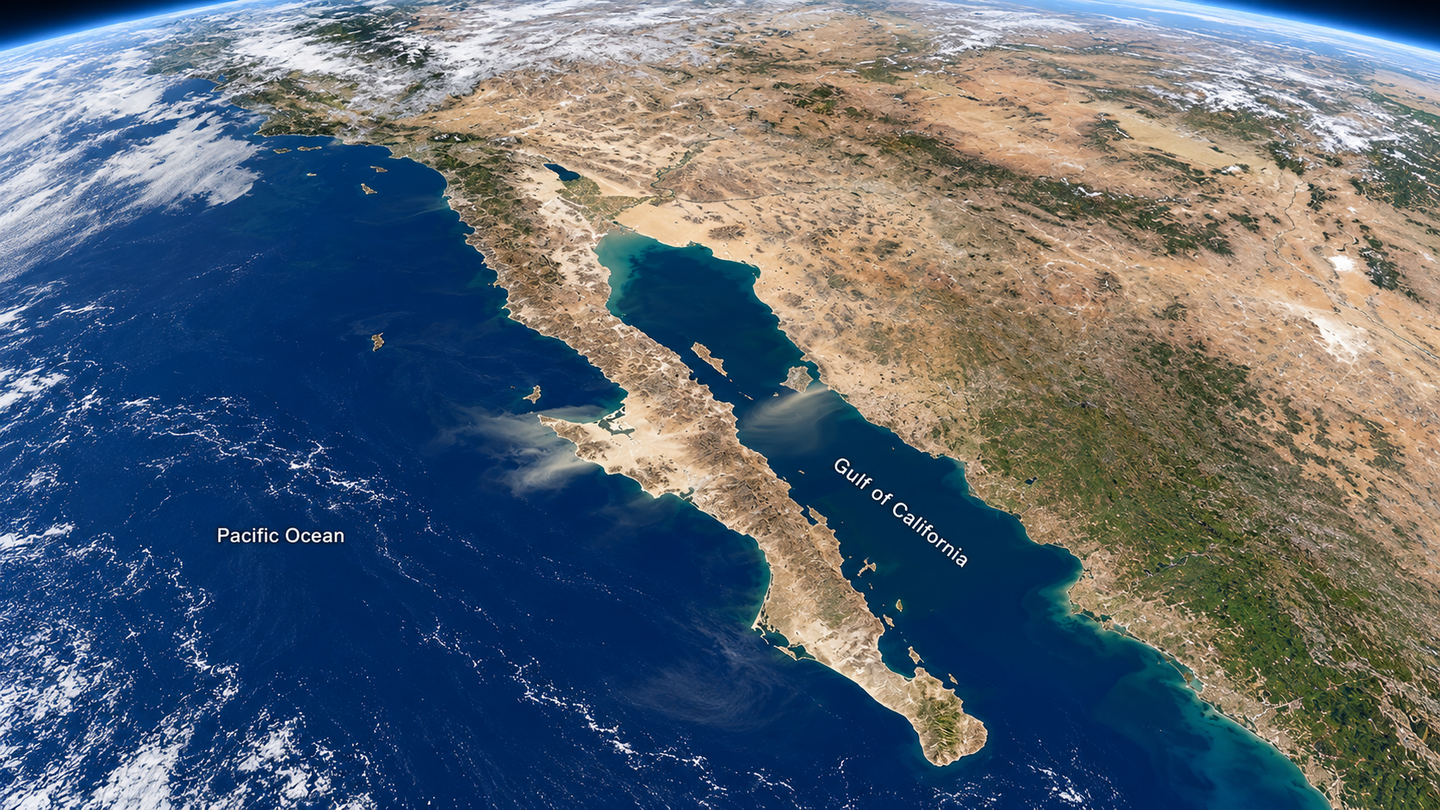
Baja California and the Gulf of California in an illustration using NASA satellite imagery as a reference. Distant tectonic forces near Japan may have helped accelerate the peninsula’s separation from mainland Mexico. (CREDIT: The Brighter Side of News)
- Global simulations suggest interacting subduction zones in the western Pacific added stretching stress near Baja California, helping accelerate continental breakup.
- The models produced roughly 5–10 megapascals of additional tensile stress around the Gulf of California and nearby regions.
- The findings identify a plausible distant driver, but do not calculate exactly how many millions of years it saved or predict earthquakes.
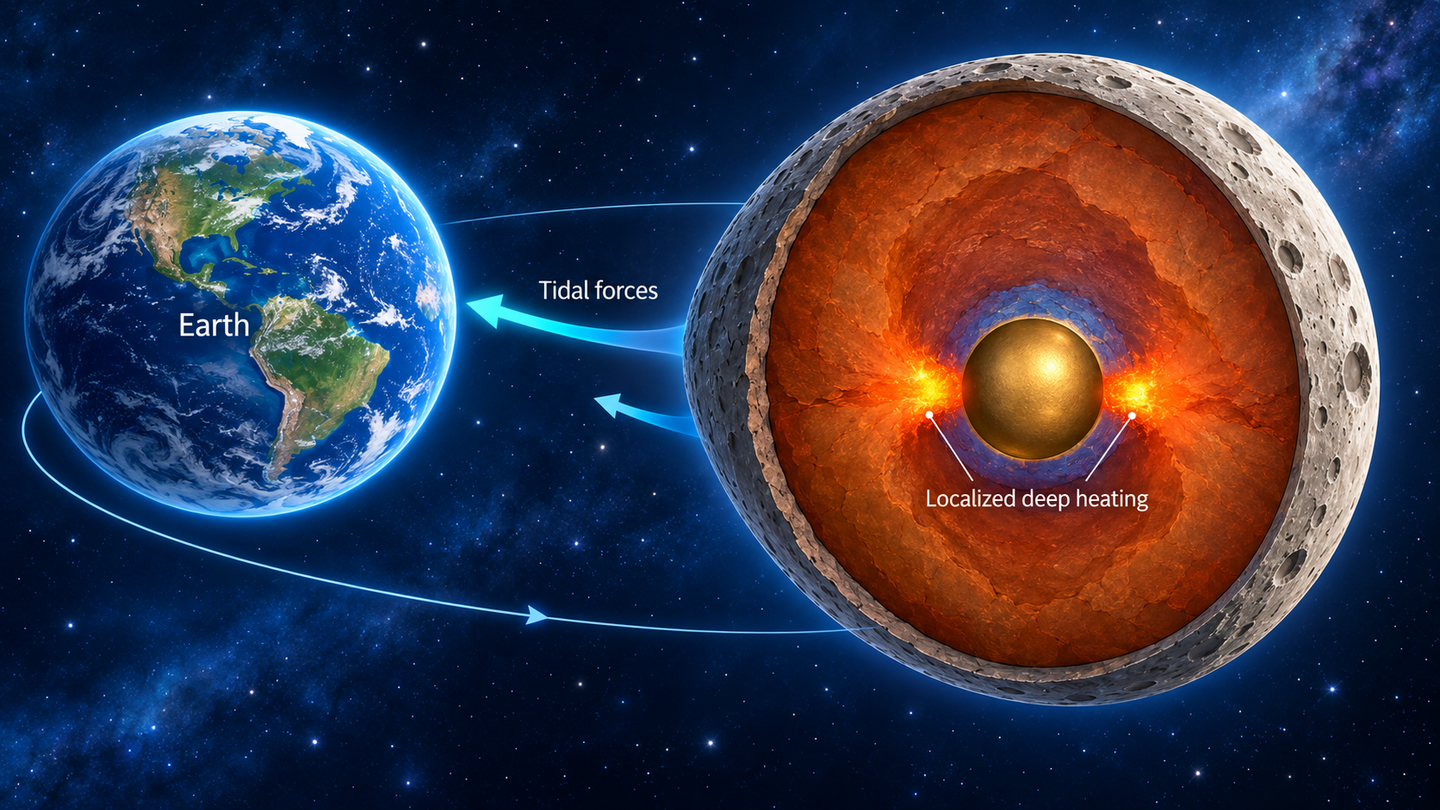
The forces that helped pull Baja California away from mainland Mexico may have originated on the opposite side of the Pacific. Computer models suggest interacting zones of sinking oceanic plates could transmit an extra pull across the vast Pacific plate. Near an already weakened continental margin, that added stress may have helped turn a developing rift into a new oceanic basin.
The study, published in Science, connects the Gulf of California’s rapid opening with tectonic changes around Japan and the Philippine Sea. Researchers from the University of Texas at Austin, Czech Academy of Sciences, Helmholtz Centre for Geosciences and Roma Tre University investigated the connection. Their results suggest local geology alone cannot fully explain how quickly the region separated.
An unusually fast continental split
Continental rifting begins when stretching deforms the lithosphere, Earth’s rigid outer shell of crust and uppermost mantle. Continued extension can thin that shell until the continent breaks and new oceanic crust forms. The Gulf of California records an unusually rapid version of this transition.
The first seafloor spreading began about 6 million years ago. Depending on which geological starting point researchers adopt, the transition from focused rifting took roughly 6.5 million to 13 million years. Continental-interior rifts that become large ocean basins commonly require about 30 million to 80 million years or longer.
Earlier stretching and magmatic activity had already weakened the lithosphere around the future gulf. Those inherited conditions made separation easier. However, the researchers argue that similar weaknesses elsewhere do not always produce such rapid breakup, leaving an additional driving force to explain.
The reorganization also transferred Baja California toward the Pacific plate and helped establish the modern San Andreas fault system. These developments linked continental stretching with sideways motion along the evolving plate boundary. Understanding the breakup therefore also helps reconstruct how today’s western North American margin formed.
Two sinking slabs can influence one another
At subduction zones, one tectonic plate descends beneath another into the mantle. The sinking section, called a slab, contributes a pulling force to the surrounding plate system. When two interacting slabs descend in the same general direction, their combined effects can alter motions beyond either trench.
“What we think happened in the western Pacific is that there was once a single subduction zone, but then a second one formed,” said co-author Xiang He. He is a graduate research assistant at UT Austin’s Jackson School of Geosciences and Institute for Geophysics. He led the numerical modeling.
The system involves the Ryukyu, Nankai and Philippine subduction zones interacting with the Izu-Bonin-Mariana system. Geological reconstructions place important changes in this coupled arrangement around 10 million years ago. That timing overlaps the later intensification of stretching and fault development around the Gulf of California.
The proposed connection operates through both stresses within plates and changes in mantle flow. It does not require a crack to extend across the Pacific. Instead, forces acting at one part of the connected system can change the balance elsewhere, with local rock strength influencing the response.
Testing the connection on a global scale
The team used ASPECT, an open-source geodynamics program, to construct three-dimensional global models. They incorporated information about sinking slab shapes, mantle structure and differences in lithospheric properties. The calculations produced mantle velocities, plate motions and stresses within the plates.
The central comparison involved configurations with and without the additional western Pacific subduction system. Subtracting their stress fields helped isolate its contribution. The reference model reproduced observed plate motions and Earth’s geoid, the gravity-defined reference surface used to describe the planet’s shape.
Researchers also tested reconstructed trench positions from about 15 million years ago. That comparison explored how changing geometry could influence Pacific plate motion. Other experiments varied assumptions about rock strength and resistance along the Gulf of California boundary, checking whether the main result depended on one setup.
These are comparisons of modeled configurations rather than a continuous simulation of every stage of breakup. They test whether the proposed distant force is mechanically plausible. They do not directly watch ancient stresses travel across the ocean or reproduce the gulf’s complete geological history.
Extra stress appeared near Baja California
The strongest modeled changes occurred near the western Pacific subduction zones, where the forces originated. A separate stretching signal appeared around the Gulf of California, the Salton Trough and the southern San Andreas system. In the base comparison, additional tensile stress reached about 5–10 megapascals, locally exceeding 10 megapascals.
A megapascal measures force distributed over an area. Here, the number describes an increase in modeled stretching stress, not the magnitude of an earthquake. Its importance depends on how close the surrounding rock already was to deforming and concentrating strain.
The modeled pull generally aligned with geological evidence for the region’s stretching direction. Changing rock-strength assumptions altered the size of the stress increase, but the increase near the gulf persisted. That consistency supports the mechanism while leaving uncertainty about its precise magnitude in the ancient Earth.
For an already weakened margin, added stress could help deformation concentrate into a narrower zone. As thinning progresses, further weakening can reinforce that concentration. The authors identify this combination of local vulnerability and distant forcing as a candidate explanation for the unusually rapid breakup.
Acceleration is more complicated than a faster plate
The interpretation does not require the Pacific plate to have suddenly accelerated throughout the breakup interval. Other tectonic changes, including the shutdown of subduction near Melanesia, reduced the total slab pull. The western Pacific system may instead have helped sustain high plate speeds when slowing would otherwise be expected.
Likewise, the comparison with 30–80-million-year rifts does not establish an equivalent amount of time saved in Baja. Those numbers describe typical development times elsewhere. The simulations identify an added force, rather than calculating a specific alternative opening date for a world without double subduction.
That distinction keeps the conclusion focused: the remote interaction could have helped accelerate an existing rift. It did not act alone or create the region’s inherited weaknesses. More detailed models must connect the changing forces with deformation and weakening through time.
A broader view of rifts and earthquake hazards
The findings could help researchers understand loading in complex fault systems. However, long-term tectonic stress models do not predict when individual earthquakes will occur. Their contribution is to explain the larger forces within which regional faults evolve.
The East African Rift offers a present-day comparison for continental stretching, with earthquakes and volcanic activity accompanying deformation. It is not evidence that the same western Pacific mechanism drives Africa’s current rifting. Becker instead suggests that additional distant pulls could reorganize a developing rift under suitable conditions.
“What’s new is that we can better model such global plate interactions, which links to the evolution of subduction,” said Thorsten Becker, a UT Austin professor and senior research scientist. The next challenge is to connect those global calculations with regional detail. Doing so could clarify when distant forcing pushes a weakened margin toward faster separation.
Dig deeper into continental rifting and distant tectonic forces
These studies explain interacting subduction systems, rift development and the numerical methods used to investigate them.
The Impact of Double Subduction on Plate Velocity and Euler Pole Shifts: Insights From Spherical Subduction Models
Spherical models explore how interacting slabs change plate speeds and the axes around which plates move. (Journal of Geophysical Research: Solid Earth, September 2026)
Non-collisional orogeny in northeast Japan driven by nearby same-dip double subduction
Earlier modeling investigates how interacting subduction zones could generate compression and mountain building near Japan. (Nature Geoscience, June 2025)
Onset of double subduction controls plate motion reorganisation
This study examines how the development of a second subduction zone can reorganize an existing plate system. (Nature Communications, February 2024)
Geodynamics of continental rift initiation and evolution
This review explains the competing forces and weakening processes that determine whether continental rifts develop into ocean basins. (Nature Reviews Earth & Environment, March 2023)
High accuracy mantle convection simulation through modern numerical methods
This foundational methods paper describes the numerical approach underlying the ASPECT mantle-convection software. (Geophysical Journal International, August 2012)
Research findings are available online in the journal Science.
The original story "Tectonic forces near Japan may have helped pull Baja California from Mexico" is published in The Brighter Side of News.
Related Stories
- Earth's tectonic plates were already shifting 3.5 billion years ago
- Ancient tectonic shifts cooled Earth and paved the way for complex life
- Lost Pacific tectonic plate named Pontus found after 160 million years
Like these kind of feel good stories? Get The Brighter Side of News' newsletter.
Rebecca Shavit
Writer
Based in Los Angeles, Rebecca Shavit is a dedicated science and technology journalist who writes for The Brighter Side of News, an online publication committed to highlighting positive and transformative stories from around the world. Having published articles on MSN, AOL News, and Yahoo News, Rebecca's reporting spans a wide range of topics, from cutting-edge medical breakthroughs to historical discoveries and innovations. With a keen ability to translate complex concepts into engaging and accessible stories, she makes science and innovation relatable to a broad audience.