Smart nanocoating slows rust corrosion by more than 600 times
Tiny pH-sensitive containers helped scratched water-based coatings keep corrosion at bay during demanding saltwater tests.

 Edited By: Joshua Shavit

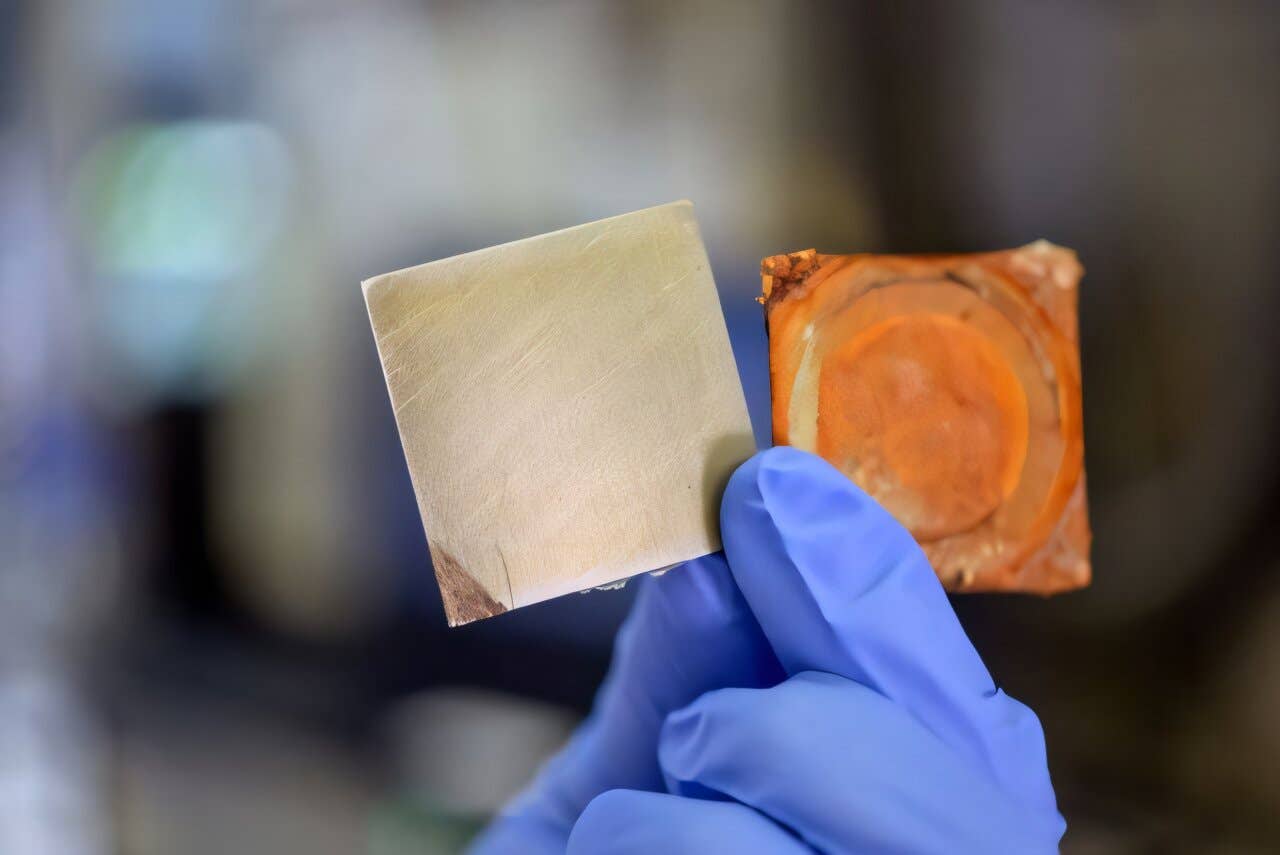
Tiny pH-sensitive containers helped scratched water-based coatings keep corrosion at bay during demanding saltwater tests. (CREDIT: University of Queensland)
- Researchers built pH-sensitive nanocontainers that store a corrosion inhibitor inside waterborne polyurethane and release much more of it when local chemistry signals corrosion.
- The strongest formulation reached a corrosion rate of 0.0000372 millimeters per year and remained highly resistant after 39 days in saltwater.
- Scratched coatings containing the high-loading particles showed no clear corrosion products after 14 days, suggesting the stored inhibitor can protect damaged areas.
A scratch in protective paint usually gives corrosion an opening. A new nanomaterial aims to make that damage trigger its own chemical defense.
Researchers at the University of Queensland developed powderlike particles that store the corrosion inhibitor benzotriazole, or BTA, inside nanoscale containers. Mixed into waterborne polyurethane, the particles largely hold their cargo under ordinary conditions but release much more when surrounding acidity changes.
The resulting coating reached a calculated corrosion rate of just 0.0000372 millimeters per year in electrochemical testing. Researchers also deliberately scratched coated steel and found no obvious corrosion products around damage in their strongest formulation after 14 days in saltwater.
The work points toward coatings that combine a physical barrier with an active response once corrosion begins.
Building a reservoir only hundreds of nanometers wide
The nanocontainers have several layers, each performing a different job.
At their center are P123 micelles, tiny structures that can trap hydrophobic molecules such as BTA. Researchers surrounded the BTA-loaded micelles with ZIF-8, a porous metal-organic framework, then added an outer silica shell.
Microscopy showed that plain P123 micelles averaged 10.4 nanometers across. After loading with BTA, their diameter increased to 20.9 nanometers.
Once ZIF-8 grew around them, the particles measured about 164 nanometers. Removing the micelles left pores averaging 21.6 nanometers, closely matching the dimensions of the BTA-filled templates.
The micelles also solved a chemical problem. Without sufficient P123, interactions between BTA and zinc disrupted formation of the intended ZIF-8 structure. Confining BTA inside micelles allowed the framework to assemble while storing more inhibitor.
More inhibitor fits inside without destroying the structure
Storage capacity changed dramatically depending on how the particles were prepared.
ZIF-8 made without P123 contained about 4.2% BTA by weight according to ultraviolet-visible spectroscopy. Adding the micelles increased loading to about 9.3%.
Researchers then raised the amounts of both BTA and P123 while maintaining their relative balance. The strongest formulation stored 16.2% BTA while retaining its intended crystal structure.
Simply adding more BTA without enough P123 did not work as well. It produced smaller particles, hollow regions and poorer crystallinity.
An outer silica shell was then added to improve stability and compatibility with the polyurethane. Finished particles measured about 203 nanometers across, including a silica layer roughly 20 nanometers thick.
The researchers mixed the nanocontainers into waterborne polyurethane at 1% by weight. Resulting coatings were approximately 59 to 66 micrometers thick and showed no obvious large particle clusters or major defects.
Changing pH unlocks the chemical defense
The key feature is not simply storing BTA, but controlling when it escapes.
At neutral pH 7, the containers released only about 4% of their inhibitor. At acidic pH 3, release rose to roughly 35%. Meanwhile, at alkaline pH 10, it reached about 32%.
That response is important because chemical conditions around an active corrosion site can shift away from neutral.
“Each tiny particle is basically a nanocontainer that releases repair molecules only when the conditions demand it,” said University of Queensland researcher Asep Nugraha.
The researchers propose that acidic conditions weaken the ZIF-8 structure, opening routes through which BTA can move. Under alkaline conditions, changes involving the silica shell and zinc coordination sites may also create release pathways.
Once outside the container, BTA can reach exposed metal and form inhibitory material at the interface, reducing continued corrosion.
Saltwater testing separates the formulations
The team immersed coated metal in a 3.5% sodium chloride solution and monitored its electrochemical behavior for 39 days.
Plain waterborne polyurethane deteriorated substantially. Its low-frequency impedance fell from about 5.9 × 10^5 ohm-square centimeters after one day to roughly 4.6 × 10^4.
Adding ZIF-8 and silica without BTA improved protection, but the strongest performance came from the formulation containing the highest inhibitor loading.
That coating reached an impedance of approximately 1.4 × 10^7 ohm-square centimeters. After 39 days, coating resistance remained at 1.26 × 10^7 ohm-square centimeters, while charge-transfer resistance measured 2.66 × 10^6.
Corrosion-current measurements told a similar story. Plain polyurethane reached 2.08 × 10^-6 amperes per square centimeter after 39 days. The high-loading nanocontainer coating measured only 3.2 × 10^-9.
Researchers calculated its corrosion rate at 37 nanometers per year.
Scratches put the self-protection idea to a tougher test
Barrier coatings are most vulnerable after physical damage, so researchers deliberately cut the test coatings before immersing them in saltwater.
Uncoated steel showed visible corrosion after seven days and extensive reddish-brown products after 14. Plain polyurethane deteriorated around the cut.
Particles without BTA reduced corrosion but did not prevent it completely.
The high-loading BTA coating behaved differently. Researchers reported no clear discoloration or corrosion products around the scratch after 14 days.
Analysis of the damaged region detected nitrogen-containing material and components associated with the nanocontainers, observations consistent with inhibitor-derived material reaching the exposed surface.
The researchers also replaced BTA with 2-mercaptobenzothiazole in a proof-of-concept test, suggesting the same micelle-assisted architecture may work with other compatible hydrophobic inhibitors.
Laboratory durability is not yet bridge durability
The results remain laboratory measurements, not evidence that a single coating could already protect a bridge for a century.
The saltwater test lasted 39 days, while the scratched samples were followed for 14 days. Real structures face years of mechanical wear, temperature swings, sunlight, moisture and repeated environmental exposure.
Nugraha said pilot-scale testing is planned, with commercialization targeted within about five years.
The significance of the design lies in how it combines three functions: a conventional polymer barrier, a high-capacity reservoir and chemistry-triggered inhibitor release.
Rather than continuously leaking corrosion inhibitor, the particles hold most of it in reserve until local conditions change. If that behavior remains reliable during larger and longer tests, future coatings could extend the interval between costly maintenance cycles on steel structures.
Dig deeper into self-healing coatings and corrosion nanotechnology
These resources examine controlled-release nanocontainers, self-healing mechanisms and the challenges of translating smart anticorrosion coatings into durable real-world materials.
Developments in anticorrosive organic coatings modulated by nano/microcontainers with porous matrices: This review examines porous delivery systems that provide controlled inhibitor release, active corrosion protection and self-healing functions in organic coatings. (Advances in Colloid and Interface Science, 2024)
Research progress and challenges of healing mechanism, types, and applications of reversible self-healing anti-corrosion coatings: This review surveys reversible self-healing coating mechanisms and discusses challenges in maintaining long-term repair capability and practical performance. (Chemical Engineering Science, 2025)
Stimuli-responsive micro/nanocontainers for multifunctional anticorrosive coatings: Design, mechanism, and applications: This review focuses on how micro- and nanocontainers respond to triggers such as local chemical changes to control corrosion-inhibitor release in next-generation coatings. (Progress in Organic Coatings, 2026)
Self-healing anti-corrosion coatings based on micron-nano containers with different structural morphologies: This analysis compares container shapes, loading capacities and stimulus-responsive release strategies used to give protective coatings autonomous corrosion-control functions. (Progress in Organic Coatings, 2023)
Nanocontainers for Self-Healing Coatings: This foundational review explains how nanoscale reservoirs can release corrosion inhibitors only after local pH changes or other triggers, reducing premature loss of protective chemicals. (Advanced Materials Interfaces, 2017)
Research findings are available online in the journal Wiley.
The original story "Smart nanocoating slows rust corrosion by more than 600 times" is published in The Brighter Side of News.
Related Stories
- New ‘Nanobone’ material could help the body regrow bones without painful grafts
- New nanorobots can target cancer cells with precision
- New ultra-black automotive coating uses carbon nanotubes to absorb 99.9% of visible light
Like these kind of feel good stories? Get The Brighter Side of News' newsletter.
Rebecca Shavit
Writer
Based in Los Angeles, Rebecca Shavit is a dedicated science and technology journalist who writes for The Brighter Side of News, an online publication committed to highlighting positive and transformative stories from around the world. Having published articles on MSN, AOL News, and Yahoo News, Rebecca's reporting spans a wide range of topics, from cutting-edge medical breakthroughs to historical discoveries and innovations. With a keen ability to translate complex concepts into engaging and accessible stories, she makes science and innovation relatable to a broad audience.