
Tiny Alabama fossil reveals an early relative of modern scorpions
A roughly 318-million-year-old Alabama scorpion fossil preserves probable breathing openings and may be a juvenile’s shed shell.
 Flinders University Writer: Dr Russell Bicknell

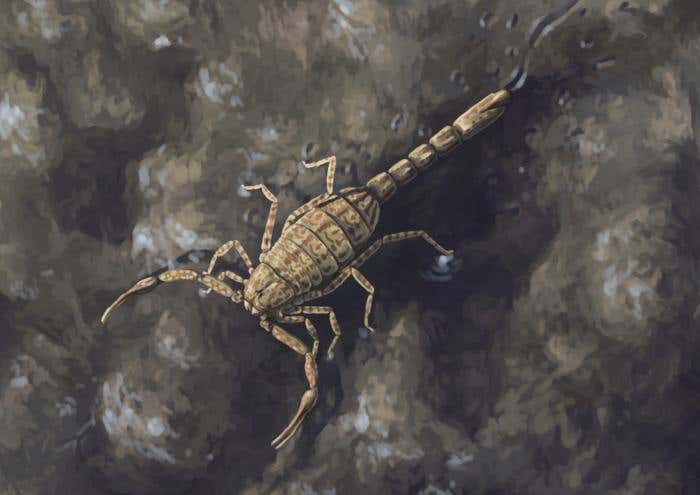
UV imaging reveals probable breathing structures in an ancient Alabama scorpion, but its species and venom potency remain unknown. (CREDIT: G Conway, Flinders University)
A scorpion scarcely longer than two centimeters has added a rare body fossil to an Alabama site better known for prehistoric footprints. Its narrow pincers and sturdy tail resemble features found in living scorpions. Yet this animal inhabited a tropical landscape roughly 318 million years ago, long before dinosaurs appeared in the fossil record.
The study, published in The Science of Nature, identifies it as the oldest known North American orthostern scorpion. Orthosterni includes all living scorpions. The discovery therefore helps document when familiar features emerged within this ancient arachnid lineage, rather than representing the earliest scorpion overall.
Gen A. Conway led the work with Russell D. C. Bicknell, Bruno A. Buzatto and Adiël A. Klompmaker. The collaboration involved Flinders University, the American Museum of Natural History and the University of Alabama. Their investigation combined anatomy, ultraviolet photography and chemical analysis.
A tiny find from a tropical landscape
T. Prescott Atkinson collected the fossil's matching halves on April 23 and April 30, 2022, at Union Chapel Mine. Also called the Steven C. Minkin Paleozoic Footprint Site, the locality lies in Walker County, Alabama. Atkinson donated the specimen to the university's museum collection, making the fossil discovery available for detailed study.
The fossil measures approximately 21.9 millimeters long and four millimeters wide. It came from the upper Pottsville Formation, whose pollen and spores help constrain its age. A relevant interval spans approximately 318.96 million to 316.28 million years ago.
However, the specimen came from loose mining spoil rather than a documented position within an intact rock layer. Its precise place in the sequence remains unknown. Describing it as roughly 318 million years old captures the geological context without implying an exact date for the individual.
At the time, this region lay about 10 degrees south of the equator. Humid conditions supported coastal mudflats and swamps, with flooding helping preserve evidence of surrounding life. The site records a Carboniferous ecosystem through plants, animal tracks and rarer body remains.
Body fossils of arthropods remain particularly rare at this locality, despite its abundant tracks and plant remains. The distinction makes the find useful: researchers can examine the animal's proportions directly, rather than reconstructing its appearance only from marks left behind in sediment.
Breathing clues appear under ultraviolet light
The fossil's most important features include probable spiracles, openings through which modern scorpions take air into their book lungs. Those organs contain layered respiratory surfaces. Identifying their position can help place ancient animals within the broader history of scorpion evolution.
Under ultraviolet light, researchers observed dark spots ringed by brighter material on several abdominal plates. Curved paired lines also appeared in positions consistent with possible book lungs. Their absence from the rearmost plate supported the anatomical interpretation.
Location matters because modern scorpions have spiracles within their underside plates, rather than along the margins proposed for some earlier forms. The Alabama specimen appears to share that internal placement. Together with other anatomical features, it supports assignment to Orthosterni.
The distinction between probable openings and confirmed organs remains important. Compression and incomplete preservation can obscure boundaries or create misleading shapes. Here, ultraviolet imaging made subtle structures easier to distinguish, but it did not remove every uncertainty about their identity.
A familiar shape with an uncertain sting
The scorpion had slender pincers with narrow, elongated fingers and a moderately robust metasoma, the segmented tail-like region. Its fifth metasomal segment was longer than the preceding ones. These details provide clues to function as well as comparisons with fossil scorpions.
In living species, longer tail segments can accommodate longer muscles associated with rapid movement. The final segment also connects to the venom-bearing tip. The fossil's proportions therefore suggest a tail suited to relatively fast stinging, although the tip itself is probably missing.
Modern scorpions with narrow pincers and sturdy tails often rely strongly on venom for defense and prey capture. Similar proportions in the fossil suggest a comparable strategy. They do not reveal the chemical composition or strength of its venom, or establish how dangerous it would have been.
Researchers propose that pressure from vertebrate predators could have favored these adaptations. Such animals diversified during the Carboniferous and occurred in the surrounding region. This remains an evolutionary interpretation of the body structure, not evidence that a particular predator attacked this individual.
The resemblance to living forms does not mean scorpions stopped evolving. Specific features can persist while other structures and relationships change. In this specimen, recognizable pincers and tail proportions coexist with missing or distorted details that limit direct comparison with any modern species.
A shed shell transformed into carbon
The fossil probably preserves a molt rather than a carcass. Scorpions shed their external skeletons as they grow, leaving an empty shell behind. The curved body and extended mouthparts resemble patterns used to distinguish molts in studies of fossil preservation.
Poorly preserved walking legs prevented the researchers from checking another useful sign: whether the legs spread outward during shedding. Nonetheless, the available evidence supports a juvenile molt. That interpretation helps explain both the small size and the loss or rearrangement of structures needed for finer classification.
Chemical analysis added another part of the story. Using scanning electron microscopy and energy-dispersive X-ray spectroscopy, the team mapped elements in the fossil and surrounding rock. The fossil showed strong carbon enrichment, with several other elements less abundant than in the rock.
The researchers interpreted this as kerogenization, chemical transformation of the original organic material during burial and heating. Parts of the exoskeleton glowed orange under ultraviolet light, a response linked to those changes. That glow differs from the fluorescence of living scorpions, showing why chemical evidence must accompany visual comparisons.
What one incomplete fossil can establish
Missing features prevent the team from assigning the specimen to a species or family. Important details around the leg bases and underside of the front body are absent, while the carapace is distorted. A recognizable outline alone cannot resolve its precise position within the evolutionary tree.
The body fossil also strengthens earlier suggestions that scorpions made some Union Chapel trackways. Those traces measure roughly 15 to 22 millimeters across. However, the fossil does not preserve enough information about leg spread to determine whether an animal of this size made them.
That distinction preserves the value of both kinds of evidence. Footprints record movement, while a body fossil reveals anatomical structures that tracks cannot. Together, they support scorpions' presence at the site without linking this particular specimen to a particular trail.
No footprints occur directly alongside this body fossil. Its contribution therefore concerns the broader community preserved at Union Chapel, not a continuous record of one animal moving and shedding. Keeping that separation avoids turning compatible evidence into a stronger claim of direct association.
The discovery also shows why specimens entering museum collections matter. Additional finds could supply missing anatomy, clarify the respiratory structures and help identify the animal more precisely. For now, this tiny shell extends the North American record of a scorpion group whose living members remain readily recognizable today.
Dig deeper into fossil scorpions
These resources explain scorpion classification, functional anatomy and the interpretation of preserved remains.
- A review of fossil scorpion higher systematics: Reviews the classification of extinct scorpions and the difficulties of connecting incomplete fossils with living groups. (PeerJ, December 2024)
- Exploring the evolution and terrestrialization of scorpions (Arachnida: Scorpiones) with rocks and clocks: Combines fossil evidence with evolutionary dating to investigate scorpion origins and life on land. (Organisms Diversity & Evolution, February 2019)
- A ‘striking’ relationship: scorpion defensive behaviour and its relation to morphology and performance: Examines how living scorpions' body proportions relate to defensive strikes, informing cautious functional comparisons with fossils. (Functional Ecology, July 2017)
- A taxonomic revision of orthosternous scorpions from the English Coal-measures aided by X-ray Micro-Tomography (XMT): Uses three-dimensional imaging to reassess Carboniferous scorpion anatomy and earlier species classifications. (Palaeontologia Electronica, May 2012)
- Scorpion taphonomy: criteria for distinguishing fossil scorpion molts and carcasses: Investigates preservation patterns that help distinguish shed exoskeletons from dead animals. (The Journal of Arachnology)
Research findings are available online in the journal The Science of Nature.
The original story "Tiny Alabama fossil reveals an early relative of modern scorpions" is published in The Brighter Side of News.
Related Stories
- World's largest scorpion lived in Britain 415 million years ago
- 125 million-year-old giant venomous scorpion fossil unearthed in China
- This Wild New Gaming Cockpit Wraps Around You Like a Giant Scorpion
Like these kind of feel good stories? Get The Brighter Side of News' newsletter.
Joshua Shavit
Writer and Editor
Joshua Shavit is a NorCal-based science and technology writer with a passion for exploring the breakthroughs shaping the future. As a co-founder of The Brighter Side of News, he focuses on positive and transformative advancements in technology, physics, engineering, robotics, and astronomy. Having published articles on AOL.com, MSN, Yahoo News, and Ground News, Joshua's work highlights the innovators behind the ideas, bringing readers closer to the people driving progress.