Einstein’s equations offer new clues to extreme gravity and space-time behavior
Physicists use plasma physics to explore gravitational reconnection, a theoretical process that could reshape field connections and alter energy exchange.

 Edited By: Joshua Shavit

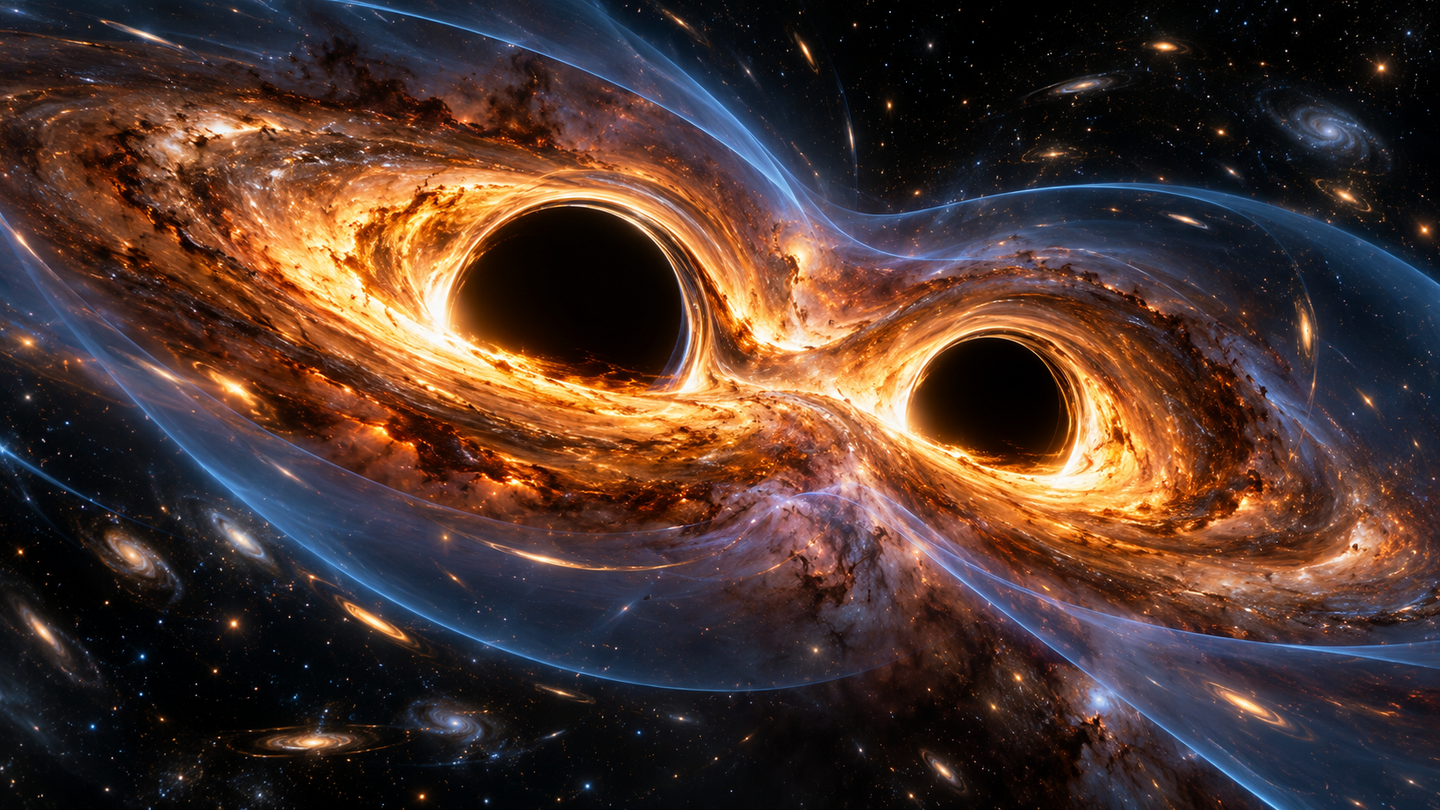
Illustration depicts two approaching black holes, with blue curves representing mathematical gravitational field sheets. A new theoretical study explores how these structures could reconnect and alter energy exchange between gravity and matter. (CREDIT: The Brighter Side of News)
- A theoretical study describes how gravitational field structures could change their connections, drawing on methods used in plasma physics.
- Rewriting Einstein’s equations reveals conditions for “gravitational reconnection” and ways to quantify its effects on energy exchange.
- The process has not been observed, and possible signatures in black-hole mergers or gravitational waves remain to be investigated.
Solar flares and colliding black holes might seem to belong to entirely different corners of physics. Yet the mathematics describing magnetic eruptions has inspired a new way to examine how gravity behaves. The connection concerns how organized field structures can rearrange, potentially changing the exchange of energy between gravity and matter.
Physicists Luca Comisso of Columbia University and Felipe A. Asenjo of Universidad Adolfo Ibáñez in Chile call the process “gravitational reconnection.” Their theoretical study, published in Physical Review D, develops conditions under which these connections can change. It also provides mathematical tools for measuring the process within their description of gravity.
The findings do not establish that astronomers have witnessed gravitational reconnection or identified it in a particular collision. Nor do they replace Einstein’s general relativity with a different theory. Instead, they explore consequences of expressing the same gravitational equations in a form that highlights similarities with plasma physics.
What solar flares offer gravity researchers
Plasma is a gas containing electrically charged particles, and it fills the Sun and much of interstellar space. Its magnetic fields can become stretched and twisted as the plasma moves. Under suitable conditions, their connections change through magnetic reconnection, releasing stored magnetic energy into particle motion and heat.
“Magnetic reconnection is when these field lines, in some specific configuration, break and reattach in a different configuration,” Comisso said. The process helps power solar flares and other energetic events in space. Comisso, an associate research scientist in Columbia’s astronomy and physics departments and its astrophysics laboratory, studies plasmas.
Field lines are a way to describe a magnetic field’s organization, rather than material wires threaded through a gas. Following their connections helps physicists understand how the field evolves and where energy can go. Comisso and Asenjo applied related reasoning to mathematical structures used to describe gravity.
The resemblance became useful when Einstein’s equations were written using quantities analogous to electric and magnetic fields. This formulation retains gravity’s complexity, including its nonlinear behavior, rather than reducing everything to ordinary electromagnetism. It gives researchers a different mathematical language for investigating the same underlying gravitational dynamics.
Gravitational reconnection involves field sheets
General relativity describes gravity through the geometry of four-dimensional space-time, combining three spatial dimensions with time. In the researchers’ framework, the relevant connections involve two-dimensional surfaces called gravitational field sheets. These sheets are mathematical structures used to track how the field is organized as space-time evolves.
“Because space-time is four-dimensional rather than three-dimensional, gravity involves something like field ‘sheets’ rather than field lines,” Comisso explained. The terminology helps describe a geometry that is difficult to picture through familiar magnetic loops alone. It does not mean that physical fabric hangs inside the universe and rips during a collision.
The new work builds on an earlier Physical Review Letters study by Asenjo, Maricarmen A. Winkler and Comisso. That research identified conditions under which gravitational field connections remain preserved during evolution. It also described associated conservation laws, providing the starting point for asking when those restrictions can fail.
Under the assumed ideal conditions, the connections stay “frozen in” as the structures move. Frozen here refers to preserved connectivity, not temperature or an absence of motion. The sheets can evolve while retaining the relationships that link their neighboring parts.
When a changed connection really counts
The latest study examines departures from that ideal behavior and defines gravitational reconnection as a change in field-sheet connectivity. Such changes require a breakdown of the ideal transport condition or a singularity in the mathematical flow used to track the structures. However, simply violating the original ideal condition is not enough to establish reconnection.
A different, smooth tracking flow might still preserve the connections. If that alternative description exists, the structures have slipped relative to the original flow without reconnecting. The researchers therefore distinguish genuine connectivity changes from cases where choosing a different tracking flow restores the preserved pattern.
This distinction gives the proposal more substance than a visual resemblance between gravity and magnetic fields. The paper identifies mathematical requirements and introduces measures of the rate at which gravitational flux reconnects. Flux describes the field passing through a chosen surface, allowing comparisons across different configurations.
The authors also examine a quantity called gravitational helicity, which characterizes aspects of the field’s topology, or connected structure. Their ideal framework conserves this quantity under appropriate conditions, while nonideal behavior allows it to change. Together, these results offer several ways to characterize departures from preserved gravitational organization.
Following the exchange of energy
One important consequence concerns energy and momentum exchanged between the gravitational field and matter. The researchers derive balance equations in which gains in one sector correspond to losses in the other. Reconnection alters that exchange, but the mathematical framework permits transfer in either direction rather than requiring every event to energize matter.
This qualification matters when comparing the idea with the explosive release of magnetic energy in a solar flare. The study supplies a general framework without calculating how much energy a specific astrophysical reconnection event would deliver. Its physical consequences must still be worked out for particular environments and conditions.
The paper also leaves open what produces the required nonideal behavior in a given setting. Possibilities discussed include singularities in the transport flow and effective descriptions that average over unresolved gravitational or matter processes. These are avenues for investigation, rather than demonstrated causes in an observed black-hole merger.
“Some implications are hidden in the equations, and they are not straightforward to capture just by looking at them,” Comisso said. Recasting those equations lets the researchers isolate rules that may be difficult to recognize in their usual form. The resulting framework can guide further analysis without supplying a complete description of every extreme event.
The analysis uses a local mathematical reference frame to express the gravitational quantities and their exchange with matter. Its energy accounting belongs to that formulation, an important detail when interpreting the results physically. Applying those quantities consistently in a concrete model is part of the work needed before making observational predictions.
Searching for a test in the cosmos
Black-hole collisions are a natural setting to explore because their gravitational fields change strongly and rapidly. Researchers usually investigate such events through numerical relativity, using computers to evolve Einstein’s equations from selected starting conditions. Those calculations help predict gravitational waves, the ripples in space-time measured by observatories such as LIGO.
General principles could help organize what those simulations reveal. The reconnection framework offers conditions and diagnostic quantities that researchers could investigate within particular space-times. It complements detailed calculations, although its usefulness for predicting an actual collision still requires testing.
For now, no gravitational-wave feature has been identified as evidence of this proposed reconnection process. The next step is to determine whether it occurs in specific astrophysical models and what consequences follow. Only then can researchers assess whether gravitational reconnection leaves a measurable signature that distinguishes it in observations.
Dig deeper into gravitational fields and reconnection
These studies connect the new framework with its theoretical foundations, plasma physics and observational tests of gravity.
Frozen-In Gravitational Fields
This earlier study establishes the ideal conditions that preserve gravitational field connections and associated conservation laws. (Physical Review Letters, April 2026)
Black Hole Spectroscopy and Tests of General Relativity with GW250114
A detailed gravitational-wave analysis shows how merger signals can test strong-gravity predictions, providing observational context rather than evidence for reconnection. (Physical Review Letters, January 2026)
Magnetic reconnection in the era of exascale computing and multiscale experiments
This review explains magnetic reconnection, its energy-release mechanisms and the challenges of connecting theory, simulations and experiments. (Nature Reviews Physics, February 2022)
Research findings are available online in the journal Physical Review D.
The original story "Einstein’s equations offer new clues to extreme gravity and space-time behavior" is published in The Brighter Side of News.
Related Stories
- New prototype quantum sensor expedites search for dark matter and gravitational waves
- Gravitational waves may be responsible for dark matter in the universe
- A falling quantum object just passed a century-old test of Einstein’s gravity
Like these kind of feel good stories? Get The Brighter Side of News' newsletter.
Joseph Shavit
Writer, Editor-At-Large and Publisher
Joseph Shavit, based in Los Angeles, is a seasoned science journalist, editor and co-founder of The Brighter Side of News, where he transforms complex discoveries into clear, engaging stories for general readers. With vast experience at major media companies like The Los Angeles Times, Times Mirror and Tribune Publishing, he writes with both authority and curiosity. His writing focuses on space science, planetary science, quantum mechanics, geology. Known for linking breakthroughs to real-world markets, he highlights how research transitions into products and industries that shape daily life.