Scientists discover why animals evolved necks, and surprisingly it wasn’t to turn their heads
A study of early tetrapod neck mobility combines fossils with sturgeon mechanics, finding that a distinct neck did not immediately mean a freely moving head.
 Penn State Writer: Sam Sholtis

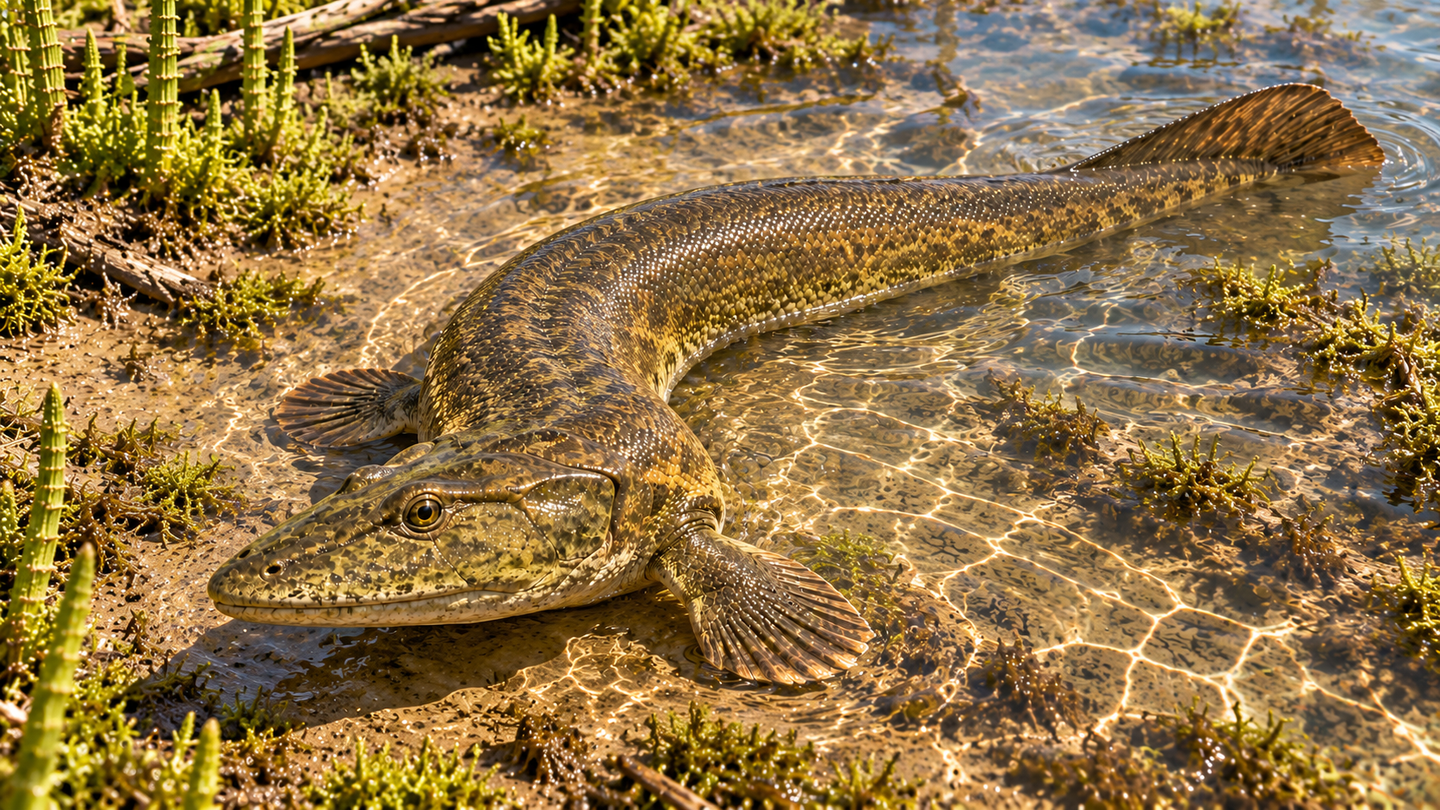
Models of early tetrapod neck mobility suggest head–shoulder separation preceded flexible necks, challenging a longstanding hypothesis. (CREDIT: The Brighter Side of News)
- Models suggest that separating the head from the shoulders did not immediately give early tetrapod relatives highly mobile necks.
- Mechanical tests on lake sturgeon, combined with fossil anatomy, predict only small head movements in most species examined.
- The findings favor a link with forelimb locomotion, but movement estimates depend on a living analogue and exclude several surrounding tissues.
An anatomical neck did not necessarily give ancient vertebrates the freedom to look around. Models of several early tetrapod relatives suggest their heads remained surprisingly restricted, even after the skull separated from the shoulders. The findings challenge the assumption that greater head mobility drove one of the major changes associated with the transition toward land.
The study, published in Nature, combines fossil measurements with mechanical tests on living lake sturgeon. First author Dana Korneisel, now a postdoctoral researcher at Uppsala University, worked with an international team including Penn State biologist Tom Stewart. Researchers at Carleton University, the University of Ottawa and the University of Washington also contributed.
The authors propose that changing demands on the shoulders offer a better explanation than a newly flexible head. As front appendages took on a greater role in movement, separating the shoulder apparatus from the skull may have become advantageous. Substantial neck mobility, their analysis suggests, generally developed later, rather than arriving automatically with that separation.
A gap between bones and behavior
Tetrapods are four-limbed vertebrates and their descendants, a group that includes mammals, birds, reptiles and amphibians. Their origins lie among lobe-finned fishes that acquired features useful in shallow-water and increasingly terrestrial settings. Many changes associated with this transition were emerging around 380 million years ago. Understanding that transition requires reconstructing what anatomical changes actually allowed animals to do.
The head–shoulder connection is one such change. In fish relatives preceding the tetrapod condition, skeletal connections linked the shoulder girdle to the skull. Their loss created a distinct neck region, apparently offering a way to move the head separately from the front appendages.
That interpretation seemed particularly plausible for animals feeding or navigating in shallow water. A movable head could help find prey without repositioning the entire body. However, an anatomical opening between head and shoulders does not establish how much the intervening backbone could bend.
Tiktaalik roseae became central to this discussion after its description in 2006. Fossils from Ellesmere Island in Nunavut, Canada, preserve a mixture of fish features and anatomy approaching that of limbed vertebrates. Its separated head and shoulders helped make it an important example of the emerging tetrapod body plan.
Testing tissue that fossils rarely preserve
The difficulty lies partly in the backbone’s unfamiliar construction. Many early tetrapod relatives retained a large notochord, a supporting rod of soft tissue, through adulthood. Small bony or cartilaginous components surrounded it, rather than forming the jointed column familiar in most living adult tetrapods.
Soft tissues rarely fossilize, leaving researchers without direct measurements of their mechanical properties. The team therefore sought a living animal with a comparable arrangement. Lake sturgeon retain a substantial notochord and surrounding vertebral components, making them useful mechanical stand-ins despite their distant relationship to tetrapods.
Sturgeon are not unchanged ancestors of the fossil animals. Their comparable spinal construction reflects a separate evolutionary history, and anatomical differences remain. The researchers used that similarity as a testable model, rather than assuming that a modern fish reproduces every feature of an ancient vertebrate.
They measured resistance to sideways bending, upward bending and twisting in both isolated notochords and whole spinal columns. The isolated notochord bent relatively easily, but the complete column was considerably stiffer. Surrounding arches and connective tissues therefore mattered greatly, even without the bone-to-bone joints found in many modern vertebrates.
Small movements, with one striking exception
Using whole-column stiffness, the team modeled six fossil species with sufficiently preserved anatomy. These included Eusthenopteron, Tiktaalik, Acanthostega, Whatcheeria, Greererpeton and Trimerorhachis. Their measurements allowed estimates of how the neck or corresponding front portion of the backbone would respond to muscle forces.
The models did not simply ask whether bones could avoid colliding. They calculated the forces needed to bend the column, then estimated how much muscle could fit around the region. This supplied an upper limit on movement based on the available anatomy and assumed muscle performance.
For Tiktaalik, the estimated sideways bend was about 5.5 degrees, with upward movement of roughly 2.25 degrees. Several other species had even smaller predicted ranges. Those results offered no clear increase in mobility corresponding to the evolutionary separation of head and shoulders.
Whatcheeria stood out from the general pattern. Its longer neck could potentially bend sideways by about 32 degrees and upward by 12 degrees. The exception shows that substantial movement became possible in some early relatives, while also underscoring how strongly neck proportions affected performance.
Twisting presented a different mechanical challenge. Even small rotations required substantial torque, the turning force needed to twist the column. The authors judged large rotations infeasible across the animals examined, while acknowledging that incomplete knowledge of their muscles prevented a precise maximum-angle estimate.
Why a soft backbone could still be stiff
These results show why soft-tissue construction does not automatically mean flexibility. The entire column’s geometry, its surrounding structures and the length available for bending determine how it behaves. Tall, narrow columns generally resisted upward bending more strongly than broader configurations.
Length also mattered because a longer bending region requires less force to achieve a given deflection. That helped explain Whatcheeria’s greater predicted mobility. Conversely, a short neck could remain restrictive even when its basic tissues resembled those of a longer-necked animal.
“We know that tetrapods did eventually gain higher neck mobility,” Korneisel said. The study places that functional development after the anatomical origin of the neck in much of the sampled lineage. Later changes included longer necks and more mobile joints between vertebrae.
The estimates could also overstate actual movement because they focus on the spinal column. Skin, muscles, ribs and bones embedded in the skin would add further constraints. Gills and other internal structures could restrict movement as well, making the complete living animal more mechanically complicated than the model.
A shoulder change with broader consequences
The proposed alternative shifts attention from looking around to moving through the environment. Front fins and early limbs increasingly interacted with the bottom or other supporting surfaces. A shoulder girdle reorganized around those tasks could separate from the head without requiring a simultaneous increase in neck flexibility.
This remains a functional explanation supported by several lines of evidence, rather than an observed evolutionary event. The modeling cannot identify a single selective pressure responsible for every anatomical change. It does, however, weaken the argument that a highly mobile neck was the immediate benefit of head–shoulder separation.
Restricted movement need not have been disadvantageous in every setting. The authors suggest stiffness could have supported efficient swimming and helped resist gravity outside water. Their interpretation therefore fits animals combining aquatic and amphibious habits, rather than assuming all the modeled species moved like later land-dwelling tetrapods.
The approach also has clear boundaries. Its assumptions suit notochord-dominated backbones and cannot simply transfer to animals with more fully developed bony vertebrae and complex joints. Reconstructing when freely moving heads became widespread will require different models for those later structures, alongside further tests of muscles and other missing tissues.
Dig deeper into the evolution of vertebrate necks
These studies explore neck anatomy, muscle development, fish movement and the fossil changes connecting fins with limbs.
Review of the tetrapod skull–neck boundary: implications for the evolution of the atlas–axis complex
This review compares the bones linking the skull and neck across living and extinct tetrapods. It supplies anatomical context for understanding how those connections changed through evolution. (Biological Reviews, July 2025)
Co-option of neck muscles supported the vertebrate water-to-land transition
Comparative anatomy and embryology trace neck muscles to muscle groups already present in fishes. The study adds a developmental perspective to the changes in skeletal structure and function. (Nature Communications, December 2024)
A neck-like vertebral motion in fish
X-ray measurements show how living fishes bend portions of their backbones during feeding. This distinguishes functional head movement from the presence of a separate tetrapod-style neck. (Proceedings of the Royal Society B, August 2021)
Evolution of forelimb musculoskeletal function across the fish-to-tetrapod transition
Three-dimensional models investigate changes in muscles and joints as fins became limbs. The findings provide context for the proposed importance of front-appendage locomotion in shoulder evolution. (Science Advances, January 2021)
A Devonian tetrapod-like fish and the evolution of the tetrapod body plan
The original description of Tiktaalik documents its mixture of fish and tetrapod-like features. It provides the fossil background for the interpretation of neck mobility that the newer biomechanical analysis tests. (Nature, April 2006)
Research findings are available online in the journal Nature.
The original story "Scientists discover why animals evolved necks, and surprisingly it wasn’t to turn their heads" is published in The Brighter Side of News.
Related Stories
- Scientists discover a hidden molecular secret behind animal evolution
- How animal feces became an evolutionary force 540 million years ago
- Asgard archaea study reveals new insights into the evolution of complex life
Like these kind of feel good stories? Get The Brighter Side of News' newsletter.
Joshua Shavit
Writer and Editor
Joshua Shavit is a NorCal-based science and technology writer with a passion for exploring the breakthroughs shaping the future. As a co-founder of The Brighter Side of News, he focuses on positive and transformative advancements in technology, physics, engineering, robotics, and astronomy. Having published articles on AOL.com, MSN, Yahoo News, and Ground News, Joshua's work highlights the innovators behind the ideas, bringing readers closer to the people driving progress.